










































Misinformation on Vaccination: A Quantitative Analysis of YouTube Videos
University of Pisa (Donzelli, Palomba, Federigi, Aquino, Verani, Carducci, Lopalco); Scuola Normale Superiore (Cioni)
"...vaccine hesitancy is closely connected with the increasing importance of the Internet and the new information and communication technologies (ICTs); in fact, they play an important role in parents' decisions on whether or not to vaccinate their children..."
In Italy, the phenomenon of vaccine hesitancy has increased with time and represents a complex problem that requires a continuous monitoring. Vaccine hesitancy refers to the delay in acceptance or refusal of vaccines despite the availability of vaccination services and the presence of vaccination rules. Misinformation on media and social media seems to be one of the determinants of the vaccine hesitancy since, for instance, 42.8% of Italian citizens used the internet to obtain vaccine information in 2016. This article reports a quantitative analysis of 560 YouTube videos, located through a search performed on August 1 2017, related to the link between vaccines and autism or other serious side effects on children.
The Andrew Wakefield paper is well known as the emblematic case of vaccine hesitancy, and, despite the fact that, after the publication of that paper, several studies have shown that there is no link between receiving vaccines and developing autism spectrum disorder (ASD), measles, mumps, and rubella (MMR) vaccination rates began to drop because parents were concerned about the risk of ASD as a consequence of that kind of vaccination. In Italy too, starting from 2013, a gradual decrease of childhood vaccination coverage was observed. For the first time, the uptake of hexavalent vaccination dropped under the 95% target, and MMR vaccine coverage level decreased below 90% at the national level. A possible link between vaccination coverage drop and disinformation spread on the web was suggested in a July 2017 Italian study.
In this context, the study addresses the following research questions (RQs):
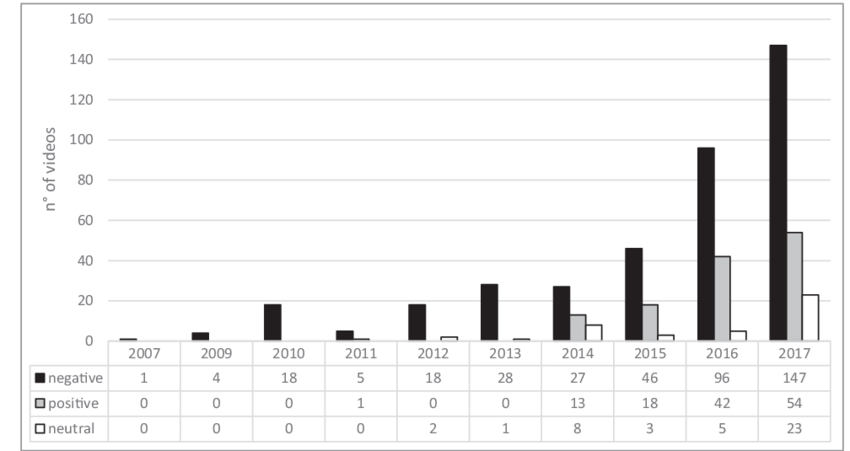
- RQ 1: What are the temporal distribution and the tone of autism-vaccines videos on YouTube? Of the 560 videos analysed, 392 had a negative tone, 126 a positive tone, and 42 a neutral tone. There was a rapid increase, starting from 2014, in the number of videos with a negative tone, from 27 (6.9%) in 2014 to 147 (37.7%) in the first 7 months of 2017, together with a delayed increase of the videos with a positive tone, from 13 (10.2%) in 2014 to 54 (42.2%) in the first 7 months of 2017.
- RQ 2: What are the general characteristics of YouTube videos? Table 1 in the paper presents descriptive statistics; for example, 461 videos (82.3%) were in the Italian language, while the remaining 99 videos (17.7%) were in the English language with Italian subtitles.
- RQ 3: What are the sources and the categories of the videos, and is there any relationship between such categories and the tone of the videos? Two sources have been very active in spreading videos with a negative attitude towards vaccines: Radio Autismo (Radio Autism) and Autismo Vaccini (Autism Vaccines). The videos have been freely and independently classified by the sources or by those who uploaded the videos. For example, those with a positive tone are highly represented only for the category "News and politics" (N&P).
- RQ 4: Is there any relationship between the tone of the video and viewers' attitudes (number of views, number of likes, and number of dislikes)? As shown in Table 2 in the paper, there is a significant relationship between the tone and the number of views, the video length, and the number of shares and likes. Figure 3 shows, for example, that the videos with a positive tone represent the majority when the variable balance assumes a negative value (or when the number of the likes is lower than the number of dislikes).
- RQ 5: Is there any relationship between the tone of the videos and the number of views for the videos above and below the median value of the number of views? Considering videos below and above the median value respect to positive and negative tone, a chi-square test detected a statistically significant difference (p < 0.0001), with a number of negative videos higher above the median value.
In reflecting on the findings, the researchers note that they found messages with a negative tone and no videos with positive tone up to 2013, with the exception of one video uploaded in 2011. Starting from 2014, they observed an increasing number of positive videos. However, the YouTube videos with negative tone were more viewed, shared, and had more likes than those with positive or neutral tone. This can be explained by the phenomenon known as confirmation bias, which leads people to favour information that confirms their beliefs and rejects facts that contradict them. Overall, anti-vaccination videos are over 3 times more numerous than the pro-vaccination videos, thus the probability of any user finding anti-vaccination videos is higher. Therefore, vaccine-hesitant users have a greater chance of being negatively affected, at least about their opinions on vaccination. Furthermore, when the users view a video, YouTube recommends other videos similar in contents on the column on the right side of the screen - thus amplifying the effect.
The researchers suggest that an accurate monitoring of the spread of the misinformation about vaccinations in the social media might be useful in order to explore key public concerns about vaccinations and to better clarify the role of the social media in forming and influencing people's attitudes and behaviour towards vaccinations. Such monitoring could also help to measure the impact of vaccination campaigns and programmes. This information could be used by academic and governmental organisations who wish to engage with ICTs in an attempt to combat false beliefs about vaccinations.
Human Vaccines and Immunotherapeutics 14(2): 1-18. DOI: 10.1080/21645515.2018.1454572
- Log in to post comments