










































The Measles Vaccination Narrative in Twitter: A Quantitative Analysis
George Mason University
"[S]ocial media analysis [can] be invaluable for providing insights about how popular health narratives are being shaped, as a better understanding of public perception of health issues can lead to more effective communication strategies."
This paper presents a case study that showcases the emergence of a health narrative from social media content, exploring the reaction on Twitter to the outbreak of measles in the United States (US) in early 2015. The focus is on the intersection between this narrative (whose structure of this narrative is implicit and emerges from the individual contributions, rather than being explicit and imposed by a certain authority) and a grass-roots antivaccination movement. The researchers note that, "by their nature, social media represent a transition from one-to-one health communications between clinicians and their patients to many-to-many communications between health care providers, patients, and broader communities. They also broaden the scope of health discussions, no longer focusing exclusively on reporting disease outbreaks but also addressing health care service, with patients sharing their experiences with various health providers. As of spring 2015, Twitter had nearly 300 million active users globally, and Facebook had 1.4 billion active users. In this realm, public opinion is formed not only as a top-down process (e.g., authoritative sources such as the World Health Organization (WHO) communicating their views to the general public) but also as a bottom-up process (whereby individual users establish circles of influence).
The researchers accessed the Twitter application programme interface (API) in order to collect tweets between February 1 and March 9 2015, using the keyword "vaccination" or its derivatives that are often encountered in social media ("vaccine", "vaccines", "vax", "vaxine", and "vaxx"). The GeoSocial Gauge system prototype was used to collect data from Twitter using a user-specified set of parameters such as keywords, locations, and time. A total of 669,136 tweets were collected from across the globe, with 60.18% of the geolocated tweets originating from within the US.
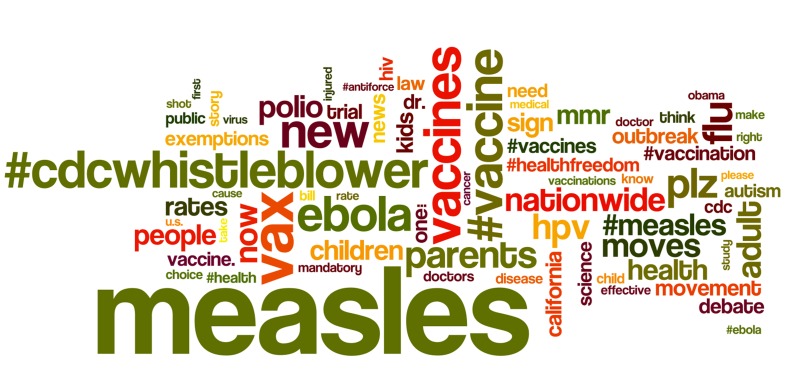
"Measles" was the most common term encountered in these tweets about vaccination, which is expected given that these data were collected during the US measles outbreak in early 2015. Furthermore, Ebola and HPV (human papilloma virus) are also encountered among the top terms associated with the discussion, reflecting the general interest in the media regarding vaccinations for them during that period. The second most popular term was #cdcwhistleblower, which emerged in August 2014 as a quick identifier to the antivaccination community of messages aligned with antivaccination views. This term did not originate from a formal organisation, but instead has emerged from an online advocacy community as a means to consolidate its views and promote its perspectives. In contrast, references to official health organisations were uncommon.
Among the 669,136 tweets, 296,223 were retweets; these retweets account for 44.27% of the overall data corpus (42.20% within the US and 45.25% overseas). "Vaccination appears to be a 'political' or partisan topic among Twitter uses, and high levels of retweeting activity may reflect high levels of activism among the participants. Retweeting is part of the process of community formation and information dissemination in Twitter..." Findings shared here about the nature of the retweets suggest that news stories from mainstream media have a substantial impact on health-related social media narratives, which is in contrast to official health agencies, which do not appear to have the ability to directly drive these conversations.
As hashtags have an elevated semantic meaning compared to other words in a tweet, their co-occurrence has been shown to be an important indicator of the sentiment of the crowd. Hashtag co-occurrences reveal the structure of the narrative by showing the distinct themes (as clustered associations of hashtags) that are present in the data corpus. See Figure 4, where the blue nodes focus on the political aspects of the vaccination, grouping hashtags such as #vaccines, #gmo, #bigpharma, #news, #obama, #gop, and #tcot (standing for "top conservatives on twitter"). The green nodes connect #vaccine to less overtly political and more health-oriented issues like #cdcwhistleblower, #mmr, and #autism. The light brown nodes show the narrative cluster reflecting the anti-antivaccination activism, which uses polio (#polio) as an argument in support of vaccination practice (#vaccineswork). The red nodes for HPV and cancer represent a conversation occurring outside the measles epidemic that also touches on vaccine themes. The researchers contend that it is the ensemble of connections that carries high observational value. For example, observing that the antivaccination views (reflected here through the term #cdcwhistleblower) are clustered within the main health-oriented discussion (green nodes) rather than as a peripheral activist debate topic (brown nodes) shows the success of a grass-roots campaign that has brought this issue to broader view in the context of vaccination. Similarly, the fact that Ebola was clustered within the same green group as measles and not together with HPV and cancer also signifies the semantic affinity that the general public assigns to 2 infectious diseases that were recently subjects to outbreaks. Pairwise association strengths shown in Table 3 communicate the level to which certain arguments are aligned in the context of particular health-related arguments. "Such data analysis processes progressively reveal the complex structure of the health-related narrative in social media, which is essential knowledge in the quest for more effective health communication campaigns."
While these social media interactions take place in cyberspace, the researchers mapped the geolocated tweets from the data corpus to explore spatial patterns. Two states stand out for high levels of involvement: Oregon and Vermont, which are the 2 states with the highest rates of religious and philosophical exemption from school-entry vaccines nationwide (6.5% and 5.7%, respectively). "Residents of these states are clearly engaging in strong ongoing debates about vaccination that are visible in the partisanship of their social media posts." Vermont and Oregon also lead in influence for the terms vaccination and measles (they are the origins of the most retweeted content). "Projecting social media traffic patterns to the corresponding geographical space provides new insights on where particular health issues are hot topics. Such information can therefore be used to devise more targeted awareness campaigns."
Key takeaway messages include the fact that the perceived importance for the general public of news stories about health issues holds for social media as well: News stories drive public participation. In contrast, official health organisations have weak standing in this emerging landscape. Thus, governmental agencies might find that mainstream media coverage of key health issues is more effective at reaching diverse online communities than direct outreach from authorities. Pointing to the fact that a bottom-up campaign (represented by #cdcwhistleblower) appears to far outweigh the impact of authoritative sources such as the top-down efforts of the Centers for Disease Control and Prevention (CDC), the researchers point to the strong potential of social media communications to support grass-roots activism.
While this study addressed the issue of vaccination in the context of the 2015 measles outbreak, the researchers argue that the methodology presented could be applied to the study of any health issue that elicits participation in social media. The emerging data analysis approaches showcased in the study are inherently interdisciplinary, bringing together principles and practices from health informatics, data analytics, and geographical analysis. "Further coalescing such capabilities will advance health communication, supporting the design of more effective strategies that take into account public perceptions and concerns. At the same time, we need to remain cognizant of privacy issues associated with the nature of social media communications. Studying the narrative rather than the individuals and aggregating data in geographical spaces can maintain the relevance of the analysis while also preserving user anonymity."
JMIR Public Health and Surveillance 2016 Jan 4;2(1):e1. doi: 10.2196/publichealth.5059 - sourced from: MeaslesUpdates, August 2 2016.
- Log in to post comments