










































Public Engagement Pilot Project on Pandemic Influenza (PEPPPI)
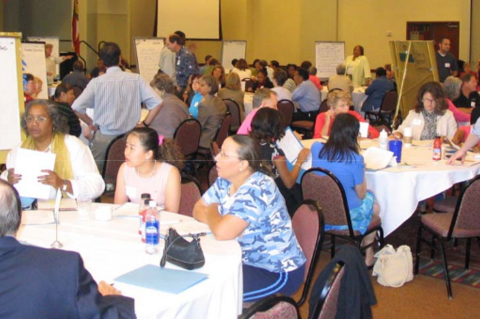
This initiative drew on face-to-face sessions, with the support of printed and other materials, to equip citizens with the necessary knowledge to discuss - and to develop goals regarding - immunisation priorities in the event of a pandemic. First, approximately 50 people (including, for instance, health care providers, members of ethnic minority and citizen advocacy organisations, representatives from federal agencies, and vaccine manufacturers), met (in July and September 2005). Amongst the background presentations at these sessions was an ethics exercise that was designed to help participants grasp the nature of values dilemmas and the challenges incumbent in policy decisions involving competing values and no obvious right choice.
Printed materials played a role in the next step of the process, which involved mixed-interest groups (with neutral facilitators present) being asked to explore the range of values and interests that they as individuals and their constituencies deemed important to guide immunisation priorities. They were provided a handout with illustrative values, goals, and population subgroups to support their discussion of dilemmas such as this one: "You are a surgeon with 5 patients who need 5 organs. You could harvest 1 healthy patient and save all 5. Should you?" In addition, they wrestled with a series of questions, such as: "What are your deepest concerns about determining vaccination priorities?"
A key strategy for continuing to engage the community was sharing the outcomes from these small-group discussions as part of an effort to build the foundation for framing the deliberations of subsequent sessions. By highlighting the fact that their input would fill a notable gap in the first U.S. Pandemic Influenza Preparedness and Response Plan (which was released in the summer of 2004), organisers were able to entice 101 citizens to volunteer to take part in an all-day public engagement event in Atlanta, Georgia. The participants were a diverse representation of gender, age (adults from 18 to 78), and ethnicity. Fourteen tables of participants were supported by volunteer facilitators as well as technical experts from multiple private and public organisations. A discussion guide structured the deliberations of the day, which began with various presentations and exercises (accompanied by handouts, such as those including essential facts about influenza). Participants then engaged in collaborative discussions to identify and weigh the tradeoffs associated with a national pandemic influenza vaccination programme.
The approach to combining stakeholder and citizen input involved meetings, as well, which featured experts providing additional handouts and presentations in response to the group's requests for supplementary data, as well as overviews provided by citizen participants. One presenter shared evidence in an effort to debunk commonly held myths about disasters; the sharing of this information reportedly sparked subsequent discussions by the group. The stakeholders were then organised into several mixed interest groups to weigh the advantages and disadvantages of an initial list of possible goals for a national pandemic influenza vaccination programme. Using a ranking exercise coupled with additional large-group negotiations, they then developed a ranking of goals to guide vaccination policy during a pandemic influenza event. In subsequent sessions, citizens from Massachusetts, Nebraska, and Oregon listened to a presentations from local infectious diseases experts and asked questions to learn the essential facts about influenza. They then gathered into small groups to discuss and share their reactions to the highest priority goals identified in the sessions described above. The facilitator then determined the degree of support for any proposed changes.
Immunisation & Vaccines.
Organisers state that, "[a]t the outset of the project, some in the vaccine community feared the process could be disruptive by providing a platform for extreme viewpoints espoused by a small minority; that citizens could not be enticed to participate; that citizens would not be able to gain sufficient understanding of the technical issues surrounding pandemic influenza to offer useful advice; that the project would be a wild card added into the game of policy making around vaccines. No one who observed any of the multiple meetings of this project has described them as disruptive. Quite the contrary, most observers were surprised by the general public's interest in participating, their rapid grasp of the central issues, and their willingness to deliberate and make hard choices....We were genuinely moved by seeing our democracy in action-seeing very diverse groups in Washington, D.C., Georgia, Massachusetts, Nebraska, and Oregon gather in table groups and engage in respectful, often passionate dialogue, knowledgeably shoulder the burden of weighing alternatives, find common ground, answer the vaccine question of interest to policy-makers, and provide their own ideas about how to best prepare for pandemic influenza. We believe that this project has provided a much needed and timely demonstration for the vaccine community-that enhanced public engagement to address value laden issues in vaccine policy is feasible in real time and can yield useful recommendations."
Atlanta Journal Constitution; Institute of Medicine; Georgia Department of Human Resources, Division of Public Health; Massachusetts Health and Human Services; National Immunization Program at the Centers for Disease Control and Prevention; National Vaccine Program Office in the Department of Health and Human Services; Nebraska Health and Human Services; Oregon Department of Human Services; Practicum Limited; Richard Lounsbery Foundation; Study Circles Resource Center; The Keystone Center; University of Georgia; University of Nebraska Public Policy Center.
Citizen Voices on Pandemic Flu Choices: A Report of the Public Engagement Pilot Project on Pandemic Influenza [PDF] (December 2005) and University of Nebraska Public Policy Center website - accessed on December 12 2007 and May 27 2020. Image credit: PEPPPI