
























Development action with informed and engaged societies

After nearly 28 years, The Communication Initiative (The CI) Global is entering a new chapter. 

Following a period of transition, the global website has been transferred to the University of the Witwatersrand (Wits) in South Africa, where it will be administered by the Social and Behaviour Change Communication Division. Wits' commitment to social change and justice makes it a trusted steward for The CI's legacy and future. 

On the transfer, co-founder Victoria Martin expressed her pleasure to see this work continue under Wits' leadership, knowing that co-founder Warren Feek (1953–2024) would have felt deep pride in The CI Global's Africa-led direction. 

As Wits, we honour the team and partners who sustained The CI for decades and look forward building from that strong base. This includes co-founders Warren Feek (1953-2024) and Victoria Martin as well as La Iniciativa de Comunicación (CILA), which continues independently at lainiciativadecomunicacion.com with links to The CI Global site. We are also eager to forge new partnerships and entertain new ideas as we consider how best to contribute to social and behaviour change in our rapidly evolving environment.

If you are joining the International Social and Behaviour Change Communication (SBCC) Summit in Panama, please join Wits and CILA on Monday, 22 June, to share your thoughts and suggestion for the relaunch of the Communication Initiative. We will be in Pacifica 5 from 12-1:25 for the Refuel, Reflect, and Renew Lunch Series: The Communication Initiative: celebrating a driving force for Communication for Social Change and the way forward. We will reflect on the legacy of Warren Feek and family in creating the Communication Initiative, consider the contributions of CI over the years and then turn our attention towards the future in this dynamic session. 

If you are unable to join us in Panama, we still want to hear from you. Please contribute your thoughts by following this link: https://redcap.link/CommunicationInitiative2026 or reaching out to ci_surveys@commint.com

You can also follow the QR Code:

 https://redcap.link/CommunicationInitiative2026

Time to read
less than
1 minute
Read so far

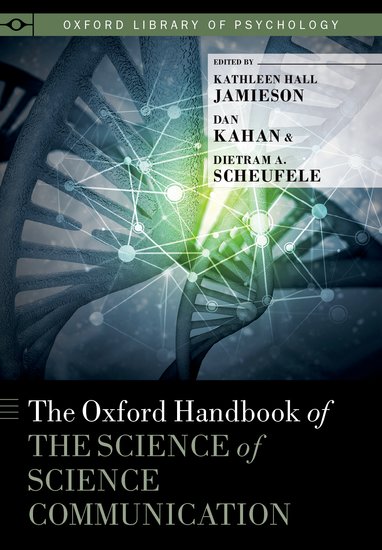
The Oxford Handbook on the Science of Science Communication
0 comments
Image
Publication Date

The cross-disciplinary Oxford Handbook on the Science of Science Communication contains 47 essays by 57 leading scholars organized into six sections: The first section establishes the need for a science of science communication, provides an overview of the area, examines sources of science knowledge and the ways in which changing media structures affect it, reveals what the public thinks about science, and situates current scientific controversies in their historical contexts. The book’s second part examines challenges to science including difficulties in peer review, rising numbers of retractions, publication and statistical biases, and hype. Successes and failures in communicating about four controversies are the subject of Part III: “mad cow,” nanotechnology, biotechnology, and the HPV and HBV vaccines. The fourth section focuses on the ways in which elite intermediaries communicate science. These include the national academies, scholarly presses, government organizations, museums, foundations, and social networks. It examines as well scientific deliberation among citizens and science-based policymaking. In Part V, the handbook treats science media interactions, knowledge-based journalism, polarized media environments, popular images of science, and the portrayal of science in entertainment, narratives, and comedy. The final section identifies the ways in which human biases that can affect communicated science can be overcome. Biases include resistant misinformation, inadequate frames, biases in moral reasoning, confirmation and selective exposure biases, innumeracy, recency effects, fear of the unnatural, normalization, false causal attribution, and public difficulty in processing uncertainty. Each section of the book includes a thematic synthesis