










































A Guide to Effective RCCE Engagement in Large, Closed Communities: An Evolving Network in RCCE in the COVID-19 Migrant Worker Outbreak in Singapore
National University of Singapore (NUS); My Brother SG; and Kitesong Global
"It is in that space of AUTHENTICITY and VULNERABILITY, that HUMAN CONNECTION can be made. And with that, the sowing of TRUST. And with that, the birth of a MOVEMENT." - Dr. Tam Wai Jia
Intended as a reference tool for community mobilisers, this document illustrates how risk communication and community engagement (RCCE) around COVID-19 was done in a large, enclosed setting with migrant worker communities in Singapore. The toolkit provides an overview of the various elements of a creative community-led, people-centred RCCE programme and provides guidance and tools for scale-up and spread in other contexts. It explores not only the importance of RCCE but how it can be delivered effectively, even in the context of the "messy realities" of a public health crisis. The purpose is to impart the spirit of community empowerment through its emphasis on building relationships, restoring human connection, and fueling hope by embracing authenticity and vulnerability and celebrating humanity, to propel agency and inspire change.
The guidance provided here for designing and implementing RCCE approaches is based on the My Brother SG team's experience using RCCE in 43 purpose-built dormitories and hundreds of smaller factory-converted dormitories experiencing lockdown due to COVID-19 from April to August 2020. My Brother SG's RCCE efforts were designed to ensure migrant workers quarantined in the large, closed communities (so-called community care facilities, or CCFs) were not stigmatised, that they were provided with timely and accurate information in accessible forms and appropriate languages, and that they were engaged in response plans and strategies. Most of the RCCE interventions originated from a bottom-up approach that happened organically, without formal strategic planning. However, as the principles of RCCE gained recognition by leaders on-ground, My Brother SG's RCCE approaches were articulated into a revised strategy that is shared in this guide.
As advised in the World Health Organization (WHO)'s COVID-19 Global RCCE Strategy, people-centred and community-led approaches that are data-driven, that reinforce capacity and local solutions, and that enhance collaboration result in increased trust and cohesion to ultimately reduce the negative impacts of COVID-19. The participatory approach outlined in the guide recognises that communities - even marginalised and vulnerable ones such as migrant communities - have the agency, power, and autonomy to influence the spread of COVID-19. Through regular two-way communication, the participatory approach recognises the strengths inherent in every community and leverages them to amplify the power to take charge of their own health.
As with many countries around the world at the beginning of the CoVID-19 outbreak, health messaging in Singapore initially focused on increasing knowledge about preventive measures to reduce COVID-19 transmission and infection. Communication was primarily directive and one-way. However, as the outbreak evolved and the need for effective RCCE was recognied, individuals from different health clusters and non-profit organisations came together as an organic RCCE working group. It soon became apparent that health messages not only needed to be translated, pictorial, culturally sensitive, and contextual, but that they were most powerful when co-delivered by agents of trust, especially migrant worker leaders themselves. It also became clear that migrant workers needed to be listened to and participate in the messaging being directed at them. Through leveraging on the inherent hierarchy structure in dormitories, My Brother SG found that migrant worker leaders were excellent sources of information, in person or digitally.
To develop the migrant worker RCCE initiative, the following steps were undertaken:
- Conducting a Strengths, Weaknesses, Opportunities and Threats (SWOT) analysis
- Undertaking Knowledge, Attitudes, and Practices (KAP) research to establish baselines
- Curating and developing content, including booklets, posters, comics, videos (see one example, below), podcasts, live webinar sessions, etc. For example, one health booklet, "How to Protect Yourself from COVID-19", features key messages such as recommending that men not mingle with those from other rooms in the dormitory and avoid praying in close proximity, providing explanations as to why. These messages arose from on-the-ground feedback, based on the workers' behaviours and cultural practices.
- Establishing a variety of distribution channels and communication modalities (e.g., Facebook, text messaging, in-person interactions), having mapped media consumption channels
- Engaging key stakeholders from other non-profit organisations, healthcare clusters, and high-level ministries (e.g., Ministry of Health)
- Recruiting a team comprising staff, hired translators, and volunteers ("to create a team, create a vision")
- Expanding outreach to migrant workers in non-purpose built dormitories such as factory-converted dormitories (FCDs) and construction temporary quarters (CTQs)
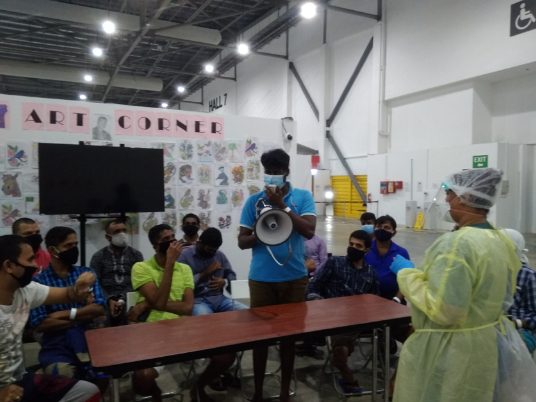
The guide details My Brother SG's process, including the theory of change and logic model. It describes the various communication products and activities created and carried out as part of the RCCE work. In one activity, posters of a language different from the audience's native tongue would be shown, and the audience would be asked to interpret the illustrations. A volunteer from the audience who could speak basic English would be invited up to explain the crowd's interpretations. Then, the poster would be flipped over to reveal the same poster in their native language. The volunteer would then read and explain the poster to his community. Such interactive engagements not only helped to build rapport and camaraderie, but also served as a training. These workers could scale the messaging using the same methods on return to their dormitory rooms. During these sessions, the activities stimulated conversations to issues the men faced. For example, in going through the poster entitled "See a doctor when you have any of these symptoms", workers shared that sometimes their friends were afraid to seek medical attention. Informative audio podcasts, announcements and explanations by loud hailer, and video testimonials recorded by COVID-19 positive migrant workers were created and shared in response.
As outlined here, various challenges were encountered along the way. For example, illustrating the migrant worker cartoons in a way that was culturally relevant and sensitive proved required great care. While some ethnic groups wore distinctive wrap skirts and had distinct facial features, others did not; yet, it was important to keep the illustrations accessible to a variety of groups. In the end, a variety of migrant worker characters with different features were used, with a bias towards Bengali and Tamil workers, who comprised the large majority of migrant workers in Singapore. Pencilled draft illustrations and digital drafts of the booklets were shared via text messaging with informal migrant worker contacts to gain feedback. Where this was not possible, feedback was obtained from Singaporean resident volunteers who shared the same country of origin as the migrant workers.
Optimising the chances of success in the RCCE programme depended on some broad key principles, such as:
- Focusing on agency, autonomy and empowerment
- Establishing a human connection
- Engaging early with migrant workers on-ground and partnering with inherent hierarchy personnel structures
- Ensuring national coordination through early engagement of stakeholders
- Communicating bilaterally with migrant worker groups
- Adopting a streamlined 3-pronged approach: COVID-19 prevention/management; mental health promotion; and chronic disease management
- Using multiple modes of dissemination
- Overcoming bureaucracy made less nimble by the pandemic
- Growing a vibrant volunteer and donor network
- Scaling up
Generalisable lessons learned in setting up a novel RCCE service include:
- Anticipate frustrations, barriers, setbacks, and conflict.
- Value the preexisting efforts of stakeholders.
- Never lose sight of the perspective of the community you are engaging in.
- Look on each problem is an opportunity.
- Create a common vision to galvanise a team together, remembering that it takes a team, even if it is formed from scratch during the outbreak, to keep the work sustainable and growing.
- Commit to key principles and values decided upon by the team, such as a commitment to high standards of work, flexibility in times of crisis, and humility to learn from mistakes.
- As the team grows, start establishing structures within the leadership team.
- Invest meaningfully in nurturing leaders within your team.
- Experience challenges such as high volunteer turnover rates positively and leverage on them to the situation's advantage.
- Commit to establishing partnerships to leverage on one another's spheres of influence.
Feedback from migrant workers was collated from online surveys and focus group discussions (FGDs) between December 2020 and February 2021, informing My Brother SG of the challenges they faced and thus directing future RCCE efforts. The results of the analysis showed that face-to-face engagements, Facebook webinars, and the My Brother SG comics significantly increased migrant workers' feelings of agency and empowerment related to COVID-19 transmission, while other activities (e.g., health booklets, posters, and videos) did not. These findings suggest that two-way interactions through a personal human touch, whether digitally or face-to-face engagements, are essential in promoting agency and empowerment in effective RCCE communication.
This RCCE network has become a growing web of partners. As My Brother SG includes more partners regionally and globally, it looks forward to working toward the vision of sustainability and longevity by building upon the relationships within and outside the network and supporting its members to continue engaging and empowering migrant workers for better health.
My Brother SG website, October 14 2021. Image credit: My Brother SG
- Log in to post comments