










































Concerns, Attitudes, and Intended Practices of Healthcare Workers to COVID-19 Vaccination in the Caribbean
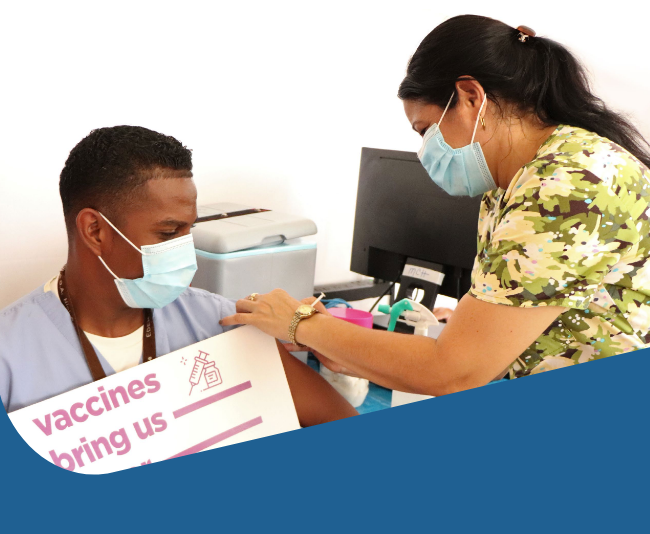
"It is...imperative that healthcare workers themselves are confident in vaccination as a public health good and are able to transmit this confidence to their patients, family, friends, and community members. However, just as with the general public, healthcare workers are at risk of falling prey to misinformation about vaccines..."
The COVID-19 vaccines have been significant targets of misinformation and disinformation, leading to public mistrust and concerns over vaccine safety. The Pan American Health Organization (PAHO) stresses that the extent to which this "infodemic" has affected and influenced the knowledge and attitudes of healthcare workers (HCWs), who are often considered trusted sources of vaccine-related guidance, must be assessed in order to design and implement targeted communication campaigns whose messaging responds to HCWs' concerns and questions. This study collected data on the behavioural and social drivers of vaccination and COVID-19 vaccines among HCWs in the Caribbean in an effort to contribute to increasing vaccination acceptance and improving vaccine confidence among HCWs in this subregion. PAHO hopes the findings will be useful to public health decisionmakers, policymakers, communication professionals, and HCWs who seek to be vaccine advocates.
PAHO set out to understand the attitudes and intentions of HCWs in 14 Caribbean countries related to routine immunisation and COVID-19 vaccination. Between March 15 and April 30 2021, 1,197 HCWs completed a mixed-methods survey. Table 3 on Page 9 of the report outlines the percentage of respondents in various categories who said they agree or strongly agree with the survey's opinion questions. (The full detailed response summary and regression results for all the opinion questions may be found in Annex C.) In short, key results include:
- Attitudes toward routine vaccines: Respondents displayed widespread agreement that vaccines in general are a good way to protect oneself from disease. Respondents also agreed that vaccines are safe (95%), efficient (97%), and that vaccine information provided by public health authorities and healthcare providers is reliable and trustworthy (94%).
- Vaccine readiness: 56% of all respondents agreed that new vaccines carry more risk than older vaccines. Variations were observed between HCW categories. 77% of all respondents concurred they are concerned about serious adverse effects of vaccines.
- Attitudes toward COVID-19 vaccines: Overall, 92% of respondents agreed that a COVID-19 vaccine will protect against severe COVID-19 infection. Physicians were the most confident among HCWs (96%), and nurses and allied professionals were least confident (85% and 82%, respectively; p < 0.001 for both categories). Similarly, while 83% of respondents overall were confident in the scientific approval process of a COVID-19 vaccine, physicians (88%) were more so than other HCW categories.
- Vaccine hesitancy: While 77% of participants said they would receive the COVID-19 vaccine, 23% of a subset of 848 (n=195) respondents displayed some level of vaccine hesitancy. Nurses were classified as hesitant at a rate twice more than physicians (with 60% of nurses planning to wait to see how the COVID-19 vaccine affects others), and younger age quartiles reported more hesitancy than older age groups. One-third of participating HCWs - mostly critical care nurses and allied health professionals (p < 0.001) in the younger age groups - said they did not know enough about the vaccines to make a decision. Almost half of respondents (47%) agreed or strongly agreed that the development of the vaccine may have been rushed or that the vaccine may not have been thoroughly tested, with more nurses agreeing with that statement (60%, p < 0.001). All that said, only 4% of all participants intend to refuse a COVID-19 vaccine altogether.
- Attitudes toward influenza vaccine: Some 23% of the respondents would not take the influenza vaccine, and 13% would not recommend it to family and friends. Nurses were more reluctant than physicians in both cases.
Qualitative responses were categorised by behavioural and social domain (BeSD) and construct. Most answers were classified as being related to HCWs' confidence (or lack thereof) in the vaccines' benefits (42%), as well as their perceived low risk of the disease compared with the perceived risks associated with the vaccines (28.5%), and their confidence (or lack thereof) in the vaccines' ability to protect them (28%). Another finding extracted from some respondents pointed to the brand of the COVID-19 vaccine available to them as reason for delaying or refusing to get vaccinated (2.9%). This prompted the investigation team to create a new construct under the BeSD "think and feel" domain related to confidence in specific vaccine brands. The most influential construct under the "social processes" domain was the lack of HCWs' confidence in health authorities (10%), with participants including statements in the open-ended questions on mandating vaccines, dishonesty, and denial or hiding of adverse events.
Implications based on the findings include:
- Efforts need to be made to increase risk perception of COVID-19 disease and acceptance of all approved vaccines so that HCWs feel more confident not only getting vaccinated themselves but also in recommending that their patients, family, and friends get vaccinated as well.
- Trusted spokespersons should be used to empathetically communicate messages about vaccine safety and efficacy and the importance of getting vaccinated with the first vaccine that is offered (and not delaying vaccination in hopes of receiving a vaccine of personal preference). References to religious objections for not getting vaccinated, as indicated in some qualitative responses, highlight the need to work with religious leaders among these trusted spokespersons.
- Messaging should clarify that allergies are not a contraindication for vaccination, and that many comorbidities in fact increase the risk of complications from COVID-19 disease, meaning populations with those conditions will benefit greatly from the protection offered by COVID-19 vaccines. In addition, the importance of getting vaccinated against COVID-19 following prior infection should be clearly communicated.
- Results of studies should be clearly and transparently communicated and explained to HCWs so they are continuously informed about new findings on vaccine effectiveness and safety.
- Considering the statistically significant hesitancy among respondents in the youngest age group, a variety of channels should be employed to reach this audience with key messages in favour of vaccination. For example, authorities should explore social media platforms like Instagram and TikTok in addition to traditional communication channels.
- HCWs could benefit from targeted training on identifying misinformation and trusted sources of information related to vaccines and vaccination so they can correct rumours they hear from colleagues, patients, and community members.
PAHO suggests that the results of this study could be used to tailor communication strategies by age group, professional category, and specialty of HCWs, focusing efforts on those groups that show more hesitancy toward COVID-19 vaccines. Hesitancy among nurses is a major concern, as the nature of their work puts them in closer and longer contact with patients. Interventions could include capacity-building and training of nurses in communicating about vaccination, especially related to vaccine safety. (Based on the WHO BeSD framework as well as the results of the study, Table 8 on Page 31 of the report outlines other possible interventions to be implemented at country level to improve vaccine acceptance among HCWs.)
Though inaccurate information spread on social networks influenced participating HCWs on COVID-19 vaccines, the report indicates that social media can be a powerful tool to provide accurate information, debunk myths and rumours, facilitate the exchange of ideas, understand different population groups' concerns and doubts, and reach different generations of HCWs in the Caribbean.
In conclusion: "More research is needed to acknowledge the multifactorial nature of vaccine hesitancy among HCWs. There is a variety of individual and social characteristics that influence vaccination acceptance; only by understanding and addressing these will it be possible to ensure a broader coverage of COVID-19 vaccines."
Washington, D.C.: Pan American Health Organization; 2021. License: CC BY-NC-SA 3.0 IGO - sourced from: PAHO Institutional Repository for Information Sharing (IRIS), October 7 2021.
- Log in to post comments