










































Doing It for Us: Community Identification Predicts Willingness to Receive a COVID-19 Vaccination via Perceived Sense of Duty to the Community
Department of Psychology, Nottingham Trent University
"...harnessing [a] sense of 'we' within communities is crucial in order to encourage COVID-19 vaccination willingness."
Much scholarly work to date on predictors of COVID-19 vaccination willingness can be understood in the context of the Health Belief Model (HBM), a model of health behaviour change. The present study is motivated by the conviction that such work is limited due to its neglect of the roles played by social context and group memberships in determining people's thoughts and behaviour, attention to which might help in developing approaches to address COVID-19 vaccine hesitancy.
The study draws on the Social Identity Approach (SIA), which posits that, in addition to a personal identity, we each possess social identities that are derived from the social groups to which we belong. At any particular time, one of these group memberships can become salient (psychologically conspicuous), and we will start to think and act in a manner consistent with the norms and values of that specific group. The extent to which the person engages in group norm-consistent behaviour will be a function of their strength of identification with the group (i.e., the extent to which they experience a subjective sense of belonging to the group, and a sense of commonality with its members). The norms associated with a specific group can involve health-related behaviours, which means that "strong identifiers" will be particularly likely to engage in these behaviours.
As outlined here, one group that has been particularly relevant during the COVID-19 pandemic is the local community/neighbourhood. Physical distancing and lockdown measures have meant that, for many individuals, local residents have been the only people with whom they have interacted on a relatively regular basis. This sense of connection has led to manifestations such as the United Kingdom (UK)'s "Clap for Carers", a 10-week activity in which people emerged from their homes at 8 p.m. each Thursday evening to show their shared appreciation for healthcare and frontline workers through applause and noise-making. Also, the rise of COVID-19 mutual aid groups is explained by a range of work that concludes that the collective provision of support in the aftermath of disasters tends to emerge from a shared sense of social identity. Observing other group members engaging in prosocial behaviours potentially creates an ingroup prosocial norm that is particularly likely to lead to prosocial behaviour in strong identifiers.
For the present study, participants (N = 130) completed an online survey in late 2020/early 2021, just as the UK's COVID-19 vaccination programme was rolling out, when vaccinations were being offered to only the most elderly and vulnerable. The wording of a measure in the survey specifically asked participants whether they consider that it would be their personal duty as a member of their community to get a COVID-19 vaccination.
The study found that community identification correlated positively with vaccine willingness and with duty to the community to get vaccinated. Duty to the community to get vaccinated correlated positively with vaccine willingness. That is, a significant indirect effect of community identification on vaccine willingness via sense of duty to the community to get vaccinated was found, even after controlling for participants' age and subjective neighbourhood socio-economic status (SES), which have been found in vaccine opinion surveys and correlational data to be predictors of vaccine willingness. In sum, this indicates that while community identification itself is not a unique predictor of COVID-19 vaccine willingness (i.e., the total effect of community identification on vaccination willingness was non-significant), the willingness to engage in community-related prosocial normative behaviour that it positively predicts is, in itself, a positive predictor of COVID-19 vaccine willingness.
These findings support the SIA literature that highlights the role played by social group memberships and group identification in predicting health-related behaviours. Moreover, they confirm the importance of ingroup norms in mediating this relationship: It was the injunctive norm of "sense of duty as a community member to get vaccinated" (i.e., the idea that "as a community member, this is how I should behave") that was the crucial predictor of COVID-19 vaccine willingness. Based on the findings, community leaders and governments seeking to boost COVID-19 vaccine uptake may consider these approaches:
- Attempt to increase people's sense of identification with their communities, perhaps by promoting formal and informal volunteering. Among other benefits, such work may have the potential to curb people's endorsement of anti-vaccine conspiracy theories, as research has shown that people who endorse conspiracy theories tend to possess low levels of trust in and connection to their communities.
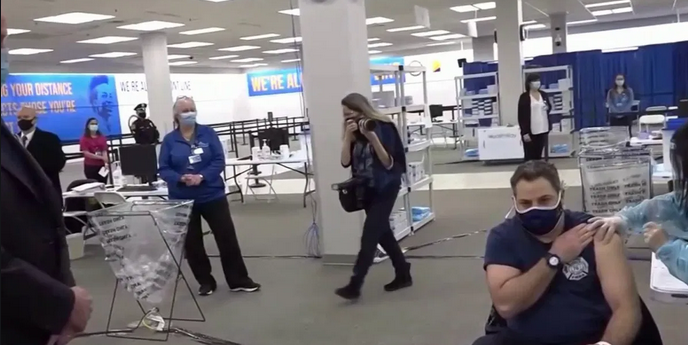
- Aim to ensure that the prevailing norms that are associated with the community are prosocial and based on the concept of collective solidarity. Seeing other community members get vaccinated and support the vaccine roll-out could tap into the observation that ingroup members' opinions are particularly likely to be heeded and to lead to attitude change.
In conclusion, this study highlights "the role played by community identification and its relationship with people's willingness to engage in community-related prosocial normative behaviour in predicting vaccination willingness. Importantly, the benefits of community identification have the potential to stretch much further than this, by possibly helping to increase vaccine efficacy, to reduce the feelings of loneliness and social disconnection that many have felt during the pandemic...and to curb anti-vaccine conspiracy theory endorsement. The community thus has the potential to be a rich and powerful resource..."
Journal of Community & Applied Social Psychology 2021; 1-12. DOI: 10.1002/casp.2542. Image credit: NBC New York (creative commons license)
- Log in to post comments