










































Democracy under Lockdown: The Impact of COVID-19 on the Global Struggle for Freedom
Freedom House
"Attention to urgent public health needs is crucial, but any successes will not be sustainable without support for human rights and strong democratic institutions, including an active and independent civil society."
Designed and written by Freedom House with support from Free Press Unlimited and Facebook, this report summarises the results of Freedom House's research into the impact of COVID-19 on democracy and human rights worldwide. It describes 5 aspects of accountability that have been weakened, while at the same time offering reasons for hope and a set of policy recommendations that could improve the dire situation for democracy that the research unearthed.
Specifically, from January to August 2020, Freedom House worked in partnership with survey firm GQR to carry out an online survey of 398 journalists, civil society workers, activists, and other experts from 105 countries, as well as research on 192 countries by Freedom House's global network of analysts. In essence, the research found that, since the coronavirus outbreak began, "Not only has democracy weakened in 80 countries, but the problem is particularly acute in struggling democracies and highly repressive states - in other words, settings that already had weak safeguards against abuse of power are suffering the most." Furthermore, 64% of the experts surveyed agreed that the impact of COVID-19 on democracy and human rights in their country of focus will be mostly negative over the next 3-5 years.
To illustrate these trends, the report points to the experience of Sri Lanka, where the government of Prime Minister Mahinda Rajapaksa has reportedly stepped up efforts to control independent reporting and unfavourable speech by ordering the arrest of anyone who criticises or contradicts the official line on the coronavirus. Early elections were scheduled but then postponed, leaving the national legislature out of session beyond the constitutional deadline and weakening checks on executive power. Freedom House asserts that authorities have also exploited health concerns as a pretext for human rights abuses, especially against the minority Muslim population.
More specifically, the research revealed weakening in the following areas, globally:
- Checks against abuses of power: 27% of survey respondents reported government abuse of power as one of the three issues most affected by the coronavirus outbreak. "Officials and security services perpetrated violence against civilians, detained people without justification, and overstepped their legal authority. Governments are also using the pandemic as a justification to grant themselves special powers beyond what is reasonably necessary to protect public health. They have then exploited these emergency powers to interfere in the justice system, impose unprecedented restrictions on political opponents, and undermine crucial legislative functions."
- Protection of marginalised communities: 29% said a lack of protection for minorities and vulnerable populations was one of three issues most affected by the coronavirus response, and 25% said new or increased restrictions on ethnic and religious minorities have been put in place in their countries of focus. For example, in Bulgaria, Romany neighbourhoods were placed under harsher movement restrictions than areas where Roma did not constitute a majority. Freedom House reports that governments and societies have used marginalised groups as scapegoats, blaming them for spreading the virus. Furthermore, "Journalists attempting to expose conditions for refugees amid the pandemic have been muzzled in several countries."
- Transparency and anticorruption: 37% of those surveyed, representing 65 countries, named government transparency and information about coronavirus as one of the three issues most affected by the response to the pandemic. For experts focused on countries that the Freedom in the World report (see Related Summaries, below) classifies as "Not Free", 46% cited transparency as a chief concern. A majority (62%) of respondents said they distrust what they are hearing about the pandemic from the national government in their country of focus; among Not Free countries, 77% distrust such information. Respondents expressed slightly more confidence about information from local governments, but 53% distrust these sources as well. About half (52%) of respondents, representing 66 countries, said the virus has "led to a proliferation of disinformation coming from the government". Some experts referred to outright government denial of the virus or promotion of unsafe or unproven treatments.
- Free media and expression: At least 91 of 192 countries (47%) experienced restrictions on the news media as part of the response to the coronavirus outbreak.; the media in 62% of Partly Free countries and 67% of Not Free countries under review experienced such constraints. In addition to specific controls on the news media (e.g., journalists covering the crisis being arrested or targeted with violence, harassment, and intimidation), government restrictions on free speech and criticism of the government have been imposed in at least 72 countries (38%); 56% of Partly Free and 57% of Not Free countries under review saw limits on free expression.
- Credible elections: National elections in 9 countries, and many more subnational votes, were disrupted in some way between January and August 2020, with frequent accusations that decisions on election administration had been politicised. Postponements "frequently failed to meet democratic standards, either because new elections were not scheduled promptly or because officials set new dates without making adequate preparations for safe and secure voting."
Furthermore, the survey found that "Individual democracy and human rights activists and journalists, who were already under tremendous pressure from undemocratic governments, have faced severe constraints during the coronavirus outbreak....[R]estrictions on movement in particular were cited for creating obstacles to holding workshops, meeting with sources, providing support to vulnerable populations, and conducting advocacy work." The report examines other work changes necessitated by the pandemic.
The report includes a brief case study of the handling of the COVID-19 pandemic in the United States (US), where death tolls been among the highest in the world. Among the issues: The pandemic hit in a crucial election year; public health has become politicised; COVID-19 has underscored the country's racial inequities; and concerns have been raised that the Trump administration has exploited the pandemic as a pretext to set aside due process obligations and intensify its clampdown on asylum seekers and immigration in general.
Despite the concerning findings not only in the US but in the overall global situation, Freedom House found several examples of responses to the pandemic that may inspire hope, which are detailed in the report. "Journalism has thrived in certain countries as people seek out factual information, and investigative reporting has persisted in several of the most hostile environments....Civil society organizations have also worked tirelessly to maintain accountability in face of new challenges. And the mishandling of the crisis by many governments has spurred demands for change, most notably in Belarus, where mass protests that began in August [2020] have blossomed into a major movement for political reform." To cite another example, survey respondents flagged Georgia's parliamentary elections, set for October 2020, as a possible positive example of international engagement in support of necessary electoral preparations. In short: "Democracy is suffering around the world, but the public's demand for it has not been extinguished."
Freedom House calls on governments, civil society organisations, and donors to protect political rights and civil liberties during and after the pandemic by:
- Ensuring that emergency measures are accountable, proportionate, and time-restricted;
- Providing technical support and training for online work;
- Ensuring that free and independent media can thrive and that people have access to fact-based information;
- Supporting free and fair elections that respect public health;
- Providing emergency funding that allows democracy and human rights organisations to continue their daily work;
- Identifying human rights abuses, condemning them when they occur, and holding perpetrators to account; and
- Combatting corruption in pandemic response efforts.
In conclusion: "As the pandemic drags on, public attention will inevitably turn elsewhere, permitting even further abuses to go unchecked. The burden of preventing degraded norms from taking hold will largely fall on democracy advocates and independent journalists....Proponents of democracy must support one another around the world to ensure that government failures lead to renewed demands for stronger institutions."
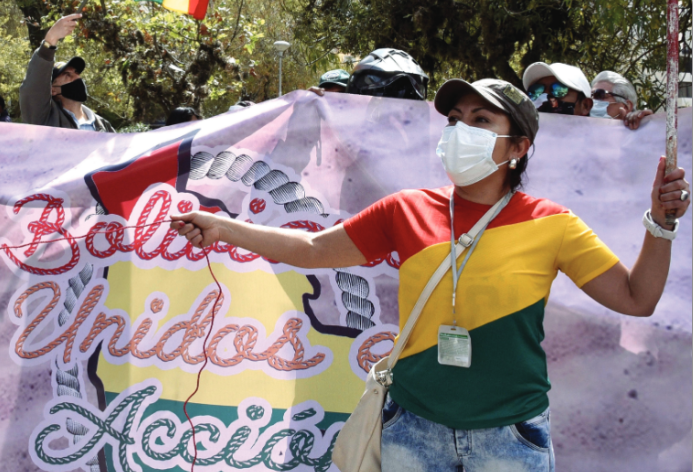
Policy Recommendations: COVID-19 and the Global Struggle for Freedom, accessed on October 20 2020. Image caption/credit: A protester wears a face mask at a political demonstration in Bolivia during the coronavirus pandemic. Credit: Aizar Raldes/AFP via Getty Images.
- Log in to post comments