










































The Echo Chamber of Anti-Vaccination Conspiracies: Mechanisms of Radicalization on Facebook and Reddit
European Union (EU) Institute for Security Studies (EUISS)
"Polarised users on both platforms can mobilize and possibly influence behaviour, with devastating effects."
Echo chambers have been defined as communities of like-minded individuals who reinforce each other's world-view and amplify certain beliefs. Communities built around conspiracy theories thrive in the echo chambers of social media. Most arguments against vaccination are built on conspiracies with little scientific evidence, where the online community predominantly echoes misinformation. This paper explores how Facebook's mechanism for community building has enhanced the spread of vaccination misinformation online and compares it to Reddit's conspiracy community, applying the RECRO model of online radicalisation.
Although not claiming that there are no legitimate arguments against vaccinations, this paper is based on the premise that anti-vaccination conspiracy and the spread of misinformation can be classified as radicalisation: The consequences of the movement have a lethal impact, even if they are not violent. As outlined here, the way in which people become convinced of the conspiracies on vaccination follows a similar path to online radicalisation, which can be illuminated by the RECRO model of internet-mediated radicalisation. RECRO stands for:
- Reflection phase, which emerges often from an individual's hesitation to vaccinate their children due to factors like lack of confidence and trust.
- Exploration phase, in which weak evidence is often embraced when researching vaccine safety; confirmation bias makes some people prefer vaccine-skeptic sources over standing authorities.
- Connection phase, which "pulls" individuals into online antivaccination groups, where they may find social support with like-minded individuals, which they might be lacking in their real-life network; this echo chamber effect on social media involves a surrounding of like-minded people influencing confidence in an extreme belief.
- Resolution phase, where the need for action is re-triggered.
- Operational phase, where the individual ultimately contributes to the cause.
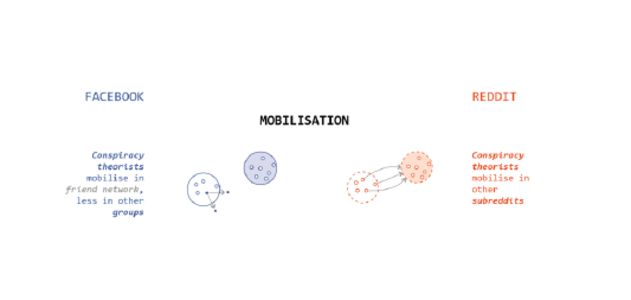
The paper looks, separately, at the community mechanisms of Facebook (e.g., its Groups) and Reddit (e.g., subreddits) and the ways in which each contributes to the echo chamber effect. Figure 3 in the paper shows the differing characteristics on the platforms, being the interaction, feed composition, community moderation, and diversity of groups. In short, Facebook's closed network of friends and closed network of similar echo chambers with only top-down moderation allows individuals to be selective in their beliefs and possibly radicalise, while also sucking in new users who are vulnerable to the appeal of conspiracies - thereby increasing the spread of the radicalisation. In contrast, Reddit's open network structure, where fraudulent science-based arguments against vaccination can be exposed more easily, could explain why a dedicated anti-vaccination community seems almost absent on Reddit. Instead, they are incorporated in the wide conspiracy community on the platform. This community is less sheltered from criticism compared to anti-vaccination groups on Facebook. So, members of this community are thus more hostile in their convictions - hence, hardening polarisation.
In conclusion: "The observations of anti-vaccination conspiracy on Facebook and Reddit can provide a fruitful insight for other types of radicalisation on both social media platforms....Its consequences can have a long-lasting effect on society, and social media radicalisation should therefore not be underestimated."
Institute for Policy, Advocacy and Governance (IPAG) Knowledge Series, forthcoming.
- Log in to post comments