











































Vaccine Hesitancy and (Fake) News: Quasi-Experimental Evidence from Italy
"Magna Graecia" University (Carrieri); RWI Research Network (Carrieri);3 University of York (Carrieri, Madio); Université Catholique de Louvain (Madio); CESifo Research Network (Madio); Erasmus University Rotterdam (Principe)
"[T]the spread of misinformation surrounding vaccines following the court's ruling caused a significant reduction in child immunization rates."
Several countries are experiencing outbreaks of vaccine-preventable diseases (VPDs), leading the World Health Organization (WHO) to name vaccine hesitancy - that is, the reluctance or refusal to vaccinate despite the availability of vaccines - as one of top 10 threats to global health. The spread of fake news and misinformation on social media is frequently cited as a primary cause of vaccine hesitancy. This paper studies the effect of the diffusion of misinformation on immunisation rates in Italy by exploiting a quasi-experiment that occurred in March 2012, when the Court of Rimini officially recognised a causal link between the measles-mumps-rubella (MMR) vaccine and autism and awarded injury compensation.
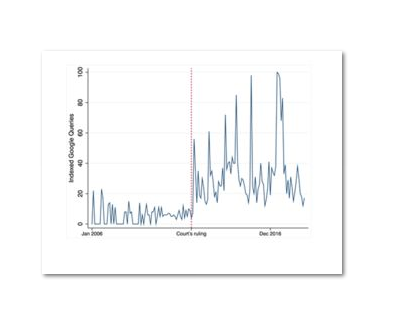
The court's decision to grant compensation to the family after recognising that the MMR vaccine caused their child's autism was initially covered by the most-read national media outlets (e.g., La Repubblica and Il Corriere della Sera). People's concerns about vaccine side effects were then proliferated on the internet. Figure 1 in the paper shows that the number of Google searches for "vaccines and autism" increased drastically after March 2012 and remained quite stable afterwards. Compared with pre-2012, the volume of searches increased by 600%.
As access to nontraditional media and exposure to misinformation is facilitated by internet availability, the researchers looked at the heterogeneity in regional (NUTS-2 level) broadband coverage across areas of the country. In the period analysed, broadband coverage in Italy increased from 15% in 2006 to 76% in 2016. The researchers explain why the changes in broadband coverage are unlikely to be correlated with the demand for high-speed internet; "this provides an exogenous variation in the regional exposure to news".
The researchers combine both sources of variations (i.e., the 2012 court ruling and heterogeneity in broadband coverage) in a Difference-in-Differences (DiD) framework. During the period considered, that is, 2006-2016, vaccines such as MMR, diphtheria-pertussis-tetanus (DTP), Polio (POL), and Hepatitis B (EpB) were mandatory by law, whereas Haemophilus influenzae type B (HIB) was highly recommended. In column 1 of Table 1, the researchers report DiD estimates for all vaccines separately and for an overall measure of average immunisation rates.
In short, they find a negative average treatment effect on all vaccines considered. Specifically, they find that a 10-percentage-point increase in local broadband coverage led to a significant reduction of 1.23 percentage points in POL coverage, 1.14 in DTP coverage, 1.55 in EpB coverage, and 1.44 MMR coverage. To retrieve the relative size of the effect, they also present the percentage change with respect to the average immunisation rates of each vaccine. This shows a similar reduction across the different vaccines (1.2-1.6%), with the highest effect found for the MMR and EpB.
In conclusion, building on growing literature studying the effects of the internet on real-life outcomes, the researchers "found that after the court's ruling in 2012, larger accessibility to nontraditional media (via broader broadband coverage) led to a reduction in child immunization rates." The negative and significant effect encompasses all vaccines and led immunisation rates to reach below the critical threshold of 95%. These results "thus corroborate the thesis that misinformation is a dangerous cause of the vaccine hesitancy issue."
Health Economics Letter https://doi.org/10.1002/hec.3937
- Log in to post comments