



































Improving Vaccination Coverage in India: Lessons from Intensified Mission Indradhanush, A Cross-Sectoral Systems Strengthening Strategy
Ministry of Health and Family Welfare, Government of India (Gurnani, Haldar, Aggarwal, Chauhan, Jhalani); The INCLEN Trust International (Das, Arora); international health consultant (Murray)
"...an analysis from the Intensified Mission Indradhanush strategy in India, showing that cross-sectoral participation can contribute to improved vaccination coverage of children at high risk..."
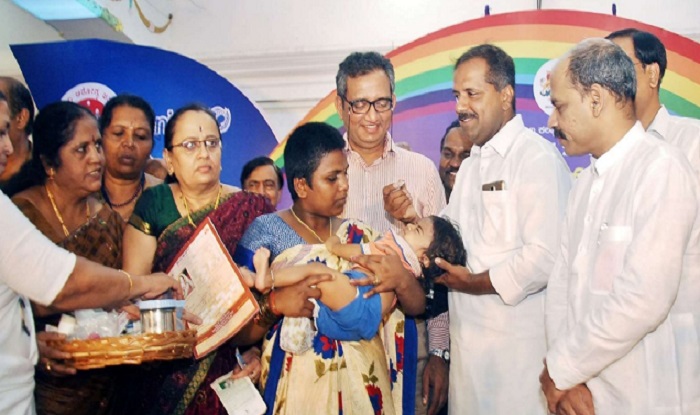
In October 2017, the prime minister of India launched Intensified Mission Indradhanush (IMI), which aimed to reach 90% full immunisation coverage in districts and urban areas with persistently low levels. IMI was an effort to shift routine immunisation into a Jan Andolan, meaning "people's movement" in Hindi. It aimed to mobilise communities and simultaneously deal with barriers to seeking vaccines. Led and coordinated by the Ministry of Health and Family Welfare, this case study records the lessons learnt from IMI. Emphasis was put on understanding how cross-sectoral and multistakeholder engagement work to strengthen access to vaccine services and improve their quality.
In 2016, an estimated 38% of children in India failed to receive all basic vaccines in the first year of life. The factors limiting vaccination coverage include large mobile and isolated populations that are difficult to reach, and low demand from underinformed and misinformed populations who fear side effects and are influenced by anti-vaccination messages. In response, India's Ministry of Health and Family Welfare launched Mission Indradhanush (MI); between April 2015 and July 2017, MI vaccinated around 25.5 million children and 6.9 million pregnant women. IMI was built on MI, using additional strategies to reach populations at high risk, by involving sectors other than health.
For the IMI case study, a modified multistakeholder review process was used, which included in-depth interviews of stakeholders at all levels and a synthesis meeting.
The report begins with a programme description of IMI, which aimed to reach all children aged up to 5 years and pregnant women, with a focus on ensuring full vaccination for children under 2 years. Cycles of immunisation were conducted each month between October 2017 and January 2018, each lasting 7 working days. A 7-step process was developed to support district and subdistrict planning and implementation of IMI, with staff at all levels receiving training. To facilitate local implementation, flexible vaccination funds were used for personnel costs, incentives for staff, transportation, social mobilisation, and production of communication materials. District task forces bought 12 non-health sectors together to devise and apply specific communication plans and materials.
Nationally, coordination between health and 12 non-health ministries was facilitated by the prime minister's office and cabinet secretariat. Examples of involved non-health sectors were the Ministries of Women and Child Development; Panchayati Raj (a system of governance based at rural community level); Minority Affairs; Human Resource Development; and Information and Broadcasting. Youth organisations such as the National Cadet Corps and National Service Scheme were asked to provide support for social mobilisation. In most communities, facility-based staff (e.g., auxiliary nurse midwives) and community-based staff (e.g., accredited social health activists and Anganwadi workers) provided support such as health education, mobilisation for vaccination sessions, and efforts to dispel concerns about the adverse effects of vaccines.
Vaccination sessions were monitored. For example, administrative data collected by auxiliary nurse midwives were transmitted through the routine health management information system. E-dashboards on mobile phones were used to collect monitoring data. During vaccination rounds, daily supervisor meetings reviewed the available data and discussed problems and solutions. External supervision was provided by national, state, and partner monitors, who met to review progress and provide feedback to all.
Administrative data estimate that between October 2017 and January 2018, 97,628 vaccination sessions were conducted in IMI areas, leading to an estimated 5.95 million children being vaccinated, with around 850,000 children being vaccinated for the first time and 1.4 million children aged 12 months or above being fully vaccinated. An estimated 1.18 million pregnant women were also vaccinated, with over 660,000 thought to have been fully vaccinated.
The 2015-16 survey estimated full immunisation coverage for children aged 12-23 months to be 50.5% in IMI districts and 62% for India as a whole. After IMI, the proportion of children with full immunisation coverage in IMI districts was estimated to be 69%, representing an increase of 18.5% from pre-IMI estimates. (However, changes in coverage cannot be attributed solely to IMI. In addition, since there is no comparison population, the relative effect of IMI on immunisation coverage compared with the non-intervention population is unknown.)
External monitors conducted household interviews of a sample of undervaccinated children in IMI districts as part of routine programme monitoring. Reasons for non-vaccination included lack of awareness (45%), apprehension about adverse events (24%), vaccine resistance (reluctance to receive the vaccine for reasons other than fear of adverse events) (11%), child travelling (8%), and programme-related gaps (4%). Apprehension about adverse events and programme related gaps fell, from 31% and 12%, respectively, compared with routine monitoring data from the same districts before IMI.
Systems factors associated with effective cross-sectoral involvement include:
- Political support and data-based targeting - Close involvement and supervision by the prime minister of India was important for ensuring the commitment of non-health government and non-government staff at all levels and promoting cross-sectoral involvement. The use of data-based criteria meant that all stakeholders understood the rationale for selection of focus areas.
- Decentralisation of management to district levels - District magistrates and immunisation officers took responsibility for mobilising health and non-health sector resources to fill staffing gaps, improve communication, and increase community mobilisation for vaccinations. This approach was effective when staff were motivated, and when additional funds or incentive payments were available.
- Household listing to improve reach - Detailed microplanning and listing of beneficiaries (creating due lists) was at the heart of the IMI approach, essential for reaching high-risk populations, and carried out for most sessions. Achieving household listing was central to the roles of auxiliary nurse midwives, accredited social health activists, and Anganwadi workers and where all were available and motivated this was feasible.
- Social mobilisation to improve access and equity - In subdistricts, local stakeholders used a range of measures to provide information, mobilise communities for vaccination, and to discredit myths or rumours about vaccinations. For example, elected community leaders and religious leaders gave information during routine meetings or weekly religious gatherings. Also, social media platforms provided information about vaccination days, about the benefits of immunisation, and dispelled fears. Remaining gaps fall into 4 main areas: (i) communication plans, messages, and materials that are inadequate to address vaccine hesitancy; better understanding of the roots of false beliefs and how they are reinforced in communities will be essential to combating them; (ii) influential community personnel and partners did not always play an active part in community mobilisation, sometimes due to a lack of recognition and financial incentives; (iii) community health workers in several areas reported that inadequate time and skills limited their ability to provide effective counselling; and (iv) in some cases, sites chosen for additional IMI vaccination sessions had inadequate toilets and other facilities, which might have discouraged attendance.
IMI showed that cross-sectoral participation can be effective in vaccinating those children at highest risk. However, a number of system and practice changes, particularly in communication, are needed for this approach to be even more effective:
- Sustained high level political support, advocacy, and supervision across sectors, and the flexibility to allocate finance and people where needed, is essential.
- All districts must strengthen staff capacity to list household beneficiaries, add additional vaccination sites to improve access, and invest in the transportation required for both.
- Better communication and counselling skills, tailored to local beliefs, are needed by community providers in health and partner sectors to deal with barriers to seeking vaccinations.
- Districts and primary care facilities must work more effectively with non-health stakeholders across sectors by involving them early in planning and communication strategies.
Repeat IMI rounds in 75 lagging districts are planned from October 2018 onwards, incorporating experience from the early rounds. A campaign focused on village empowerment and development (Gram Swaraj Abhiyan and Extended Gram Swaraj Abhiyan), led by the Ministry of Rural Development, will also introduce IMI as one component of a multisectoral development effort. In the longer term, it is hoped that the lessons learnt from IMI will be incorporated into routine programming and overall development, with cross-sectoral participation leading to a people's movement (Jan Andolan), for reducing vaccination inequities through social change.
BMJ 2018; 363. doi: https://doi.org/10.1136/bmj.k4782. Image credit: Mission Indradhanush website
- Log in to post comments