










































Sustainable WASH Services for All (SDG 6): Using Social and Behavior Strategies to Improve Water Sanitation and Hygiene
United Nations Children's Fund (UNICEF); Global Alliance for Social and Behaviour Change - Informed and Engaged Societies
The role of social and behaviour change strategies in achieving Sustainable Development Goal (SDG) 6.2 is the focus of this presentation from the July 17 2018 event Raised Hands - People, Cities and WASH: Global Alliance for Social and Behaviour Change - Informed and Engaged Societies. After situating water, sanitation, and hygiene (WASH) issues within the SDG framework, WASH specialist Michael Emerson Gnilo provides an overview of community approaches to sanitation and then looks in depth at 3 country examples: (i) Mali, to explore effectiveness and impact; (ii) the Philippines, to examine addressing sustainability; and (iii) Guatemala, to highlight institutional triggering.
SDG 6.2 holds that, by 2030, we shall achieve access to adequate and equitable sanitation and hygiene for all and end open defaecation, paying special attention to the needs of women and girls and those in vulnerable situations. This goal of reaching everyone has an impact on how we design our programmes, Gnilo explains. Targeting our interventions becomes much more important, and understanding the barriers that prevent access and use for specific populations become more relevant than ever.
The World Health Organization (WHO)-UNICEF Joint Monitoring Programme (JMP) estimates that, in 2015: 2.9 billion used a safely managed sanitation service; 5 billion used at least a basic sanitation service; 2.3 billion still lacked basic services; 600 million used a limited service; and 892 million still practiced open defaecation. Gnilo notes that we are moving away from simple reporting of access to infrastructure - not that access is not important, but we are more concerned about whether or not the WASH facilities are actually being used. He stresses:
- Toilet construction alone will not reduce open defaecation and therefore cannot be expected to impact child health and nutrition. We must determine whether people actually use toilets.
- Individual household toilet use, while other households in one's neighbourhood or community continue to practice open defaecation, cannot be expected to impact child health and nutrition outcomes. We should at the very least be measuring community-level outcomes.
Gnilo outlines UNICEF's WASH strategy, 2016-2030, which is a strategic framework for supporting the SDGs. It supports programming to address the "how": empowering communities, strengthening enabling environments, and utilising evidence to promote children's rights. Another slide illustrates community approaches to sanitation (CATS), which is UNICEF's primary methodology for community engagement. CATS uses tools such as social network analysis, community dialogue, community pledges, and participatory planning and monitoring, as well as verification and certification (to encourage diffusion of the results). About a decade ago, with CATS, the organisation moved away from an infrastructure and individual behavioural change strategy that didn't seem to lead to results at scale or to sustained results, shifting instead to a community-level outcome called an open defaecation free (ODF) village. Though there are variances in country definitions, an ODF community is an environment free of faecal contamination, where everyone uses a latrine. In some cases, handwashing and safe disposal of children's faeces are also included in the verification criteria.
This approach started with community-led total sanitation (CLTS), but a look at CLTS against a framework like the socio-ecological model reveals that it focuses on the individual until community-level interventions are instituted; CLTS is missing interventions at organisational and policy levels. So CATS took the basic steps of CLTS (pre-triggering, triggering, and post-triggering) and applied it at organisation levels, often called "institutional triggering".
Using CATS, in the last decade, UNICEF has reached approximately 70 million people living in ODF communities. In the remainder of the presentation, Gnilo discusses progress across CATS programmes in 3 countries: Mali, the Philippines, and Guatemala (with reference also to Indonesia).
An evaluation of CATS as implemented in Mali that was published in 2015 in The Lancet Global Health found, in brief:
- Individual-level outcomes: Self-reported open defaecation rates decreased by 23% points among adult women, 24% points among adult men, 43% points among children aged 5-10 years, and 43% points among children younger than 5 years.
- Household-level outcomes: Access to a private latrine almost doubled in intervention villages (from 33% to 65%, while holding stable at 35% in the control group). Latrine ownership rose more steeply for the economically poorest quartile (39% point increase vs. 26% point increase in the richest quartile).
- Community-level outcomes: 58 of 60 intervention villages became ODF.
- Health and nutrition impact: Diarrhoeal disease prevalence remained similar in intervention and control villages; however, children under 5 years old were significantly taller (+0.18 HAZ), and the difference in height is even more pronounced for those under 2 years old. The researchers also found a that stunting has a positive linear relationship with latrine coverage and not with household latrine ownership.
Gnilo observes that part of the reason Mali had such a high success is they understood where CATS would work. They understood that not all communities are the same: Some villages have sparse households, some have heterogenous populations, and some have poor community cohesion. The terrain can be challenging, or sanitation coverage may already be high - all of which make conversion success less likely. Though these challenges can be overcome, to do so may require a much more seasoned facilitator, and these contexts are often underestimated by poor-performing programmes.
In several of the CATS programmes, UNICEF has started measuring "social norms" and their relationship to sustained latrine use. In a published study conducted in Indonesia, it was observed that sustained latrine use is associated with the availability of water, income status, and presence of social norms. Given that most of the latrines in Indonesia are pour flush, it is easy to infer why water mattered. Similarly, poverty has an influence in the type of latrine a household can build. Presence of social norms basically meant that in villages where the greater majority of its population believed everyone in the village should use a latrine because their neighbours expected them to tended to use them more after 1 year compared to villages that didn't.
In the Philippines (see Slide 16 for the phased approach), sustainability issues were addressed through development of a communication for development (C4D) strategy that employed tools including advocacy videos, radio, and theatre for development, to reinforce the messages, particularly for the behaviours not found in standard triggering tools. They were tailored to reach certain audiences and used multiple touch points across the life cycle, at home, at the day care centre, at school, and at health care centres.
Citing Mackie (2014), Gnilo highlights the fact that creating something more to aspire to can change what the future might look like; self and group efficacy can lead to greater agency and confidence, which can potentially benefit multiple domains. The Philippines programme was designed to achieve an aspiration similar to the SDGs: It started with ODF similar to the standard CATS programming. But it then lays out 2 more levels of community outcomes to aspire to. Adopting the simplicity of CATS, the idea is that after communities have achieved ODF status, they can work together to address more challenging outcomes. The hypothesis is that, with functional community mechanism to cooperate, they are in a better position to reach out to local governments for budgetary allocations for public good outcomes (e.g., latrines for schools). Reflecting this emphasis, the verification criteria required community action planning as a requirement to be certified across the stages.
In Guatemala, about 10% of the rural population, amounting to 1.6 million people, still practice open defaecation. Those still practicing open defaecation can be found in a few departments, so targeting the programmes there will be critical. The Guatemala CATS programme, still in its very early stages, entails:
- Institutional strengthening
- Communication sub-committee under the municipal scaling-up nutrition programme
- Partnerships with implementing partner (IP) civil society organisations (CSOs) that work with indigenous populations
- Videos for participatory planning
- Guidance on participatory monitoring
Gnilo indicates that this programme is in the process of systematising their approach and using research to build the evidence they need for policy and programming decisions. (Results need to be measured across the levels, he stresses.)
In concluding, Gnilo outlines some common learning across the programmes he has shared:
- Context matters; it should shape what your programme looks like. Clarity on who you are trying to reach and the behaviour you are trying to change should help define the social and behavioural approaches you use.
- It is important for countries to invest in a clear results frameworks and strong monitoring and evaluation mechanisms to measure effectiveness. The different countries whose experiences are cited here invested in a set of comprehensive strategies that address the different levels that can influence a person's behaviour. Investments in these approaches are critical for WASH, but they can result in positive outcomes for other sectors - particularly when work is also done to strengthen cooperation within communities, improve implementation capacity of organisations, and leverage resources for children.
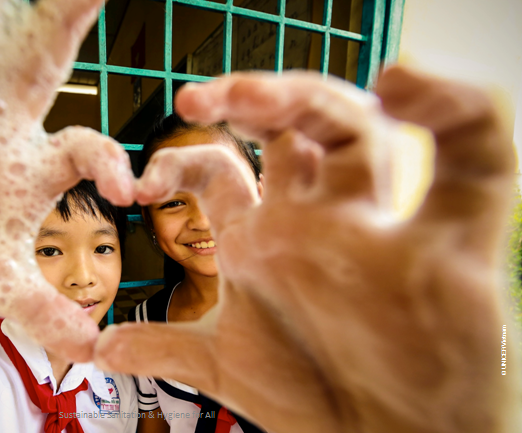
Image credit: © UNICEF/Vietnam
- Log in to post comments