










































Information Needs Assessment: Cox's Bazar - Bangladesh
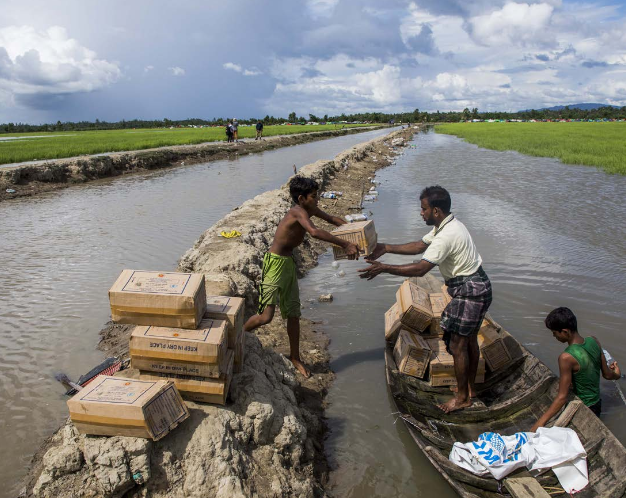
Internews (Iacucci, Copeland, Mahmood, Campbell, Hanley); World Food Programme (Jameel)
"The refugee population is clearly a very tight one, where communication means and habits are strictly community-based, with great emphasis on personal connection and community leaders."
Bangladesh is hosting more than 820,000 Rohingya refugees who have fled Myanmar, and conditions in the resettlement camps are dire, according to Internews. This assessment, conducted in late October 2017 by Internews in the refugee settlement in Cox's Bazar, Bangladesh, 77% of the Rohingya population feel that they do not have enough information to make good decisions, and 62% report that they are unable to communicate with aid providers. World Food Programme (WFP) also contributed to this report with the support of the Emergency Telecommunications' (ETS) Services for Communities Adviser, who collated data from various sources to provide information about the telecommunications landscape. The goal of this report is to help build a more robust and accountable response to the information needs of the affected populations in Cox's Bazar. It is intended as practical resource for assisting the humanitarian response and, ultimately, the affected communities.
According to Internews, there is a virtual "information blackout" in Myanmar's northern Rakhine state, which, along with misinformation and outright propaganda, has raised tensions on all sides, stoking rumours, emboldening extremist elements, and enabling an environment of impunity. The Rohingya community in particular is remarkably vulnerable to this risk. In the settlements, there is no accessible media in the Rohingya language, leaving the Rohingya population of well over a million, now spread between Myanmar and Bangladesh, reliant on information only available in languages other than their own. (Compounding this, there is no agreed written script for the Rohingya language, meaning literacy is often in a second language.) Trust levels in Burmese and Rakhine language outlets are extremely low.
Communications with Communities (CwC) is a field of humanitarian response that helps to meet the information and communications needs of people affected by crisis. CwC is based on the principle that information and two-way communications are critical forms of aid in their own right, without which disaster survivors cannot access services, provide input, or make the best decisions for themselves and their communities. Internews sees CwC as a strategy that must be based on the perspectives of the affected population. This is a community-centred approach where communities are the heart of the information ecosystem and, as such, all information and communication strategies start with "them" and not with "us" (aid providers).
Internews' and ETS's Cox's Bazar Information Ecosystem Assessment included a comprehensive review of government statistical sources, previous assessments, and statistically representative Information Needs surveys of approximately 570 affected populations (refugee and host community) conducted on the ground. In addition, focus group discussions and key informant interviews (KIIs) were held with stakeholders, including local media, authorities, and aid providers. The assessment explored information needs and communications channels, as well as trust networks and issues of language and literacy.
In addition to the data in the first paragraph above, the survey revealed that: 71% of the affected population has had no formal education of any kind; 77% are totally illiterate, in any language; 96% list Rohingya has their primary language for communication, though it has no agreed written script. Other findings:
- Almost 80% of the population does not feel like they have enough information to make good decisions for themselves and their families. Refugees are mainly looking for information on how to get food (18%); how to get water (10%); how to get cooking fuel/firewood (9%); the security situation (9%); and general news (7%). Host communities are mostly looking for information about how to stay safe, to prevent attack/harassment and how to get help if you have been harassed/attacked (31%); news on what is happening in the country (23%); and the security situation (23%).
- While the host population prefers to receive information on their mobile phones (30%), via their families and friends (21%), and through radio (17%) or religious leaders (10%) - the refugee population places family and friends first (23%), followed by religious leaders (17%), radio (14%), and army and police (12%). More than 60% of the population from both communities feel that they are not able to speak with aid providers.
- Access to radio sets is limited, and the signal is weak in many areas. What mass media that is available is in Bangla or Chittigonian. Only 21% of the population is currently listening to the radio.
- Television habits are also very similar between host population and refugee populations. Only 18% of the population watch TV; the rest of the population is unable to either access TV (45%) or does not have access to electricity (29%). People tend to watch TV at home or with friend and family, and 12% of the population say they use their mobile phones to access TV.
- 81% report they never use the internet.
- Mobile phones were one of the main sources to send and receive information prior to arrival in the camps. 54% say they have use a mobile phone, although regular use is overwhelmingly restricted to making and receiving phone calls, and just 19% of those with a phone report that the handset is capable of internet access. Within newly arrived families, smart phones are mainly used by adult men between age 15 to 24; many of them have taken an active role to mingle with others, to access Facebook and YouTube, and to bring information back to the households. Young men find places to gather, such as shops, where they can charge phones and share information with others of the same age.
- Media outlets lack the capacity and the skills to provide high-quality coverage, and local media does not have the necessary knowledge of conflict-sensitive journalism, humanitarian reporting, and the do-no-harm principle. Access and language barriers also present major challenges.
- While many individual agencies in Cox's Bazar are implementing or actively developing various community engagement and accountability (CEA) interventions, and the CwC Working Group (CwC WG) enjoys active participation from most of the major international humanitarian actors, technical capacity in emergency CwC remains low across the response. Overall, there is enthusiasm and crucial recognition of the importance of clear two-way communication channels in effective humanitarian programming, but there has been little targeted investment so far from organisations (and donors) in dedicated staff and specialist, on-the-ground technical CwC expertise.
To expand a bit on the latter point, in a section of the paper devoted to CEA, it is noted that information hubs provide an obvious and essential physical location for the collection of complaints and feedback, and valuable community input is being collected and documented at these locations. As yet, however, there is not an agreed collection and analysis tool across hubs run by different agencies, nor a clear mechanism for sharing or collating feedback between agencies. Training of hub staff - and outreach staff engaged in CwC more generally - is also yet to be widely standardised. "While these [and other] challenges [explored in the paper] are significant, the resources and the will from the humanitarian response are certainly present. With a boost to technical CwC capacity and a focus on coordination at the implementation level, current CwC activities can be readily optimized, and complementary interventions effectively rolled out."
Local media in Cox's Bazar played a key role in getting the word out on the extent of the Rohingya crisis during the early days of the influx in September 2017, and has since then influenced public opinion as well as official policy towards the refugees. One section of the paper shares the findings of the assessment that were compiled through KIIs with staff at local news organisations, media monitoring, and through online research. Profiles of local media organisations are included. Following this is a telecommunication sector analysis.
Overall recommendations, in brief, include:
- Information must be disseminated and collected using a range of different channels, tools, and methodologies.
- Communication must be done in the language best understood by the intended community. Any programme aiming at different communities needs to be done in multiple languages.
- Audio and video are key communication channels to counteract the low literacy rate.
- More needs to be done to deploy CwC technical capacity and to address accountability to affected populations, including maximising existing resources.
- Organisations should work together for the creation of a Collective Service and Community Engagement Mechanism, but only if this mechanism is designed to respond to the needs of affected communities and not just as a data analysis and gathering system for humanitarian organisations.
- Humanitarian responders need to explore and expand on the potential represented by local radio - While radio is not listened to by the majority of the population, this problem seems to be related to lack of access, rather than lack of trust. Considering the low literacy rate, radio represents a very interesting option for mass distribution of information, feedback collection, and engagement.
- Donors and other stakeholders need to work to introduce short- to medium-term mobile connectivity solutions for the Rohingya population - Some sort of convenient connectivity package, for example, could be introduced, to help affected populations better communicate with their own families and communities, and also to better connect with the humanitarian community.
Email from Internews to The Communication Initiative on November 28 2017; "The Rohingya Crisis in Bangladesh: Still Left in the Dark", Internews, November 28 2017. Image credit: WFP / Saikat Mojumder
- Log in to post comments