










































YouthMobile
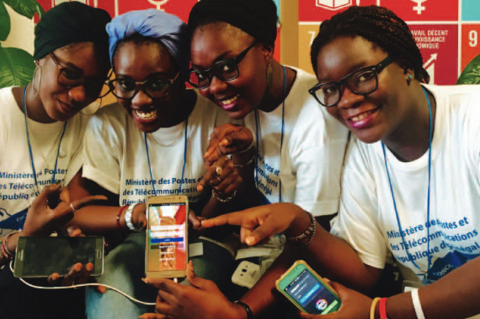
"At a time when the world is looking for new ways to build peace and sustainable development, encouraging innovation and creativity of youth is vital for effectively addressing these challenges."
Recognising that mobile technology has become a medium for youth empowerment and activism, in early 2014, Knowledge Societies Division of the United Nations Educational, Scientific and Cultural Organization (UNESCO) began a project to teach young people to create mobile applications (apps) for sustainable development. By providing young people with basic technical skills and the confidence to develop, promote, and sell locally relevant mobile apps, the initiative aims to create employment opportunities and at the same time spark solutions to challenges in fields such as agriculture, health, and education. These youth-made innovations can contribute to the fulfillment of the Sustainable Development Goals (SDGs), UNESCO hopes. Beneficiaries include: youth and youth organisations, secondary students, and teachers and principals.
The YouthMobile initiative draws on the experience of many worldwide initiatives that introduce young people to computer science programming (learning-to-code) and problem solving (coding-to-learn). It also seeks to build on efforts to reach young women who are vastly underrepresented in this field. The information and communication technology (ICT) project that works by:
- supporting local and international initiatives: training young people, building on the experience and best practices of many worldwide programmes introducing computer science programming and problem solving;
- training teachers and youth organisations: developing the capacities of teachers and telecommunication advocates and raising awareness about the potential of mobile phones in everyday life for all; and
- linking mobile app competitions: organising competitions on sustainable development issues and encouraging trained students to submit their apps for prizes, recognition, and employment opportunities.
Examples of apps made by young participants in YouthMobile: Sama Carnet, Senegal (providing pregnant women with information on what's good for the baby, safeguarding their health records, and connecting them with doctors in case of emergency), Market App, Rwanda (connecting farmers with industries and helping them to extend their products in the national/international marketplace), Traffic App, Cambodia (tracking realtime road conditions), Crop Production App, South Sudan (providing farmers with necessary information on how to grow crops and improve their harvests), Aaro's Adventure, Finland (raising awareness about the condition of the oceans through a game drawing attention to marine pollution), Wecco, Senegal (providing children in primary school with quality learning materials), and Rasail al Salaam, South Sudan (sharing peace messages among different social groups).
There are many case studies of YouthMobile experiences on the YouthMobile page on the UNESCO website; see also a 72-page report on YouthMobile as implemented in Central Asia [PDF]. To examine one YouthMobile experience, from October 24 to 28 2016, 16 students participated in a "Peacebuilding and Literacy through Tech Innovation Bootcamp" in Juba, South Sudan. The goal for participants was to design and develop a mobile app to explain to their fellow youth how ordinary citizens (Mwathinin) could actively engage in the national peace building agenda. This "PeaceApp" would describe the terminologies related to conflict, as well as its impact on daily life interactions. It would offer practical steps to peace and reconciliation and allow the users to share relevant messages and make personal commitments to the peacebuilding process. With guidance from Web4All, an ICT company based in Kenya, the students went through a hands-on training on the development process of the app. This included lessons on User Experience design (UX), an Introduction to Object Oriented Programming with Java, and the basics of Android Studio. The training included several case studies to learn from and exercises. In one of them, students were taught the importance of user experience and how to develop an app of high usability, matching diverse user profiles. As a practical example, the participants were asked to develop a prototype for a phone to be used by visually impaired individuals, a challenging task where the developers need to focus on what the user needs by, for instance, adding a voice feature that will read through the contact list, a keypad with keys that can be felt when pressing, or a screen that voices the icon the user is touching. In addition to technical aspects, the students were given lectures on the growth of mobile technology in Africa, as well as an introduction to revenue-generation modules for mobile apps. At the end of the Bootcamp, the PeaceApp was released for testing and published on Google Play Store for download and use. In order to give some visibility to the app and ease the download, the app has been made available through dedicated website. This Bootcamp was the follow up to a series of previous UNESCO YouthMobile workshops which have involved some 43 young South Sudanese students since 2014 on mobile apps development.
In organising this Bootcamp, UNESCO paid special attention to encouraging and empowering girls in STEM (Science, Technology, Engineering, and Mathematics) fields where women are, in general, underrepresented. UNESCO believes that smartphone ownership and locally relevant applications can be a key to women's empowerment. Enabling them to actually create apps can give them an even bigger push by enriching their skillset, creating job opportunities, and offering them a platform in emerging digital economies. Martha is a young female entrepreneur from Kenya who founded the Dev School, which provides low-cost classes to students from the Kenyan slum areas on the development of mobile apps. With the support of the YouthMobile initiative, she could improve training materials and attract financial partners. Using Martha's success story as an example to motivate and empower young girls in ICT, UNESCO and its partners set up a programme to find and train 1,000 "Marthas" to enhance their mobile ICT entrepreneurship, management, public speaking, and leadership skills. The goal is to help them successfully develop, promote, and sell effective mobile apps that will help to reach the SDGs.
YouthMobile is collaborating with 2 global mobile app competition programmes. The Technovation Challenge is an annual initiative where more than 6,000 young girls from 30+ countries undertake a 3-month training course in apps programming, design, marketing, and entrepreneurship culminating in a challenge in Silicon Valley (California, United States). UNESCO is also supporting Telefonica's Mobile4Change mobile app competition with Patronage, serving as judges for the education-related apps.
Technology, Youth, Girls, Economic Development
UNESCO observes that the number of mobile internet connections is rapidly increasing in developing countries, and smartphones are often the only computer to which young people in these countries have access. This connectivity can allow them to create solutions to personal challenges and problems faced by the local community. In developing countries, up to 43% fewer women have access to the internet than men (source: Dalberg, 2012).
Two years after its launch, YouthMoblie had organised activities in more than 25 countries.
"It was my privilege to attend the past trainings which were full of new things and experience in the field of technology," said Dennis Vuciri, one of the October 2016 Juba participants who had attended previous trainings. "I had been hearing about mobile applications and I saw them installed on different mobile phones and tablets, but I never had the chance to be involved in development of an app. I never even imagined how it was done. But today, I am happy to say that the first and second [YouthMobile] trainings which were held in 2014/15 gave me the knowledge and experience to develop the Android Apps of my choice. This will help me solve some of the problems in my country."
YouthMobile page on the UNESCO website, UNESCO website, YouthMobile brochure [PDF], and YouthMobile website - all accessed on November 18 2016. Image credit: © UNESCO
- Log in to post comments