










































Against the Wall: Women, Politics, and Graffiti in Egypt
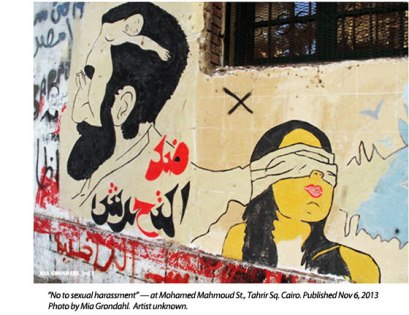
Author: Stephanie Perrin, July 3 2015 - History often forgets revolutionary women, but those involved in the protests in Egypt since January 25, 2011 refuse to be overlooked and continue to build on the nation’s long history of women’s activism. Despite their enormous contributions to what has been contentiously called a "revolution," scholars and activists have found that in post-Mubarak Egypt, women’s rights have seen a decline (Olimat, 2014; Women’s Status Report 2014). The rise of sexual harassment is particularly troubling, with 99% of Egyptian women reporting an experience with some form of sexual harassment in their lives, while new and brutal forms of violence are being used to deter female activists including strip searches, gang rapes, and virginity tests (Al Jazeera, 2015; FIDH 2015).
Graffiti has exploded on the streets of Egypt since 2011, and some of the women and men who have fought for change continue to use spray cans to mark their place in public memory and to protest ongoing gender inequality. Graffiti is particularly effective in challenging the status quo, as it facilitates public dialogue while revealing individual and community attitudes that are silenced elsewhere (Rodriguez, 2003). Creating street art is exceptionally powerful for female artists, and more dangerous, as it serves as a triple threat to three "masculine" spheres: graffiti, activism, and public space. Women’s roles are explored in murals, paste ups, and stencils of historic female leaders, entertainers, and martyrs, mourning mothers, women’s bodies, and calls for recognition of women’s political agency. These graffiti question gender politics and imagine a better future for Egyptian women.
While protest and street art are certainly operating less perceptibly in 2015 than 2011, graffiti continues to facilitate revolutionary thinking through the invisible networks maintained between artists and the viewers who see their work on daily routes through the city. By taking control of their representation on Egypt’s walls, revolutionary women have inserted themselves into street-level conversations, making the inequality and harassment they experience unforgettable for all Egyptians.
Click here to access this blog by Stephanie Perrin, Simon Fraser University ASC! Project Research Assistant, in the Art for Social Change newsletter. Stephanie's email: sjperrin@sfu.ca
Image credit: Photo Mia Grondahl, artist unknown
- Log in to post comments