










































What Is Health Communication and How Does It Affect the HIV/AIDS Continuum of Care? A Brief Primer and Case Study from New York City
Center for Communication Programs, Department of Health, Behavior & Society, Johns Hopkins Bloomberg School of Public Health (Storey), Office of HIV/AIDS, United States Agency for International Development (Seifert-Ahanda), Department of Health and Mental Hygiene, Bureau of HIV/AIDS Prevention and Control (Andaluz, Tsoi, Matsuki, Cutler)
From the Abstract: "This article responds to key questions related to health communication that are commonly asked in the HIV/AIDS arena: 'What is health communication?'; 'What is its role beyond HIV prevention?'; and 'How can it be used to achieve better HIV/AIDS outcomes?'"
Written to establish "common ground about health communication," this article describes communication science and "the HIV/AIDS continuum of care to identify roles that communication can play." The article is from the JAIDS: Journal of Acquired Immune Deficiency Syndromes supplement addressing clinicians and public health scientists in the field of HIV prevention and treatment who might value information on health communication. (Footnotes removed by the editor.)
With the intention of bridging disciplinary boundaries between health and communication scholars, the authors discuss communication as a discipline, a mechanism, a means, and a process, and, in regard to health, as "a critical aspect of how health professionals provide care and patients seek and use it, and the process by which a person is persuaded to do something healthy or unhealthy....Communication science, seeks to understand these diverse processes and effects, including how different channels and types of information can be mobilized instrumentally and strategically in domains such as public health."
The authors emphasise the breadth of communication as a social process, not simply the messages or materials that communication produces, for example: "Ideation research shows that behavior (eg, going for an HIV test) is influenced by multiple factors, often simultaneously, including knowledge and attitudes about the behavior (eg, whether or not testing is beneficial), one's self-image (eg, as healthy or responsible), perceived risks (eg, of HIV infection), self-efficacy or confidence (eg, to protect oneself from HIV), emotional reactions to the health issue or situation (eg, fear of AIDS or of transmitting it to an unborn child), perceived social norms (eg, how common testing is), and the social influence of other people around you (eg, whether or not friends or partners approve of getting tested). In the context of particular HIV/AIDS interventions, theory-based research about which of these factors are most strongly associated with desired behavioral outcomes informs the communication strategy, the design of messages, and the choice of communication channels."
Regarding the functions of communication, scientists study a variety of "formal and informal communication functions, updating them as new technologies and modes of communication emerge, such as e-health, m-health, and social media." This article focuses on the information, persuasion, social connection, and social structural/cultural functions. HIV communication directed towards patients means communicating with "sexually active men and women, vulnerable women and girls, sex workers, men who have sex with men, and other high-risk groups to reduce risky behavior, encourage the uptake of gateway services, such as HIV testing, promoting uptake of services, such as voluntary male medical circumcision (VMMC), and encouraging treatment adherence." Questions remain about those outside this group, including families, schoolteachers and officials, work groups in the office, communities, community leaders, or policy makers and how "to create and sustain a positive, supportive environment within which positive HIV-related behaviors can occur, and promote behavior change itself." Channels of communication - both one-way and interactive - are examined, including emerging digital technologies.
In answer to what communication can do for HIV/AIDS, examples of the possible effects of communication on knowledge, attitudes, social norms, risk perceptions, and behavioural decisions include a televised public service announcement (PSA) that is intended to start an ongoing conversation between sexual partners, client and clinician, neighbours, etc., with the goal of heightening awareness of other HIV messages and linking these as a series of events, "carefully and strategically framed and sequenced, based on rigorous, theoretically informed formative research to have an optimum effect on the intended audience." However, "[w]hat is missing is a systematic and strategic approach to thinking about the roles communication can play in addressing the complex range of issues across the HIV/AIDS continuum of care or treatment cascade." This approach should include prevention efforts so that communication plays a role in various ways across all stages.
The authors offer this continuum "as an organizing framework, ...linked ...(Table 1 in the document) to the 4 main functions of communication described earlier: Information, Persuasion, Social connection, and Social structure." It shows relevant communication function at the various stages for, for example, information and persuasion, or behaviour change. Stages and examples include:
- Preventing Acquisition, e.g., for behaviours of risk reduction behaviours, and the acceptance and uptake of condom use: "the early stage of a campaign can create demand and influence behavioral intentions through ideational change, encourage interpersonal communication about behavior, and model positive risk reduction, so that subsequent phases of the campaign can cue the already interested to action."
- Getting Tested, e.g. for diagnosis of HIV infection, "[a] systematic review in 2005 found that communication plays a critical role here, as well, by creating demand for testing."
- Linking to Care, e.g., for referrals and counselling, "[n]etworks of peers can be activated to provide psychosocial support, encourage healthy living, and advocate for preventing transmission of the virus to others.
- Staying in Care, e.g., for adherence to treatment, "counseling communication improves the uptake of care, and several meta-analyses confirm that effective communication during medical care leads to better adherence to treatment in general and in the context of HIV/AIDS specifically."
- Maintaining a Low Viral Load, e.g., for maintaining confidence in the treatment and its benefits, "effective provider communication is critical."
The authors use as a case study the example of HIV/AIDS communication delivered by the New York City Department of Health and Mental Hygiene during 2005-2013. Some approaches include:
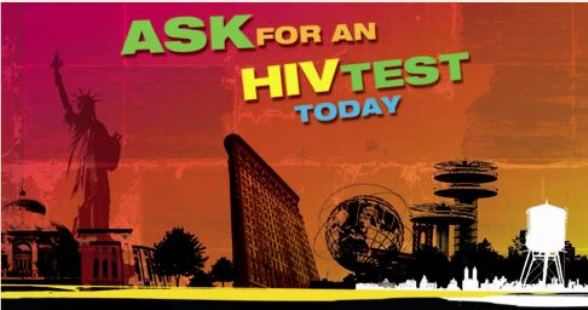
- Promoting HIV testing included a tactic known as "station domination" using subway station surfaces and other transport vehicles that went beyond subway routes for messaging promoting testing, as well as distributing palm sized cards for drivers to hand to passengers. Celebrity PSAs were shown in movie theatres, and digital and mobile media were accessed for sending promoted Tweets, paid Facebook timeline posts, and Grindr pop-up ads, which all link back to Tumblr posts to promote community partner events. A health survey suggested that nearly 7 in 10 New York City residents aged ≥18 years reported in 2012 that they had tested for HIV, a figure rising to 8 in 10 in the Bronx, the focus of "enhanced, boroughwide social marketing and community mobilization."
- Care and viral load messaging was done through short message service (SMS) reminder in a programme called "HIV Care" - "the campaign itself was introduced on social media promoted Tweets; paid Facebook timeline posts; Tumblr posts; e-mail blasts through MANHUNT Cares (a social networking site for gay and bisexual men); and traditional media (press release, posters, palm cards)." Tweets and Facebook "metrics being tracked for this campaign include overall site traffic generated to the dedicated campaign web page, unique visitors, traffic sources, bounce rates, and total number of subscribers for each SMS function."
The authors recommend more research on the effectiveness of integrated multimedia communication programmes on HIV outcomes and on the following questions: "How does communication at one stage of the continuum (eg, about testing) affect subsequent communication (eg, between partners about prevention) and/or outcomes at later stages of the continuum? What are the most effective combinations of communication channels for specific outcomes (eg, does social media networking enhance the effects of mass media prevention or treatment messaging)?" And "...since suppressing viral load is a lifelong process among positives, how can we best measure the longitudinal effects of communication occurring through multiple channels over a period of years on maintenance, not just adoption, of protective behaviors? Also, how can communication help young adults maintain risk-free behavior over time and remain HIV-negative in the face of physiological urges, social pressures, and media content that encourages sexuality?"
The conclusions section adds that portability of digital devices make personalisation of health information more possible: "exchanging visual and oral information and using local languages in a way that begins to resemble older, face-to-face communication channels." The authors describe the interdisciplinary nature of high-quality communication interventions and high-quality biomedical interventions "deployed in a complementary fashion to improve and sustain outcomes."
JAIDS Journal of Acquired Immune Deficiency Syndromes, August 15 2014 - Volume 66 - Issue - p. S237-S240, accessed July 22 2014.
- Log in to post comments