










































Investment Visualizer
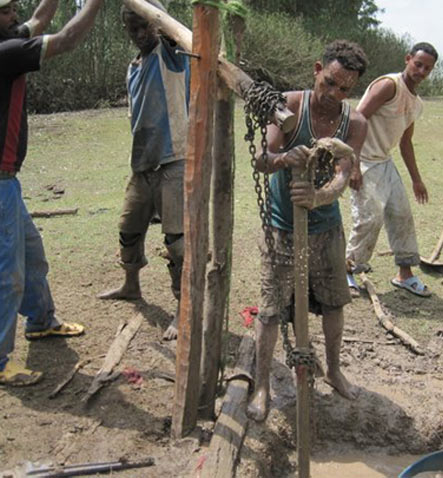
The Investment Visualizer is an interactive, web-based water management investment tool that is designed to allow policymakers to assess the potential impacts of different small-scale irrigation options on the number of people reached, yield improvements, and income earned by smallholder farmers. The potential for different irrigation options is assessed for different scenarios based on the severity of climate change, the price of crops, and the cost of implementing the chosen approach. The online mapping tool aims to help policymakers make effective investments in low-cost smallholder water management methods in order to allow smallholder farmers in Sub-Saharan Africa and South Asia, where rain is rare or unpredictable, to meet the food needs of a growing population in poor, rural areas.
The analysis underlying the scenarios is based on an integrated modeling system that combines geographic (GIS) data analysis, biophysical and economic predictive modeling, and crop mix optimisation tools. The GIS analysis uses a set of suitability criteria to identify areas where the technology could potentially be applied across the region based on environmental suitability and labour availability. The results are then further refined through the application of 2 biophysical and economic predictive modeling tools: the Soil and Water Assessment Tool (SWAT) and the model of Dynamic Research Evaluation for Management (DREAM) for a combined agronomic-economic-hydrologic cost-benefit analysis for each crop and technology assessed.
This resource comes from the Agricultural Water Management Solutions Project (AWM Solutions), a collaborative project by the International Food Policy Research Institute (IFPRI) and several international partners, led by the International Water Management Institute.
Emails from Marcia MacNeil on August 29 2012 and September 10 2012 and from Meredith Giordano on September 10 2012 to The Communication Initiative; and Investment Visualizer website, September 5 2012.
- Log in to post comments