










































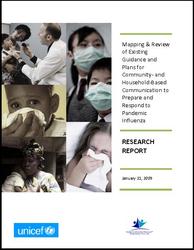
Mapping & Review of Existing Guidance and Plans for Community- and Household-Based Communication to Prepare and Respond to Pandemic Influenza
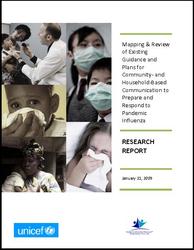
Report completed: January 2009
This 85-page study was initiated and contracted by the United Nations Children's Fund (UNICEF)'s Communication for Development (C4D) Unit to strengthen communication planning around pandemic flu and provide guidance to field staff. The study looked at relevant experiences, pandemic flu communication plans, theoretical models, and existing technical guidance. The aim was to extrapolate lessons learned, key success factors, key issues, and potential elements that will inform and shape the future development of technical guidelines and standards for planning short- and long-term behaviour- and social-change-based communication interventions for pandemic influenza that are designed for the community and household level.
Overall, the findings analysed and discussed in this report support the need for technical guidance and tools on pandemic flu communications at the community and household level. They also confirm the existing divide in terms of levels of pandemic flu communications preparedness between developing and industrialised countries. As expected, several factors - including lack of adequate resources, conflicting public health priorities, and other key obstacles featured in this report - contribute to this divide. (Table 1, beginning on page 10 of the report, includes a list of potential obstacles identified by study's respondents and/or existing literature).
Because of the complexity of the issues and obstacles, as well as "the critical and well-established role communication can play in handling health emergencies, the need for adequate guidelines and toolboxes is supported by this study's findings." Overall, while these guidelines may more specifically address communication planning at the community and household levels, they would also need to include guidance on interventions intended for secondary audiences who have an influence on communities and households (e.g., healthcare professionals, communication and social mobilisation partners, local and international non-governmental organisations (NGOs), local public health departments and governments, etc.). A list of sample obstacles (e.g., as outlined in Table 1) should be included together with case studies and checklists that may aid field officers to develop strategies to address them. Key milestones and research steps (e.g., validation of expected behavioural results within country contexts; community consultation; risk mapping, etc.) that would need to be achieved prior to planning and implementing interventions at the community and household level should also be considered for inclusion. Moreover, while study respondents felt that communication preparedness at the community level makes sense, this would need to be preceded by interventions that seek to strengthen the capacity of non-governmental communication systems and social mobilisation partners.
The study also identified several needs, priorities, and next steps:
- Clarity on behavioural results of pandemic flu communications interventions may be needed to facilitate planning and implementation at country level. For instance, existing pre-pandemic communication efforts and plans tend to focus primarily on 4 key interventions that aim to establish long-term practices and behaviours: hand and personal hygiene; respiratory etiquette; staying home if sick; and proper and safe care of loved ones who may be sick.
- The role of local and international agencies in the global coordination of communication efforts should be further clarified in order to increase synergies and maximise use of existing resources. One suggestion offered here: Organize an interagency meeting that would include UNICEF, the World Health Organization (WHO), the Centers for Disease Control and Prevention (CDC), other UN agencies, and international partners.
- Capacity building both at the government and community levels should focus not only on outbreak communications principles but also on disease-specific guidance. Detailed recommendations for 3 different key capacity-building audiences are included: local governments and other authorities, communication and social mobilisation partners, and healthcare professionals and businesses.
- Further emphasis should be placed on pre-pandemic communications to address existing behaviours, traditional practices, social norms, and other obstacles that may hinder the effectiveness of outbreak communications during an actual pandemic.
Specific findings and recommendations to be considered in the pre-pandemic phase included the importance of risk assessment and mapping, community consultation, and efforts to increase awareness and preparedness on pandemic flu at the community level and among other key audiences who influence community's actions. For example, most study participants also supported the need to prepare communities, households, and the general public in the pre-pandemic phase on pandemic flu symptoms, key mitigation measures, as well as credible resources. Some common threads that emerged from the findings include:
- Carefully crafting communication strategies and messages to prevent the unnecessary spread of panic among community members and the general public, and/or false rumours about the imminence of a pandemic, which may jeopardise local economic resources (e.g., tourism);
- Early engagement and training of local mass media (e.g., community radio, local reporters, etc.) - a major channel in crisis communications - to increase preparedness on potential coverage of pandemic flu and minimise the risk that local media (a) may contribute to misperceptions and confusion in the pandemic phase and/or (b) mistrust information they would receive from local governments or community spokespeople;
- Emphasis on communication and community engagement/mobilisation activities intended for special populations who may influence community and household leaders and decision-makers (children, health workers, healthcare professionals, social workers, family caregivers, teachers, women's groups, religious leaders, etc.);
- Adequate funds and resources that would allow implementation of pandemic awareness efforts at the community and household levels; and
- Use of suitable and region-specific communication angles to introduce preliminary messages on pandemic flu preparedness in pre-pandemic phase.
The following example of more detailed guidance provided in the section of the paper "Community and Household Outreach and Consultation" illustrates the study's identification of community participation and ownership in a pandemic communication strategy: "a community and household consultation model that is participatory - but yet focused on specific individual and social behavior outcomes - may help community members to reflect on past health emergencies and disease outbreaks as well as identify key factors and communication chains that may contribute to increasing community trust and perceived transparency of future communication activities while gaining knowledge on pandemic flu....as for other activities identified or recommended so far in this report - a fundamental step in implementing this community consultation model is to empower and train community leaders, relevant groups, and communication and social mobilization partners on interpersonal communications skills, dialogue and group facilitation, and information management as well as overall communication planning and implementation strategies."
Finally, the study revealed some confusion about the terminology used for recommended measures for pandemic flu mitigation (and/or control of other infectious diseases), which should be clarified to enhance communication's effectiveness.
Avian and Pandemic Influenza Communication Resources website, accessed February 2 2010.
Citation: Schiavo, R. Mapping & Review of Existing Guidance and Plans for Community-and Household-Based Communication to Prepare and Respond to Pandemic Flu. Research Report. A report to UNICEF. UNICEF: New York, NY, January 2009. From the UNICEF website, accessed November 2009.
- Log in to post comments