Yayasan Tambuhak Sinta (YTS)
YTS is built around the conviction that the following principles are key for engaging successfully and sustainably in the development process:
- Understand the local context clearly: both government and community.
- Involve local people as partners: both government and community.
- Invest in building local capacity, based on local needs and aspirations: both government and community.
- Work with local institutions and existing mechanisms to strengthen the links between community and government.
YTS draws on participatory research and interpersonal communication as part of its quest to collaborate with local communities and governments to strengthen their capacity to jointly manage the process of development. For instance, YTS' work to provide social and decision making support to 18 villages surrounding Kalimantan Gold Corporation Limited (KGC)'s copper gold project in Central Kalimantan (expected to eventually involve all 31 villages in the area) involves helping villagers discuss and make decisions on a whole range of issues affecting their daily life - everything from local education to job opportunities and the use of leisure time. The directors of KGC are entirely committed to the community programme, not only to ensure that local communities share in the benefits of any future mining activity, but also as part of the company's long-term social license to operate.
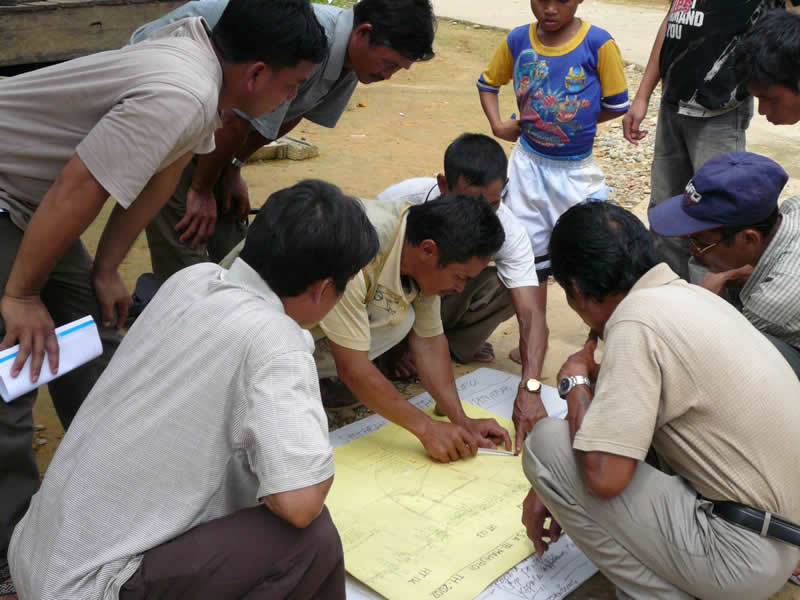
To foster this process, YTS staff facilitates community-based needs analysis, using the Participatory Rural Appraisal (PRA) approach and methodology. The commitment to this strategy reflects a desire to provide a deeper level of understanding of the dynamics in each community, and to create appropriate and realistic programmes. Specifically, each village develops an annual Community Development Plan that feeds into the government planning cycle. Government planners and service departments use this information to design and fine-tune their support programmes and community services. Villages are then able to access support that is directly relevant to their needs. YTS helps the village find the means to implement the plan, including promoting components to government and donor agencies. This approach is designed to empower villagers to improve their situation from within and to find the ways and means to take action on the activities they identify in their plan.
To cite one concrete example, Borneo Prima, a small Surabaya-based coal company, contracted YTS to help them with community development work in several villages. So, in mid-July 2007, YTS sent a 5-person team to initiate participatory planning in 3 locations in the villages of Tumbang Olong 1&2. The team spent 2 days training 18 village men and women as facilitators, and 4 days implementing the planning process in the 3 locations. Villagers set priorities by collective agreement, then took part in a meeting and presentation arranged in the sub-district office. Representatives from district government were amongst the 100 people who took part in a meeting to discuss the results of the planning process. "It was a very robust affair with plenty of good humour, and positive interactions between the villagers and the district officials."
Along these lines, YTS is facilitating community involvement in the government's bottom-up planning mechanism, called 'Musrenbang'. This activity reinforces the community-based participatory planning process that YTS facilitates, by drawing the result - the 'village development plan' - directly into the government arena, where the administration is obliged to respond to the collective needs and demands of villagers. To cite an example of this approach in practice, the Forum for Participatory Village Development (FPPD), in cooperation with the government of South Kalimantan, held a workshop on "Acceleration of Pro-Village Policy towards Poverty Alleviation" in June 2008 in Banjarmasin. Village heads, local government officials, NGOs, and private sector representatives attended the workshop, which reviewed the concept and practice of village autonomy in poverty alleviation. Most participants agreed that communities are not being given full responsibility to manage the Village Allocation Fund mechanism for their own development. This workshop provided an opportunity for YTS to exchange experiences with other NGOs dealing with the same issues. Based on the perceived success of this methodology, YTS is promoting an integrated platform for development and is lobbying both government and development agencies to work together with the private sector and non-governmental organisations (NGOs) to create a common development framework.
As a second measure, YTS provides immediate technical support for key livelihood activities that are prioritised in the village plan. These include upland rice cultivation and rubber production, and chicken, pig and fish rearing. Technical experts for these activities are contracted by each village directly, with the idea that - by learning to manage the contract mechanism and the community planning process - each community can take charge of its own development, hopefully becoming much more self-reliant and independent in the process. A 5-day media development training programme was held for YTS in an effort to improve the quality of the technical information materials provided to villagers. The Studio Driya Media (SDI) trainers utilised a practical, step-by-step, hands-on approach, drawing on a YTS booklet on rubber cultivation as a demonstration tool. Each section of the booklet was re-worked with the goal of making it easier to understand. A critical part of the process was testing the booklet in the field with the villagers who will be using it as a learning aid. This provided specific feedback on the appropriateness of the text and illustrations. This approach will be applied to all technical information materials that YTS prepares, with the hope that the improved materials will make it easier for villagers to improve their livelihood activities.
In addition to village-based development, YTS has developed a framework for regional development. The idea is to bring together a partnership of interested parties - government, civil society, businesses, and funding agencies - who work together to build an integrated platform for future development in all sectors in Kalimantan Tengah. YTS has also collaborated with two United Nations agencies, the United Nations Conference on Trade and Development (UNCTAD) and the United Nations Industrial Development Organization (UNIDO). Click here to view the website YTS created to capture the lessons learned from a project on artisanal and small-scale Mining (ASM) that emerged from a partnership with UNIDO. In addition, YTS has joined forces with several NGOs, and is an active member of the Susila Dharma International (SDI) network, which is an affiliation of NGOs located on every continent. SDI has Special Consultative Status with the Economic and Social Council (ECOSOC) of the United Nations and the United Nations Children's Fund (UNICEF).
August 2010 update: YTS has in the past few years expanded its activities into new locations as part of an initiative to share and spread its approach and methodology to other jurisdictions in Kalimantan and other parts of Indonesia. For instance, YTS is working for an Australian exploration company, Robust Resources, in one of the Molukus islands in eastern Indonesia. In addition, YTS is in its second year of activities in an entire subdistrict close to Palangka Raya, the provincial capital of Central Kalimantan. It is also into a second term with the Blacksmith Institute, providing awareness-raising and technical support for preventing the release of toxic mercury into the environment.
Natural Resource Management, Democracy and Governance, Economic Development.
YTS also supports local development through the Kalimantan Kids Club, which provides financial support to Dayak villagers so that they can educate their children. To date, more than 50 young people have received scholarships to continue their education to higher levels.
Email from Yayasan Tambuhak Sinta to The Communication Initiative on December 4 2007, including Kabar Itah, the quarterly newsletter of YTS, Edition 15: July-September 2007; Kalimantan Surya Kencana website; and emails from Bardolf Paul to The Communication Initiative on November 7 2008 and August 3 2010.