










































CLEAN-India
- Systematically assess and document the environmental quality of all major towns and cities in India;
- Generate awareness among citizens, decision-makers, and other stakeholders in society on the causes of environmental problems, and to propose possible ameliorative actions;
- Establish a vibrant network of schools, welfare associations, NGOs, the media, the corporate sector, scientific institutions, district administrations, and local government for advocacy and policy change; and
- Mobilise communities to undertake environmental improvement actions at the local level.
The CLEAN-India programme aims to mobilise community responsibility for environment assessment and improvement by drawing on the enthusiasm, conviction and dedication of young people. These students make their voices heard, communicate their concerns, and translate their vision into action for a cleaner environment through projects that engage individuals, households, and communities.
CLEAN-India draws largely on interpersonal communication and information to spark interest and action amongst students, providing them with productive and fun opportunities to understand and improve the environment. The programme envisages learning through community service and scientific investigation, to the end of fostering life-long habits of active citizenship and environmental stewardship. Specific activities include:
- Systematic environmental quality assessment - Students of member schools are trained on scientific skills for monitoring the quality of the environment, which is carried out using DA-designed field-based kits called Jal-TARA (for testing water quality) and Pawan-TARA (for testing air quality). These tools enable students to put into practice in real-life conditions the theoretical aspects of chemistry that are learnt in the classroom. Similarly, systematic plans for monitoring other environmental attributes are being developed.
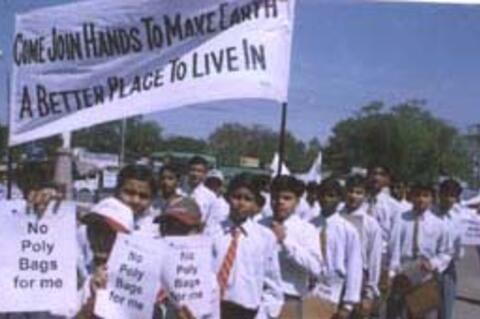
- Generation of awareness - Following the assessment process, if students detect a problem, they actively campaign to further spread awareness in their own school, neighbouring communities, and nearby schools. (CLEAN provides them with equipment, technical expertise, manuals, and other kinds of support). Whether the medium is creative street plays, public hearings, rallies, door-to-door signature campaigns, exhibitions, or competitions, students develop ways to communicate the data they have gathered - to both fellow community members as well as to local authorities/Pollution Control Boards. The goal of these youth-generated campaigns, which are designed to be of local relevance, is to educate local communities and stimulate a change in their attitudes about irresponsible activities such as using polybags, making "immersing idols" with non-environmentally-friendly materials, bursting crackers during festivals like Diwali, and using toxic colours during the Holi festival.
- Advocacy - Emphasis is placed on involving students and NGOs in efforts to convince civic agencies to take action against the degradation of their cities' environment. This process involves encouraging local authorities to bring about changes in policy, and to file Public Interest Litigations (PIL). It is hoped that best management practices designed to improve environmental quality will emerge, and be put into place.
- Community-initiated action for environmental improvement - Depending on the local problems, students and community members initiate various programmes such as solid waste management including vermicomposting, tree plantation, creation of herb corners, energy conservation, paper recycling, stream cleaning, simple water treatment methods, and rain water harvesting.
To cite one example of this process "in action", in early 2007 a class of 45 students in a suburban school in Pune, India, began scouring Pune's busiest highways, bodies of water, public taps, and civic water pipelines. Armed with monitoring kits, they tested 14 parameters for water quality and marked off levels of physical, biological, and chemical components. Similar air-testing kits were used to monitor suspended particulate matter, sulfur dioxide, and nitrogen oxides. The results from both monitoring exercises were sent to DA's TARA laboratory on the outskirts of New Delhi. Using the data gleaned from this evaluation, the students interact with decision makers to act as catalysts for change. According to organisers, "[t]hey will not rest until their voices are heard and remedial action is taken." In addition, these same students undertook a project in which they asked their parents to engage with them in collecting garbage for one week, segregating it meticulously, and then bringing it to school. As a result, the school now has a miniature worm composting (vermiculture) pit, a lush row of plants fed on what it churns out, parents whose kitchen waste is regularly put to good use, and a group of students who "stride about officiously after class hours to check if anybody has left behind any litter."
Networking is also a key strategy. In participating towns, NGOs have formed networks from schools to communities, townships, districts, states, and regions, fostering cooperation and community action. The CLEAN-India website, with its forum, resources, findings, action ideas, and details about CLEAN projects, is one tool for fostering this collaboration. The website is also geared toward participating youth, and includes such features as an "enviro quiz" and details about contests in which they may take part.
Environment, Youth.
Funding has been provided by the European Commission, with technical support from the Central Pollution Control Board (CPCB).
Development Gateway Foundation dgCommunities: Youth for Development, October 11 2007; and CLEAN-India website.