










































Intervention and Interaction Model Protocol for Security Forces Regarding Journalists, Communicators and the Media
Image
SummaryText
"The press and the security forces need each other."
This model protocol, developed by the United Nations Educational, Scientific and Cultural Organization (UNESCO) in collaboration with the Inter-American Institute of Human Rights (IIHR), is designed to address challenges posed by the intersections between journalistic work and public safety. Specifically, it has been published to serve as a reference in the development or updating of intervention and interaction protocols for security forces regarding the media, in accordance with international standards on freedom of expression, access to information, and safety of journalists. It can also be used by the media and civil society organisations to promote good practices between the police and the press and to contribute to improving the safety of journalists, with an emphasis on differential risk assessment and specific protective measures for women journalists. Finally, the protocol can serve as a pedaegogical tool for police academies, as well as for journalism or communication schools.
As explained in the document, "It cannot be ignored that both a free press and security forces that respect human rights are essential elements for the rule of law and democracy. Indeed, one of the main characteristics of a democracy is to have both media and security forces that respect and protect the exercise of fundamental rights. The press and the security forces need each other. Freedom of the press is a fundamental right that must be guaranteed by the State, including the security forces." It is therefore necessary to work further on the improvement of action protocols for the security forces regarding their interaction with the press.
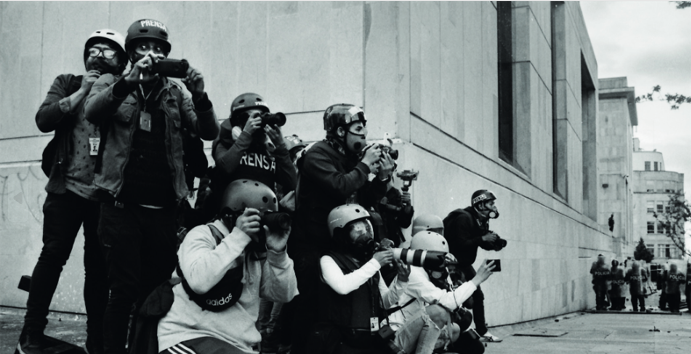
In particular, the protocol covers three of the areas of interaction that generally exhibit higher stress levels:
The guidance outlined in the protocol is the result of a regional consultation process carried out in the second half of 2022 with representatives of the media, journalists' associations, civil society organisations, and law enforcement institutions in Ibero-America. Representatives of regional and international organisations also participated in this process.
This model protocol, developed by the United Nations Educational, Scientific and Cultural Organization (UNESCO) in collaboration with the Inter-American Institute of Human Rights (IIHR), is designed to address challenges posed by the intersections between journalistic work and public safety. Specifically, it has been published to serve as a reference in the development or updating of intervention and interaction protocols for security forces regarding the media, in accordance with international standards on freedom of expression, access to information, and safety of journalists. It can also be used by the media and civil society organisations to promote good practices between the police and the press and to contribute to improving the safety of journalists, with an emphasis on differential risk assessment and specific protective measures for women journalists. Finally, the protocol can serve as a pedaegogical tool for police academies, as well as for journalism or communication schools.
As explained in the document, "It cannot be ignored that both a free press and security forces that respect human rights are essential elements for the rule of law and democracy. Indeed, one of the main characteristics of a democracy is to have both media and security forces that respect and protect the exercise of fundamental rights. The press and the security forces need each other. Freedom of the press is a fundamental right that must be guaranteed by the State, including the security forces." It is therefore necessary to work further on the improvement of action protocols for the security forces regarding their interaction with the press.
In particular, the protocol covers three of the areas of interaction that generally exhibit higher stress levels:
- the interaction of security forces with journalists in social protest contexts;
- investigations of crimes by security forces and access to information by the press; and
- the threats and other attacks on the press, as well as the responses by security forces to prevent and investigate these actions with a gender perspective.
- to contribute to improving the interactions of law enforcement forces with journalists, communicators, and representatives of the media, promoting rapprochement processes and activities between both professional sectors, based on their mutual recognition of the importance of their duties for democracy and human rights;
- to foster relationships based on mutual respect, tolerance, empathy, and collaboration between journalists and members of the security forces, highlighting the common features of both professions; and
- to emphasise that potential conflicts that may arise from the professional practice of both sectors can be solved without undermining the fulfilment of their respective missions, through dialogue, continuous communication, common learning, and joint planning.
- The relationship of security forces with journalists in contexts of social protest;
- Crime investigations by security forces and access to information by the press;
- Threats and other attacks on the press and security forces' responses to prevent and investigate them from a gender perspective;
- Training - including police training on freedom of expression and the training of journalists regarding police duty; and
- Good practices - including good practices of security forces in their interactions with journalists during protests and when investigating attacks and crimes against journalists.
The guidance outlined in the protocol is the result of a regional consultation process carried out in the second half of 2022 with representatives of the media, journalists' associations, civil society organisations, and law enforcement institutions in Ibero-America. Representatives of regional and international organisations also participated in this process.
Publication Date
Languages
English and Spanish
Number of Pages
30
Source
UNESCO website on May 8 2023. Image credit: Andrés Torres Galeano - Demonstrations
PDFLink
- Log in to post comments