










































USAID Tulonge Afya
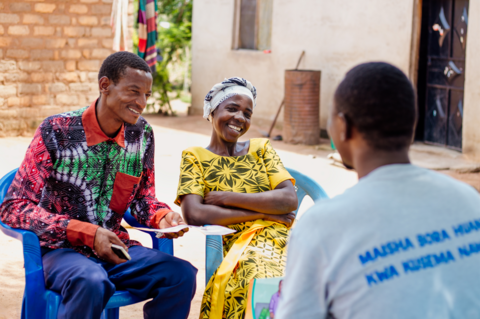
"...It used to be a challenge before because people thought it was a waste of time to come and listen to you.... So, we were helped by village and hamlet leaders, village and ward executive officers and they know about the TA [USAID Tulonge Afya] project." - civil society organisation, Newala District
From 2017-2022, FHI 360 worked together with the United States Agency for International Development (USAID), the Government of Tanzania (GOT), local partners, and communities to deliver participatory, integrated social and behaviour change (SBC) and capacity and institutional strengthening activities under the USAID Tulonge Afya ("Let's Talk about Health") project. The project worked to improve health status, especially of women and youth, by addressing sociocultural norms and promoting the adoption of healthier behaviours in households and communities, with a focus on: family planning and reproductive health (FP/RH); malaria; HIV and AIDS; maternal, newborn, and child health (MNCH); tuberculosis (TB); and emerging infectious diseases. Gender and youth equality were incorporated into all project activities.
- Address norms and inequities that drive poor health;
- Advance health while promoting rights;
- Use data to better support regional needs;
- Harmonise messages across various channels;
- Strengthen institutional capacity to manage and deliver high-quality SBC; and
- Facilitate coordination to maximise SBC impact and efficiency.
- Nationally, through national mass media and overarching technical assistance and support provided to the GOT, United States Government (USG), and local implementing partners.
- Regionally, through tailored media and other support (e.g., community theatre and other mid-media) in 19 regions where USG implementing partners are also supporting improved services.
- Within 29 districts, through national and regional support, as well as intensified community-based activities including small-group dialogue, household visits, provider behaviour change (PBC), and other interpersonal communication (IPC) and community engagement activities.
- A behaviour prioritisation workshop with national-level stakeholders to select behaviours to be addressed under each platform and campaign;
- A participatory strategy development workshop with national-level stakeholders;
- Sharing of the strategy with stakeholders for review and input;
- Finalisation of the strategy reflecting stakeholder input; and
- Ongoing annual refinement of the strategy based on project data and learning, and shifts in donor, Ministry of Health, and implementers' needs and priorities.
Key interventions included:
- NAWEZA ("I can"): an integrated SBC platform to reach and engage adults during pregnancy and caregiving of a child under 5. NAWEZA employed a life-stage approach as a framework for integrated SBC. As individuals have different health needs and priorities based on their life stage, the life-stage approach allowed the project to interact and engage with audiences more holistically, with a focus on issues most relevant to them at key points in time. Activities and supporting media/materials included:
- A long-running radio anchor show that showcased real-life stories related to behaviour and norm change priorities, with a focus on how audiences have addressed and overcome key barriers of these behaviours.
- Radio spots aired nationally and regionally for select behaviours, as well as to promote male engagement.
- Community radio that localised content, engaged communities in dialog, and recognised community members' success in achieving healthy behaviours. Stations were supported through a community radio guide, community radio training, and supplementary topic guides.
- Social media using Facebook, Instagram, and Twitter.
- Billboards in strategic locations to emphasise key calls to action.
- Community theatre and other mid-media that engaged audiences in reflection and dialog around the key behaviour and norm change priorities, barriers, and facilitators and that generated community-driven solutions to their uptake. This activity was supported by development of a community theatre guide and community theatre scripts.
- Timed household counseling visits implemented by USAID-Tulonge Afya-supported community health workers (CHWs) to reach pregnant women and new mothers at key time points in their pregnancy and postpartum journey. Visits incorporated discussion and counseling related to all health areas, as well as linkage to health services.
- Household- and facility-level counseling conducted by CHWs and community volunteers using job aids that incorporated all health areas and on targeted behaviours as appropriate. Support was provided to USG-implementing partners through the provision of one-on-one IPC tools.
- Small group dialog that aimed to build skills and confidence, identify solutions to barriers, and create a sense of support among peers. These small group dialogues were supported by interactive toolkits.
- Mother meet-up events for women with young infants, which combined song, dance, games, and entertainment with space and time to discuss the challenges of early motherhood and support one another to overcome those challenges.
- Kijiwe cha kahawa (men's coffee corner) discussion sessions for male partners of pregnant women and fathers of children under 5, which offered opportunities for men to come together in social spaces to discuss the importance of their role in supporting their partner and family's health and wellbeing, with an emphasis on engagement in care-seeking. These sessions allowed men the opportunity to ask questions, share concerns, and support one another to act and shift norms that inhibit their involvement in care-seeking.
- Orientations for providers on use of life stage packages, including service provider orientations and life stage package implementation guides. The focus of the NAWEZA PBC activities was on provision of respectful client-centred care and quality counseling (e.g., non-biased FP counseling). A mix of approaches was used, including modeling and peer-to-peer support approaches to highlight positive deviants, facilitate dialog, and shift norms. Emphasis was placed on strategic activities and materials that can easily be integrated within existing service delivery partner programming. Pledges and commitments sought to generate public accountability for PBC and shift providers' self-perception (e.g., I CAN provide all of my clients with the FP services they desire). Non-financial incentives and rewards (e.g., community recognition through community programmes and media) were used to motivate providers and to recognise and elevate those who adopt the desired behaviours. All PBC activities sought to take a supportive approach that engaged healthcare providers as solutions, rather than barriers, to behaviour change.
- Other print materials: NAWEZA Actions for a Healthy Pregnancy Card; service invitation coupons; early antenatal care (ANC) postcard; appointment/key milestones reminder tool; key milestones facility poster; and brochures.
- FURAHA YANGU: an HIV-focused campaign that aimed to drive uptake of priority behaviours and shift norms that will contribute to achievement of the 95-95-95 HIV testing and treatment targets. The campaign used national mass media, community group dialogue and IPC, peer-led approaches, and faith-based strategies. Phase I of the campaign focused on raising awareness of the GOT's new Test and Treat policy, the availability of antiretroviral therapy (ART) immediately for anyone who tests positive, treatment normalisation, and stigma reduction. Subsequent phases of the campaign included strategic engagement of people living with HIV (PLHIV) and higher-risk groups (men, key and vulnerable populations, caregivers of orphans and vulnerable children) to support personal risk assessments, to promote adoption of HIV testing and treatment initiation (including index testing) and adherence behaviours, and to address HIV/TB co-infection through promotion of TB testing. FURAHA YANGU campaign activities increasingly emphasised community-level SBC approaches, including small group dialog, referrals, and linkages to care, supported by low-level and targeted mass media. These activities were further reinforced through use of provider tools and materials to improve the quality of HIV counseling and adherence support The various channels used were mutually reinforcing, with consistent messages and clear calls to action under the common framework that crosses over HIV and TB.
- SITETEREKI: an integrated youth platform that seeks to transform FP/RH and HIV behaviours and norms through a harmonised, multi-channel approach, linking national level radio, social media, and print materials with community-level mid-media and small group IPC activities led by peer leaders. Activities were created to be entertaining and engaging, while also providing space for youth to discuss concerns and issues that are important to them, centred around their sexual and reproductive health, relationships, and life aspirations.
- Supporting norms related to prevention of household and community violence;
- Reducing stigma and discrimination related to HIV and respectful care more broadly;
- Encouraging norms that support couples' decision-making and dialogue; and
- Overcoming norms around masculinity that inhibit healthcare seeking among men and directly affect women's and children's health and well-being.
- Use of the ADDED (Audience-driven Demand, Design, and Delivery) approach to ensure that audiences co-design and co-deliver interventions (delivery of programme interventions by and through audiences, themselves). ADDED uses a socio-ecological model to address multiple levels of influence on behaviour and applies specific SBC tactics based on where audiences fall on a spectrum of behaviour change to:
- Increase desire or demand for healthy behaviours, products, and services
- Move audiences from intention to action
- Support behavioural maintenance
- Facilitate individual and community advocacy for change
- Focus on gender-transformative programming and equity
- Emphasis on community engagement and empowerment
- Capacity and institutional strengthening with the GOT and civil society partners to lead, as well as design, implement, and evaluate, SBC programming
- Strong integration of participatory and experiential activities using adult learning principles, such as games, into small group sessions
- Deep engagement of community, faith, and government leaders and other community platforms
- For additional information, view a case study and a webinar on the Tulonge Afya project (click on video, below) developed under the USAID Breakthrough RESEARCH project.
- Click here to register for a September 27 2022 webinar (8:00-9:00am EDT - 15:00-16:00 EAT) on Key Achievements and Learning from the USAID Tulonge Afya Integrated Health SBC Project, which will: reflect on the opportunities and challenges that integrated health SBC projects present; consider how SBC implementers can advance sustainable capacity and institutional strengthening; and share best practices for the design, implementation, monitoring, and evaluation of large, complex integrated SBC projects.
FP/RH, Malaria, HIV and AIDS, MNCH, TB, Gender, Youth
USAID undertook this project after a situational analysis of Tanzania that identified the following:
- For individuals, families, and communities, there is a need for practical knowledge, changes in attitudes and norms, and improvements in skills to prevent HIV, malaria, and TB and initiate and adhere to treatment regimens; to increase MNCH and FP/RH behaviours; and to motivate and empower people to demand and seek appropriate services.
- For healthcare providers, there is a need for knowledge around changes in clinical guidelines, as well as improved attitudes towards clients, skills to effectively communicate with and counsel clients free from stigma (and with kindness and empathy), and professional motivation.
- At the community level, there is a need to challenge existing social and gender norms that negatively affect adoption of health practices. For example, focus group discussions with married/cohabiting adults identified key social norms that impact modern contraceptive method (MCM) use for child spacing that include: (i) the expectation that married women should bear many children; (ii) the assumption that household decision-making, including around use of FP and family size, is the role of men and is not something discussed between couples; and (iii) the fact that norms around masculinity are closely tied to family size.
The mid-term evaluation, conducted by Breakthrough RESEARCH, concluded that USAID Tulonge Afya improved the ability of individuals to practice healthy behaviours and noted improvements in attitudes and perceptions of behaviors related to HIV, FHP/RH, and MCH (with an emphasis on pregnancy and antenatal care), as well as descriptive norms. The evaluation cites the project's use of audience insights to inform: emotional drivers among intended audiences; the look and feel of the programme's platforms; how they engaged with audiences; and use of multiple channels to deliver interventions and participatory approaches. It also noted that the project's activities were successful in empowering and engaging the government and civil society structures at district and regional levels to support and facilitate delivery of quality SBC.
Posting from Claire Gillum to IBP Global on September 20 2022; email from Claire Gillum to The Communication Initiative on September 22 2022; and FHI 360 website, NAWEZA: An Integrated Social and Behavior Change (SBC) Strategy to Engage and Support Adult Audiences to Take Action for their Health and Wellbeing [PDF], June 2020, USAID project description [PDF], January 2019; Population Reference Bureau website; and Toward Shared Meaning: A Challenge Paper on Social and Behavior Change and Social Norms, Institute for Reproductive Health, The Social Norms Learning Collaborative, June 2021 - all accessed on September 21 2022. Image caption/credit (top): A couple in Sengerema Region talk with a NAWEZA volunteer during a timed household visit. USAID