










































Global Infodemiology of COVID-19: Analysis of Google Web Searches and Instagram Hashtags
Mensana srls (Rovetta); United Arab Emirates University (Bhagavathula)
"The analysis and methods used in this study could aid public health and communication agencies in identifying and diminishing infodemic monikers circulating on the internet."
There is a growing interest in examining social media data to understand and monitor public behaviour in real time. In that vein, this study investigated internet search behaviours related to COVID-19 and the extent of infodemic monikers - terms, queries, hashtags, or phrases that generate or feed misinformation - circulating on Google and Instagram during the pandemic.
The infodemic monikers gathered from February 20 2020 to May 6 2020 are characterised as follows:
- Generic: The moniker confuses, due to a lack of specificity (e.g., "COVID" instead of "COVID-19").
- Misinformative: The moniker associates a certain phenomenon with fake news (e.g., "coronavirus laboratory").
- Discriminatory: The moniker encourages the association of a problem with a specific ethnicity and/or geographical region (e.g., "Chinese coronavirus").
- Deviant: The moniker expresses opinions to influence public opinion or expresses a particular attitude to influence the public (e.g., "China puppets").
- Other specificities: Special cases that prove to be exceptionally serious (e.g., "anti-mask protest").
To determine the severity of the various infodemic monikers, each was assigned 1 to 2 points on the infodemic scale (I-scale) ranging from 0 (minimum) to 10 (maximum). Based on the sum of the I-scale scores, the infodemic monikers were classified as follows: not infodemic (0), slightly infodemic (1), moderately infodemic (2-4), highly infodemic (5-8), and extremely infodemic (9-10).
Among the findings is that the use of monikers with moderate-to-high infodemicity far exceeded the use of scientific names: 52% of Google web searches were moderately infodemic and 34% highly infodemic. Widely used infodemic monikers on the internet include: "coronavirus ozone", "coronavirus laboratory", "coronavirus 5G", "coronavirus conspiracy", and "coronavirus bill gates".
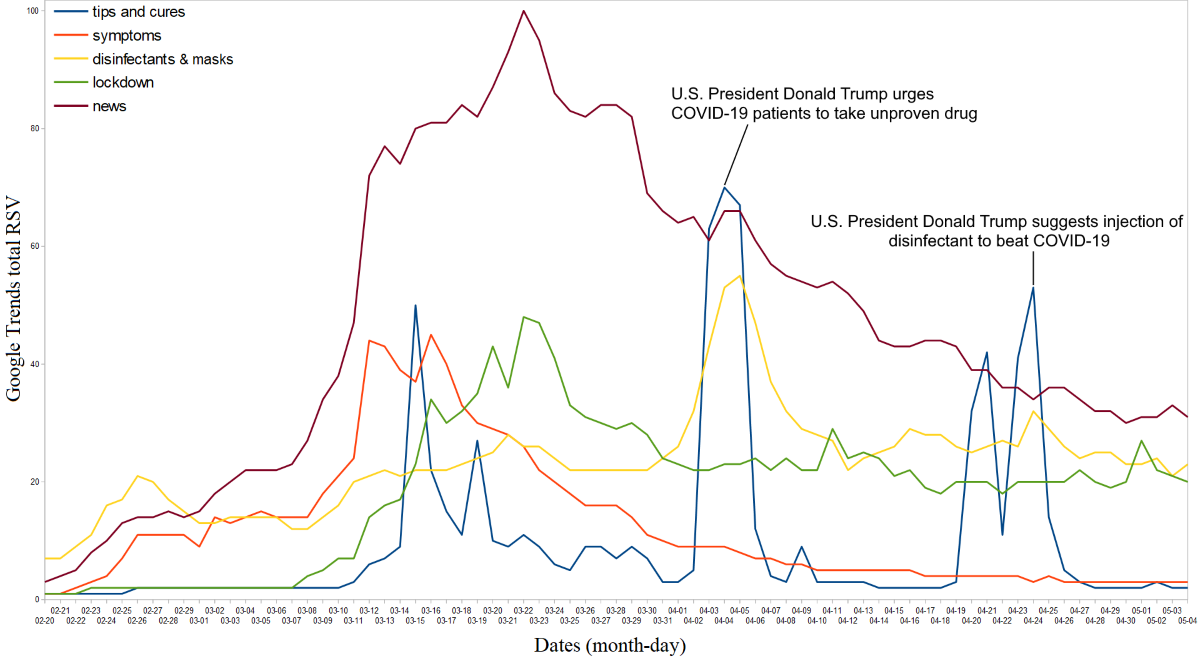
The researchers further examined circulation of these and other infodemic monikers to identify correlations with real-life events. For example, infodemic monikers related to coronavirus origins, such as "SARS-CoV-2 made in the laboratory", went viral when the National Associated Press Agency (Agenzia Nazionale Stampa Associata - ANSA) of Italy posted a video about the origins of SARS-CoV-2 virus on March 25 2020. (The researchers in no way attribute responsibility to ANSA, which has made it clear that the information in the video was fake news.) In addition, the moniker reached breakout levels on April 17 2020, when the French Noble Prize winner Professor Luc Montagnier stated that the new coronavirus was the result of a laboratory accident in a high-security laboratory in Wuhan, China. Searches related to "tips and cures" for COVID-19 spiked multiple times when the United States (US) president suggested that hydroxychloroquine (an unproven drug) was a "miracle cure" on April 4 2020.
Reflecting on implications of the study's findings, the researchers suggest that negative information posted on the internet should be counter-balanced with evidence-based content from health organisations. However, a 2017 study by Guidry et al. examining social media misinformation during Ebola outbreak showed that the percentage of Instagram posts and tweets posted by health organisations (e.g., the US Centers for Disease Control and Prevention (CDC), World Health Organization (WHO), Médecins Sans Frontières (MSF - Doctors Without Borders) that correct misinformation found online is less than 5%. In the context of the COVID-19 pandemic, when the US president suggested injecting disinfectant to treat COVID-19, the number of Google searches considering it as a cure sharply increased and resulted in 30 cases of disinfectant poisoning within 18 hours in New York City, US. In response, say the researchers, "Health authorities should be vigilant and provide more positive and informative messages to combat the circulation of infodemic monikers on social media."
The researchers conclude that, by characterising and classifying various infodemic monikers based on the degree of infodemicity (e.g., via the I-scale), it is possible to use social media data to monitor the monikers' outcomes. Future studies could investigate the influence of infodemic monikers on individual cyber behaviour.
Journal of Medical Internet Research 2020; 22(8); e20673; and email from Alessandro Rovetta to The Communication Initiative on August 27 2020.
- Log in to post comments