Children’s Voices
According to Positive Vibes, at the core of the project is the philosophy that children should be seen AND heard. Children have voices and, in a world shaped by adults, the project equips them with the confidence to formulate their own views and needs. At the same time the project provides adults with the opportunity to better understand and respond to these.
The actual training was first piloted at a rural school in northern Namibia in 2005, which resulted in the production of a series of films that have since been distributed widely in Namibia and watched by high-level decision makers such as the Prime Minister of Namibia. The roll-out of the project began in October 2008 with funding from Family Health International (FHI) and IBIS. In line with the Positive Vibes approach to HIV communication, the project, which runs until May 2010, is carried through a cadre of about 40 community-based facilitators coming from local support groups of people living with HIV. The project is split into two major parts: the foundation phase and the voice phase. During the foundation phase, which is done in tandem with an intervention for the parents and caregivers, the children take part in a 5-day participatory workshop aimed at building mutual trust and understanding. The foundation phase is centred on art, play, and interactive communication techniques. At the end of the workshop, the facilitators provide the children with a safe space in which to discuss issues related to HIV. In the current project most of the 500 children are either directly or indirectly affected by HIV.
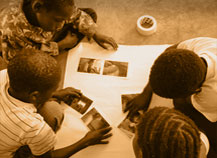
During the voice phase of the project, the children set up their own support groups or clubs. In these groups the children decide on an issue that they want to advocate about. They then explore telling their stories and developing "storyboards" - pictorial scripts - that become the basis for their advocacy projects. These include plays, exhibitions, radio shows, photography, movie making and/or film screenings. All is shared with parents and caregivers in feedback sessions that are primarily designed to prime them for the changes occuring in the children as well to solicit their buy-in to the process.
Following the two phases, the children’s voices are screened, displayed, showcased or broadcast – all depending on the type of media produced and, more importantly, on the wishes of the children. The primary audience is the immediate stakeholders group. If the children wish it, the media is then shown to the local community or even further afield. Other children who have not had the opportunity to participate in the foundation phase workshop also benefit, when the films and other communication initiatives are shared at the community level. Team members facilitate discussions around issues raised in the films, and assist stakeholders and service providers in developing action plans to address problems highlighted by the children.
Children, HIV/AIDS
Positive Vibes pilots and implements innovative, participatory, and PLHIV led approaches to HIV communication. It is funded by the Dutch development organisation HIVOS. The Positive Vibes facilitators and its staff are either affected by or living with HIV. Its approaches are designed to give people greater control over the epidemic, within their own lives and within their communities.
Hivos, Family Health International (FHI), IBIS, People In Need, Development Aid from People to People (DAPP), Nawalife Trust, and LifeLine-Childline.
Ibis website on December 12 2005 and Positive Vibes website July 2 2009 and email received from Casper Erichsen on October 8 2009.