










































Zamboanga Learning Review on Post-Conflict Community Engagement
"Critical here was how we engaged the displaced populations to understand their experiences and listen to their feedback as regards access to life-saving information, as well as opportunities for dialogue, connectivity and community participation. The learning review helped build a framework of what a successful communication, accountability and community response looks like in an armed-conflict context and mapped what was needed from different actors to achieve this." - Mark Bidder, Head of Office, Office for the Coordination of Humanitarian Affairs (OCHA)
Conducted by the Asian Institute of Journalism and Communication and commissioned by the Community of Practice on Community Engagement, this report seeks to capture the lessons learned from a humanitarian communication response to the Philippines' Zamboanga conflict, at the height of which (September and October 2013), over 80,600 people from 14 barangays were forced to leave their homes and to seek shelter in 59 evacuation centres and displacement sites. The Zamboanga learning review identifies effective strategies appropriate to armed-conflict settings which could serve as a guide for other responses worldwide, beyond Zamboanga's specific cultural context. Specific objectives are to: (i) document and synthesise experiences and feedback of community members and humanitarian workers in terms of access to information and opportunity for dialogue and (ii) identify and examine good practices, challenges, and value-added features in communication, accountability, and community participation work at the field and national levels.
The Communication Working Group (CWG) in Zamboanga City was established in October 2013 to bring together all actors working in humanitarian communication activities related to the siege, such as communicating with communities (CwC), accountability to affected populations (AAP), and community participation. It is a "multi-sector group tasked with spearheading information campaigns and programs to coordinate and disseminate information on humanitarian, recovery and rehabilitation from the local government and its partners to the IDP communities, and to counteract misinformation". CWG members include the City Government Public Information Office (PIO), Philippine Information Agency (PIA) Region 9, Department of Social Welfare and Development-Regional Office (DSWD-RO), City Social Welfare and Development Office (CSWD), City Health Office (CHO), United Nations (UN) agencies, international and local non-governmental organisations (NGOs), civil society organisations (CSOs), faith-based organisations, and youth volunteers. Partners and members of the Communicating with Disaster Affected Communities Network (CDAC-N) are also involved in the CWG, which has coordinated and implemented communication initiatives to address the various information and communication needs of internally displaced persons (IDPs), host communities, humanitarian organisations, government agencies, the media, and other stakeholders.
Methodology of the learning review includes a desk review of relevant documents and materials, focus group discussions (FGDs), and a key informant interview (KII). A total of 75 IDPs, government representatives, and humanitarian workers participated in 10 FGDs. Key findings and analysis cover the following:
- Sociopolitical context of communicating with IDPs - there are issues such as those arising due to indigenous persons (IP) languages. Although they can speak and understand Filipino, the national language, the IDPs have their own local languages, such as the Tausug language, Badjao (or Sinama) language, Balangingi (dialect of the Sama Bangingi), and other Sama dialects. To address this challenge, the city government works with a consultant on Muslim affairs to provide guidance and help in translation. This consultant served as translator for the Tausug and Badjao languages during the information caravans (see below).
- Communication process as an integrated whole - This learning review takes the approaches mentioned above - CwC, AAP, and community participation - as an integrated communication whole, considering their common and overlapping elements of: people centeredness and human rights; transparency, two-way communication, and information sharing; accountability and feedback; and dialogue, participation, and empowerment.
- Implementing humanitarian communication through the CWG - This section of the review examines aspects of the CWG, such as organisation and membership, objectives and functions, capacity building (e.g., training was provided on information, education, and communication (IEC) efforts in conflict situations), and challenges (e.g., sustaining participation of CWG members and the fact that, even among CWG members, communication and information may not be seen as immediate or priority needs).
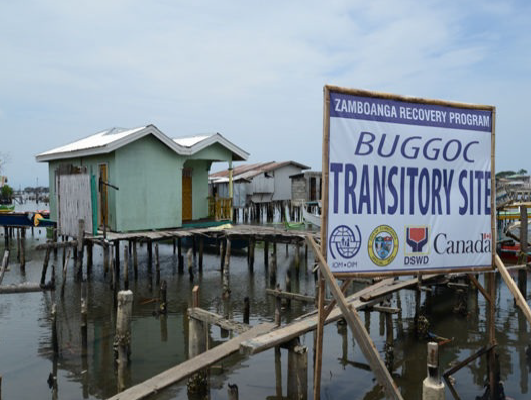
- Various communication initiatives implemented - Activities are outlined, including: face-to-face engagements (e.g., health and gender-based violence (GBV) information sessions for IDPs, information caravans featuring open forums with the IDPs, kumustahan (camp dialogue) series, community consultations, Bajau learning forum, art workshop for children affected by the siege, and other partners' initiatives, such as a poster-making contest on hand-washing with games and other activities); production and dissemination of IEC materials such as 3 issues produced of the newsletter Bangon Zambo! featuring IDP leaders and volunteers to not only recognise their contributions but also to encourage and motivate them further; mobilisation of volunteers (e.g., IDPs in 3 transitory sites were mobilised as Community Peace Media (CPM) volunteers and then trained in citizen peace journalism, learning how to write news and how to use social media); networking with/use of traditional media; use of new media (e.g., SMS text blasts); public information (e.g., an IDP hotline); and other initiatives (e.g., distribution of statement shirts to IDP leaders and of paper fans on the health services schedule and health referral pathway).
- Segmenting of communication stakeholders - The CWG has defined as its "target audience" IDPs, the general public in Zamboanga City, and the national and international community. However, this definition needs to reformulated; even among IDPs, segmentation may be necessary to address specific characteristics and needs of the Tausug community or the Badjao population, or of the home-based IDPs versus the IDPs in transitional sites. Furthermore, as described in the concept of Communicating with Communities (CwC), "people are not 'messaged to' but 'communicated with.' They are not passive recipients of messages, but active participants in the process of communication."
- Information needs of IDPs and key messages of humanitarian partners - Because an integral part of the process of planning for effective communication activities is identifying the information needs of stakeholders as they relate to the overall humanitarian response goals and objectives, this section of the report outlines these needs as identified during the FGDs and in the documents reviewed. For example: "The IDPs expressed their desire for transparency and timeliness from government in the sharing of information. Thus, although the Information Caravans were meant to address their concerns about permanent housing, the IDPs noted the following: resource persons could not give a definite date or even a flexible timeline; resource persons did not want to be quoted (and therefore held accountable for their pronouncements); and resource speakers admitted that delivery was dependent on national agencies..." Examples of the key messages from the different humanitarian partners, which are primarily related to their mandate and programmes, were identified by the FGD participants and in the desk review and are listed here. Challenges are discussed, such as persuading IDPs to adopt desired behaviours. For instance, women who had experienced GBV did not want to report such cases, preferring to keep it in the family, highlighting the need to surface information on existing gender dynamics (e.g., vulnerability of women, gender discrimination, gender roles) and highlight the potential risks to women as a result. IDPs are also vulnerable to misinformation (unintentional) and disinformation (deliberate), as well as to exploitation by vested interest groups with political agendas.
- Communication channels and information flow - FGD participants said that interpersonal and group communication was the most feasible channel used in interacting with IDPs. Advantages include "immediacy, ability to clarify and validate issues and concerns immediately, and establishment of rapport or personal relationship....In this model, it is noteworthy that the PIO head sees the IDPs as initiators of communication and not just as receivers or reactors." Also examined here is the initiative's use of: print collateral materials (one note: for non-literate or low-literate IDPs, there is the need to use more visuals or simplify the content); mass media (one note: "coverage of the IDP situation in both the national and local media lacks depth and analysis. What is needed are investigative stories that dig for facts, provide context, and explain the why and how"); new media and telecommunications (one note: with their limited resources (e.g., ability to charge phone batteries), it is often not IDPs who are the stakeholders accessing these channels); community volunteers, many of them college students and young professionals, some of them IPs or IDPs (one note: "In relating with the IDP communities, the youth were seen as enthusiastic, committed, and even entertaining. According to them, the IDPs did not feel shy with them or intimidated by them and treated them as their children or grandchildren."); and other channels, such as visual and performing arts, after-prayer announcements in mosques, use of symbolism and inter-faith healing programme, and community bulletin board and suggestions box.
- Feedback mechanisms and coordination structures - Platforms that provide opportunities for participation and feedback include community consultations, information caravans, community dialogues (e.g., Kumustahan), campsite meetings, house visits, the text hotline for IDPs, and meetings and interviews with humanitarian and government agencies. IDPs voiced the perception that their situation and sentiments do not reach the national level, where policies and decisions are made. Amidst this perception that their concerns were unattended or ignored, the IDPs felt swamped and overwhelmed by visits from different agencies getting baseline data or asking the same questions, journalists writing stories about them, and students doing their thesis. The CWG, with the City PIO as lead and OCHA as co-lead, facilitates coordination among humanitarian actors for communication initiatives. "In addition to the multi-levels [described in the report], coordination of the recovery and rehabilitation activities becomes more complicated because of the many actors involved....By the nature of its function that cuts across the clusters and sectors, the CWG has a strong role to play in coordination at the field level. But this role has not been fully developed because of the many concerns of the PIO (which leads the CWG), of the partner agencies, and of the sector leads. The PIO chief cited, for example, how CWG work was slowed down because partner members couldn't fulfill their CWG tasks, e.g., reviewing the correctness of content in IEC materials."
Following a discussion of lessons learned from this process - where the reader can explore personal reflections by service providers (e.g., about cultural sensitivity, dialogue and empathy, and listening skills), as well as what worked and what did not work - recommendations of the review are offered and are as follows:
- "The CWG needs to convene an assessment and planning workshop to determine what communication initiatives to undertake to respond to evolving needs and concerns of the affected communities, as well as to address medium- and long-term objectives. The output will be a strategic communication plan for the Zamboanga post-conflict recovery and rehabilitation.
- As a planning tool and guide for the CWG, inventory or mapping of existing IEC materials and current communication activities needs to be done.
- As an immediate response to the urgent need of the IDPs for information about their permanent housing, the CWG needs to plan and implement a follow-up series of community meetings or community consultations to effective close the communication loop.
- To better meet the information needs of IDPs and strengthen community engagement, the CWG can build the capacity of IDPs to plan their communication activities and produce their own IEC materials.
- Capacity building for CWG members and CWG youth volunteers must be sustained.
- Success stories and the overall communication experience in a post-conflict context need to be thoroughly documented.
- To strengthen media engagement in the humanitarian response, a series of training-workshops or a continuing training program for Mindanao-based journalists can be planned and implemented.
- The Command Post in IDP camps is the main communication center for the IDPs and serves as their direct link to needed services and support. It is therefore necessary for camp managers and camp management support staff to build their capacity for humanitarian communication.
- The CWG can advocate with the CMO [City Mayor's Office] for strengthening information management for better planning and decision-making. These may include IDP population disaggregate data and ethnic composition.
- OCHA can help develop content for a college level course on Humanitarian Communication, which will be included in the Commission on Higher Education (CHED) curriculum starting in 2018."
C4D Network Slimline Twitter Trawl: 18 - 24 January 2016; and Active Learning Network for Accountability and Performance in Humanitarian Action (ALNAP) website, July 13 2016. Image credit: OCHA/Gil Arevalo
- Log in to post comments