










































Youth Autumn School in Morocco: Youth and Political Engagement for an Alternative World
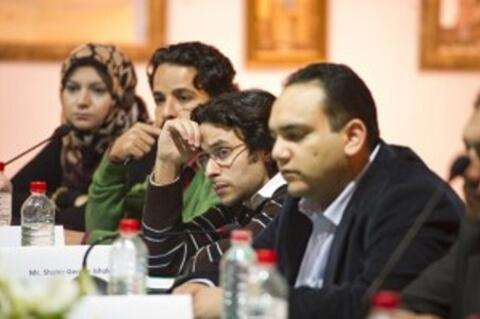
From October 12 to 14 2012, nearly 200 young participants from Morocco, Algeria, Egypt, Lebanon, Mauritania, and Tunisia gathered in Bouznika, Morocco, for the Youth Autumn School on "Youth and Political Engagement for an Alternative World". The seminars and workshops were designed with the objectives of enhancing their capacity to: conduct policy analysis; build alternative models of society; and lead advocacy actions. The Youth Autumn School is a project of the United Nations Educational, Scientific and Cultural Organization (UNESCO).
In time of crisis, the Youth Autumn School aimed, in particular, to help young people build alternative visions of society, thus strengthening their leaders’ capacities (theoretical knowledge and practical skills) in advocacy and civic commitment.
The approach adopted was as follows:
- At the upstream stage, 20 ‘cafés liberté’ were organised at the regional level during September 2012 to assist the young participants in preparing their analysis and proposals.
- During the Autumn School session, seminars and workshops were held to discuss and consolidate their proposals and lead to the final memorandum.
During the 3 days, 6 thematic seminars took place, followed by corresponding workshops to deepen the participants’ alternatives:
- What kind of Youth Council towards what kind of youth public policy?
- Challenges of participative democracy;
- Democratic transition: what is at stake?
- Gender equality: how do young people engage themselves?
- Social movements: modalities of action / driving force for proposal and change / role during democratic transition;
- Youth and culture: what role in building a culture of citizenship and of freedom?
In addition, two training workshops on policy analysis and on participative techniques were offered.
Democracy and Governance, Youth, Gender Equality
This activity is part of UNESCO's actions with and in favour of youth, especially in the framework of its Strategy on African Youth (2009-2013). UNESCO focuses its efforts in promoting full and relevant participation of youth in their society.
UNESCO Office in Rabat, Moroccan National Commission for UNESCO, Deutsche Gesellschaft für Internationale Zusammenarbeit (GIZ), Forum des Alternatives Maroc (FMAS)/Action Jeunesse
UNESCO website, December 4 2012.
- Log in to post comments