










































World Press Freedom Day Podcast
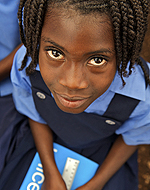
This podcast from the United Nations Children's Fund (UNICEF) series on education in emergencies commemorates World Press Freedom Day (May 3) 2010. In it, moderator Amy Costello speaks with two journalists and a professor about the media's role in reporting on education and children in times of crisis. Media coverage and stories from conflict zones can shape the international response to humanitarian emergencies, and ultimately impact the lives of children and protect their fundamental rights.
In the podcast, Jake Lynch, Associate Professor and Director of the Centre for Peace and Conflict Studies at the University of Sydney, began by discussing peace journalism as a "movement" - a push to encourage journalists to highlight more of the peaceful aspects that characterise response to conflict, thus offsetting the tendency to focus on "big bangs" - that is, the violence.
According to Colombian journalist Jenny Manrique, children are fascinated by being in front of a camera and by the microphone. However, the questions that journalists ask may deeply affect children in trauma and as such, journalists should consult professionals - psychiatrists and psychologists - in addition to parents. Mr. Lynch drew attention to the ethical questions raised by Ms. Manrique. Before his role in academia, Mr. Lynch was an international journalist, stating that the media is really "there to get the story." Editors prize highly emotional responses in front of a camera, but he recalls having had a sense that, in many cases, "we are re-traumatising these people." He stressed the need for journalists to bear in mind the psychological harm that interviewing can inflict on children impacted by disasters or conflict.
When asked to comment on the role the media can play in times of crisis, Ms. Manrique stated, "I definitely think the role of the media is huge. We have to see through the media what the conflict is about, and how are people solving this conflict. This also helps to understand the problem." United Kingdom (UK) journalist Brendan O'Malley added that the media have been "hugely helpful" in exposing attacks on educational institutions, teachers, and students - bringing these issues to the world's attention by "telling the human stories". He noted that many journalists put themselves at great risk to get those stories.
On the other hand, Mr. Lynch argued that journalists often gloss over complex issues such as the role of education in conflict. Mr. O'Malley agreed that there is a need to dig deeper, saying that "the reporting seems to focus on the fact the school has been attacked, the fact that teachers have been killed, and what is often overlooked is why those schools are being attacked." Ms. Manrique added: "It's a matter of rethinking the exercise of journalism."
Email from Taleen Vartan to The Communication Initiative on June 11 2010; and "Podcast #25: World Press Freedom Day", by Pi James, May 3 2010 - accessed on June 30 2010. Image © UNICEF/NYHQ2010-0209/Noorani

- Log in to post comments