










































From the Web to the Phone: Information System Sends RSS Feeds to Chilean Farmers via SMS

DataDyne
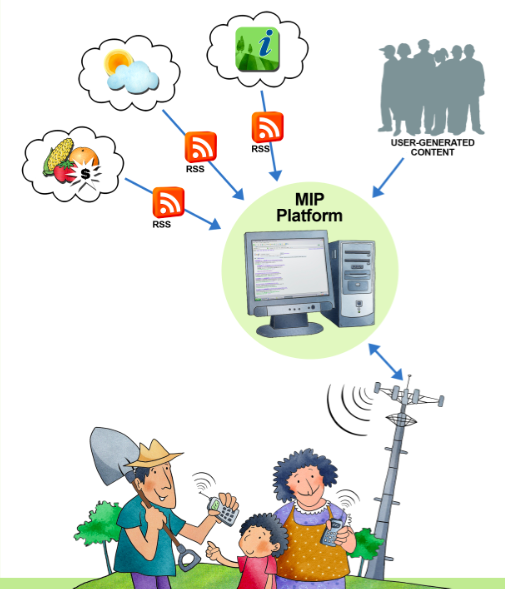
From ICT Update, Issue 53: Farmer Services: "In Chile, the Mobile Information Project takes advantage of the growing ubiquity of mobile phones to deliver agricultural information from the web directly to farmers." The Mobile Information Project (MIP) is based on the theory that mobile phones have sufficient processing power to provide farmers with the information they need. Using software from DataDyne, a United States (US) non-profit organisation, the programme organises searchable content from the internet into news feeds (RSS) and then passes that content on to farmers via text messaging (SMS). The programme designers developed the system to work on simple, low-cost mobile phones, and to operate effectively even over slow networks with intermittent connectivity.
Since early 2009, DataDyne has been working with a cooperative of agricultural producers, Cooperativa Campesina Intercomunal Peumo (Coopeumo), in the Cachapoal Valley, two hours south of Santiago, Chile, on a project called DatAgro. Focused on smallholder farmers, the project seeks to support them in becoming more competitive, for which small-scale farmers need support to enhance their productivity levels and to enter export markets. "In particular, farmers need timely information on emerging weather patterns for their region, along with information on farming inputs including soil conditions, the quality of seeds, market prices, local infrastructure and global pressures. Studies, carried out in 2008 showed that the majority of Coopeumo’s smallholder farmers consider an internet connection as essential. Improved access to specific market-, technology- and climate-related information, along with cultivation advice, would make farming easier and more productive, and help farmers make better-informed decisions, such as what to plant and when."
Because the internet does not reach them, farmers now receive this information via SMS messages over their basic mobile phones. "Most prepaid mobile users in developing countries have these types of phones and often only have access to lower-quality networks." The information comes from several sources, including the United Nations Educational, Scientific and Cultural Organization (UNESCO), the Fund for Agrarian Innovation, and the El Mostrador and El Mercurio newspapers. Users can customise which message feeds they subscribe to, and can rate the messages they find the most helpful. The cooperative reports that information about supply prices, product prices, the weather, and what’s going on in international markets are valued by the farm members.
Challenges include focusing the content of the RSS feeds to individual users' needs, and ensuring that SMS messages contain useful information within the first 160 characters, the limit available via SMS. The project is now expanding beyond the beta testing stage, and MIP technology is being used in a joint project with the Pan American Health Organization to send messages about the management of childhood illnesses to doctors and nurses in Lima, Peru. The article concludes that "[t]he challenge is to develop a reliable and scalable way to send relevant, internet-based information by SMS messages. There is a huge opportunity to reach a large number of people with basic, but essential, information via their mobiles."
ICT Update, Issue 53: Farmer Services, May 10 2010. Images courtesy of DataDyne
- Log in to post comments