










































Vaccines and Your Baby (VAYB)
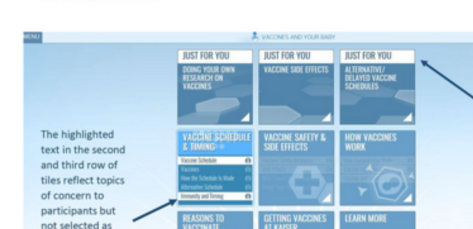
Vaccines and Your Baby (VAYB) is a web-based tailored messaging intervention that uses values framing an an effort to counteract parental vaccine hesitancy and childhood undervaccination. It has been developed as part of a trial called Reducing Delays In Vaccination (REDIVAC) that will test its efficacy in changing parents' attitudes and behaviour around their children's vaccines. Women in the third trimester of pregnancy enrolled at Kaiser Permanente Colorado (KPCO), an American integrated managed care consortium, between April 2016 and October 2017 have been recruited for the trial.
Message tailoring along the lines of VAYB is designed to provide parents with information about vaccines that is customised to their own personal needs before their child's clinical appointments. Message tailoring allows for written information - shared via the internet - to be individualised to reflect each person's unique beliefs, experiences, knowledge, attitudes, and barriers to action. The idea is that, by doing so, the personal relevance of the information increases, which, in turn, improves individuals' receptiveness to that information - this is especially important in the case of vaccine hesitancy, when the new information may not align with a person's current attitudes or beliefs.
The conceptual model for the intervention is based on a hybrid of the theory of planned behaviour (TPB) and the value-attitude-behaviour hierarchy model. It also incorporates strategies derived from motivational interviewing and self-affirmation. According to the TPB, behaviour (in this case, following the recommended vaccination schedule) is influenced by intentions (in this case, vaccine hesitancy), which are a result of attitudes towards the behaviour, perceived behavioural control, and norms. The intervention primarily focuses on strategies for influencing attitudes - that is, tailored messages addressing individual behavioural beliefs (e.g., beliefs that immunity is best achieved through exposure to a pathogen or "natural immunity") framed according to personal values (e.g., emphasising the benefits of vaccination for preventing spread of illness for those who value protecting one's community). The idea is that affirming individual patient values and identity, using non-judgmental and empathetic language, emphasising autonomy (e.g., adding tenets from motivational interviewing and self-determination theory), and constructing controlling tones of messages can minimise reactance and counterarguments. Individually tailored messages, in general, are known to have greater effects on attitude change than are universal (untailored) messages.
VAYB messages are tailored for multiple constructs, including intention to vaccinate, personal attitudes about vaccines, vaccination values, vaccination beliefs and concerns, logistical barriers to vaccination, and child's name, sex, and birthday. (Data to inform this initial tailoring come from REDIVAC's preintervention questionnaire.) Interim questionnaires are used to refresh the tailored information at 3 times during the study period. Tailoring occurs based on an embedded algorithm that is part of the VAYB website.
As part of the VAYB interface, 3 "Just for You" tiles that are displayed prominently on the page reflect the top 3 vaccine topics of concern about which each participant indicates they want more information. The tiles are further customised to highlight the vaccination values the participant most endorses and to reflect their most recently reported intention to vaccinate. The remaining content is lightly tailored to reflect the participant's attitudes, concerns, hesitancy, and demographics, but it is not tailored based on vaccination values. Highlighted text on the home page is used to further identify additional information that is most relevant to the participant based on their survey answers.
A 3-armed, individually randomised clinical trial with longitudinal follow-up is in the works, as of this writing. (The protocol for the REDIVAC study is available at the URL, below.) Study arms will include: (1) the VAYB (tailored) intervention, (2) an untailored version of the VAYB, and (3) usual care (receipt by mail of Vaccine Information Statements (VISs) for all recommended vaccines in the child's first year of life). The primary outcome to be assessed is vaccination status, assessed at age 200 days, reflecting the time when infants should have completed the first set of vaccine provided (at age 2, 4, and 6 months). Secondary outcomes include vaccination status at age 489 days, reflecting receipt of recommended vaccines at age 12-15 months, as well as vaccination attitudes, hesitancy, and intention.
Immunisation and Vaccines
Increasing numbers of children are failing to receive many recommended vaccines, which has led to significant outbreaks of vaccine-preventable diseases in the United States (US) and worldwide. A major driver of undervaccination is parental vaccine hesitance. Addressing vaccine hesitancy can be difficult and time consuming because parents' vaccination decisions are often complex, as they are heavily influenced by emotion, past experiences, and peers. In many cases, the resistance to vaccination is related to psychosocial and political beliefs as much, or even more than, knowledge deficits. These factors may pose a challenge for healthcare providers who attempt to persuade parents to vaccinate their children, given that typical paediatric clinical encounters last only 15-20 minutes.
Members of the research team hail from the University of Colorado Denver, KPCO, University of Colorado School of Medicine, and the University of Michigan.
"'Reducing Delays In Vaccination' (REDIVAC) Trial: A Protocol for a Randomised Controlled Rrial of a Web-Based, Individually Tailored, Educational Intervention to Improve Timeliness of Infant Vaccination", by Amanda F Dempsey, Nicole Wagner, Komal Narwaney, Jennifer Pyrzanowski, Bethany M Kwan, Courtney Kraus, Kathy Gleason, Ken Resnicow, Carter Sevick, Jessica Cataldi, Sarah E Brewer, and Jason M Glanz. BMJ Open, Volume 9, Issue 5, May 22 2019. http://dx.doi.org/10.1136/bmjopen-2018-027968
- Log in to post comments