










































URGENT: Understanding and Responding to Global Emerging News Threats
Date
Summary
"The media development community doesn't seem to have realized so far that the world has changed, that we are in a really, really terrible time that we are living through that threatens the existence of independent media in many countries."
This report, published by Internews, seeks to help the media assistance community learn and understand what type of support independent media partners on the ground need. In particular, it looks at the needs in three types of contexts: countries where pressure is building, countries that have undergone a fast pivot to a worsening situation or crisis, and exiled journalists and the countries that host them. It identifies both the acute needs of journalists and media in these situations and the longer-term and structural needs, setting out a series of recommendations on how donors, implementers, and diplomatic actors should reassess their approaches if they are to effectively support public interest media and address the increased vulnerability of media globally. Overall, the report underscores the need for a holistic approach that, in addition to bridging financial and technical gaps for struggling media outlets, facilitates collaborative strategic programming and advocacy.
The report explains how the global COVID-19 pandemic has intensified a decade of pervasive democratic erosion and closing civic space and that this has put "inexorable pressure on independent media around the world already struggling to figure out models of sustainability in the platform era. The overthrow of elected governments in Afghanistan and Myanmar and the Russian invasion of Ukraine propelled an unprecedented exodus of journalists that strained existing support mechanisms while underscoring the need for more strategic support from the foreign policy establishment and coordination by the international community."
The findings and recommendations in the report are based on extensive multi-method research grounded in the perspectives of 96 journalists, media practitioners, and editors with experience working in the three types of contexts. The report is also informed by ethnographic research and information produced by the media assistance and scholarly communities. Countries covered in the research include, for example, Indonesia, Mexico, Thailand, Tunisia, Afghanistan, Russia, Ukraine, Myanmar, and Syria.
The first section of the report describes the rising repression, democratic deterioration, platformatisation, and post-pandemic pressure that characterise the underlying conditions in which media around the world are operating for each of the three situational contexts. Subsequent chapters analyse each of the three types of contexts and provide key findings, as well as a list of recommendations for donor organisations, governments, and Media Freedom Coalition Member States, as well as for implementers with donor support.
The chapter looking at the context of pressure building, for example, identifies some of the signs that civic space is deteriorating, stressing the importance of increased attention to this issue by the media support community. Media leaders and journalists need donors to explicitly consider how macroeconomic conditions influence the viability of different business models, including access to credit, financial gateways, and exchangeable or volatile currency. In the context of a fast pivot or crisis, the findings show that media become even more politicised, and other institutions are affected in ways that put further pressure on independent journalism - both inside the country and in surrounding areas, as well as in those that become migratory hosts. In addition, safety becomes an acute priority, business plans and revenue streams become moot, and audiences shift. For journalists forced into temporary or permanent exile, who can play a vital role reporting on their countries of origin, support is needed to adapt to new realities and safely transition their operations. In addition to discussions on the three contexts, the report includes a section on coordination and collaboration, highlighting the important contribution of media development coordination networks, collaborative crisis management, collective infrastructure, and collaborative journalism.
Recommendations emphasise the need for the media assistance community to recalibrate support to match evolving dynamics. They include a greater focus on: preparedness; holistic physical, digital, legal, and psychosocial support that is readily available and tailored to their needs; more flexible funding to build their businesses, prepare for unexpected events, and absorb shocks; better access to data and analytics capacity and tech expertise; and increased engagement with the technology companies that shape their ability to connect with audiences, particularly at times of crisis.
The report finds that a holistic approach to media assistance that includes the provision of money, technical assistance, and collaborative strategic programming and advocacy, while also improving the global enabling environment, is urgently needed. It underscores the role that the United States and European policies play in the global information ecosystem and urges donor countries to take a more comprehensive approach to foreign assistance that includes addressing domestic immigration and technology policy frameworks.
This report, published by Internews, seeks to help the media assistance community learn and understand what type of support independent media partners on the ground need. In particular, it looks at the needs in three types of contexts: countries where pressure is building, countries that have undergone a fast pivot to a worsening situation or crisis, and exiled journalists and the countries that host them. It identifies both the acute needs of journalists and media in these situations and the longer-term and structural needs, setting out a series of recommendations on how donors, implementers, and diplomatic actors should reassess their approaches if they are to effectively support public interest media and address the increased vulnerability of media globally. Overall, the report underscores the need for a holistic approach that, in addition to bridging financial and technical gaps for struggling media outlets, facilitates collaborative strategic programming and advocacy.
The report explains how the global COVID-19 pandemic has intensified a decade of pervasive democratic erosion and closing civic space and that this has put "inexorable pressure on independent media around the world already struggling to figure out models of sustainability in the platform era. The overthrow of elected governments in Afghanistan and Myanmar and the Russian invasion of Ukraine propelled an unprecedented exodus of journalists that strained existing support mechanisms while underscoring the need for more strategic support from the foreign policy establishment and coordination by the international community."
The findings and recommendations in the report are based on extensive multi-method research grounded in the perspectives of 96 journalists, media practitioners, and editors with experience working in the three types of contexts. The report is also informed by ethnographic research and information produced by the media assistance and scholarly communities. Countries covered in the research include, for example, Indonesia, Mexico, Thailand, Tunisia, Afghanistan, Russia, Ukraine, Myanmar, and Syria.
The first section of the report describes the rising repression, democratic deterioration, platformatisation, and post-pandemic pressure that characterise the underlying conditions in which media around the world are operating for each of the three situational contexts. Subsequent chapters analyse each of the three types of contexts and provide key findings, as well as a list of recommendations for donor organisations, governments, and Media Freedom Coalition Member States, as well as for implementers with donor support.
The chapter looking at the context of pressure building, for example, identifies some of the signs that civic space is deteriorating, stressing the importance of increased attention to this issue by the media support community. Media leaders and journalists need donors to explicitly consider how macroeconomic conditions influence the viability of different business models, including access to credit, financial gateways, and exchangeable or volatile currency. In the context of a fast pivot or crisis, the findings show that media become even more politicised, and other institutions are affected in ways that put further pressure on independent journalism - both inside the country and in surrounding areas, as well as in those that become migratory hosts. In addition, safety becomes an acute priority, business plans and revenue streams become moot, and audiences shift. For journalists forced into temporary or permanent exile, who can play a vital role reporting on their countries of origin, support is needed to adapt to new realities and safely transition their operations. In addition to discussions on the three contexts, the report includes a section on coordination and collaboration, highlighting the important contribution of media development coordination networks, collaborative crisis management, collective infrastructure, and collaborative journalism.
Recommendations emphasise the need for the media assistance community to recalibrate support to match evolving dynamics. They include a greater focus on: preparedness; holistic physical, digital, legal, and psychosocial support that is readily available and tailored to their needs; more flexible funding to build their businesses, prepare for unexpected events, and absorb shocks; better access to data and analytics capacity and tech expertise; and increased engagement with the technology companies that shape their ability to connect with audiences, particularly at times of crisis.
The report finds that a holistic approach to media assistance that includes the provision of money, technical assistance, and collaborative strategic programming and advocacy, while also improving the global enabling environment, is urgently needed. It underscores the role that the United States and European policies play in the global information ecosystem and urges donor countries to take a more comprehensive approach to foreign assistance that includes addressing domestic immigration and technology policy frameworks.
Source
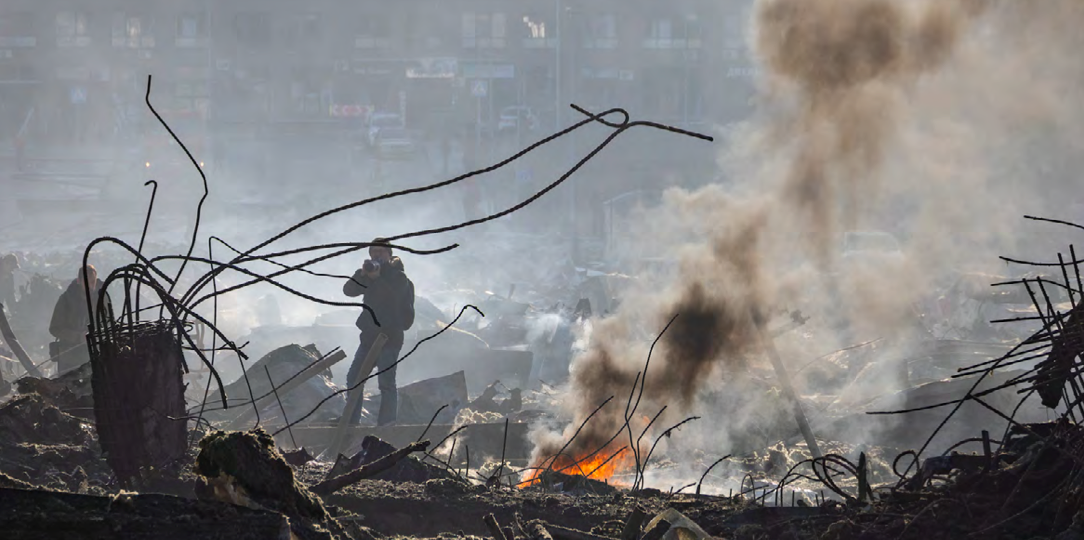
The Leading Question, sent from Internews to The Communication Initiative on May 3 2023; and Internews website on May 4 2023. Image caption/credit: Journalist surveying the damage in Ukraine. Photo: Andrii Dubchak