










































TV Koodo
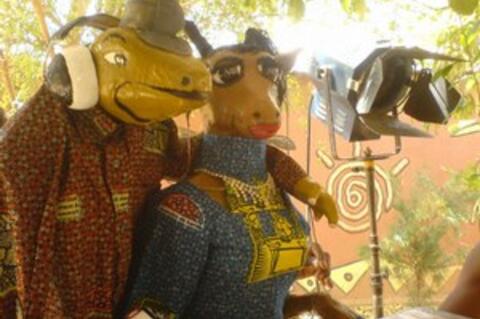
The show, which airs once a month on the national broadcaster, stars two puppet characters: Chevrina, "a seductive female goat reporter, and her sidekick Margouillat, a lizard." In each episode, they talk to experts and go on the road to shed light on issues such as food security and grain marketing. Each show ends with a report on current grain and livestock prices around the country. Organisers say that using puppets instead of real people means that the hosts can interview guests in a more direct and popular way.
The show was developed out of IABER's need to disseminate information it had gathered during an exercise that monitored and collected up-to-date prices for cattle and cereal crops. They also wanted to provide people with investigative information on pressing agricultural issues, such as food security, grain marketing, and land rights. IABER says that it felt the national television network was the most effective medium, since it attracts viewers in all areas of the country.
The producers of TV Koodo have realised that there is a demand for market prices to be broadcast more often than just once a month. Thus, in the future, the programme will be split into two separate programmes. One will be devoted to various agricultural themes and will continue to be shown once a month, while the other will be broadcast at a shorter interval, and will offer only prices.
According to the organisers, the idea behind the show is to bring rural reality home to the Burkinabe public. The intended audience are farmers and those involved in the agricultural and livestock marketplace, but the show is also applicable to the general public as well as policymakers and donors.
Agriculture, Economic Development
According to organisers, both producers and buyers (consumers, middlemen, etc.) now have access to information about which local markets are offering the best prices. Farmers can negotiate better prices for their produce, enabling them to make better decisions or to seize new business opportunities. In one example, the programme was particularly effective in improving understanding of the best use of phytosanitary products, permitting a considerable reduction in accidents on the part of the producers. In addition, now that both sellers and buyers are more aware of the prices of produce on local market, they have begun to lose some of their traditional mutual suspicion and antagonism.
In 2005, the TV show won the Galian Prize, a Burkinese award for excellence in communications, as the best television information magazine programme of 2005.
International Institute for Communication and Development (IICD), Manivelle Production, Association des gens de Wisga, Institut Africain de Bio-économie Rurale (IABER).
IICD website on January 22 2009 and April 8 2010.