










































Turtle Bag Initiative
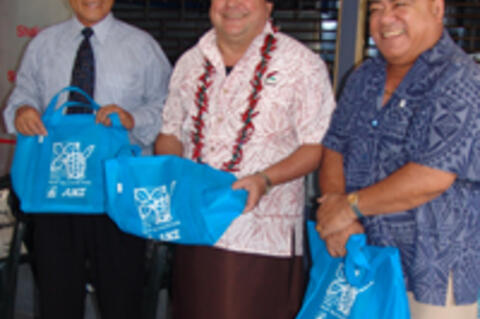
The Turtle Bag Initiative draws on cross-sectoral engagement to encourage shoppers to say "no" to plastic bags - instead purchasing reusable bags from supermarkets throughout Samoa for a recommended retail price of SAT4.00. (For every bag sold, one of the private sector partners, ANZ Samoa, will donate SAT1.00 to a fund which will be distributed to community-based turtle conservation initiatives).
Supported by this cross-sectoral approach to coordination and implementation, SPREP and its private sector partners used a "flagship" species - the "loveable turtle" - to discourage an unsustainable behaviour: using non-biodegradable plastic bags. Printing and distributing the bags as part of the Year of the Sea Turtle was a deliberate, promotional exercise; working closely with the members of the private sector was designed to ensure that a system is now developed for continued supply.
The first step of the social marketing plan was to raise awareness about turtles and the threat of floating debris to sea animals, in part through the launch of, and activities implemented as part of, the Year of the Sea Turtle. In addition, a 3-minute video clip/song was developed by a local Samoan "boy-band" that included an emotive plea to say no to plastic for the sake of Pacific culture and heritage. This film clip was played on Samoa Broadcasting Corporation (SBC) television in the weeks leading up to the official launch of the Turtle Bag. Finally, a series of articles appeared in national and regional publications about the Year of the Sea Turtle and promoted the importance of not using plastic bags and using reusable bags.
However, underlying this initiative is the belief that sustainability can only be achieved through convincing people to take action - that is, to go beyond education. Thus, SPREP worked to identify, communicate, and promote single, easy actions that people can do to reduce their impact on their environment. In effort to effect this behavioural change, organisers looked at barriers to action - both real (e.g., the plastic bags are handy around the household for rubbish removal and storage, and the shopping norm is that all goods are placed within plastic bags) and perceived (e.g., "Nobody else is doing it" - fear of standing out).
Reflecting on these barriers, they developed a list of incentives for using the Turtle Bags: They are a "better" way to carry goods home from supermarkets (biodegradable bags break easily), they are "attractive" and distinctive, there is a "feel-good factor", and one contributes to the ANZ Save the Turtle Fund by purchasing a bag. To make these incentives concrete, supermarkets in Samoa coordinated in-store promotions to encourage their shoppers to bring their Turtle Bags when they go shopping. To strengthen these incentives, SBC provided free air time to show Turtle Song and television commercials, in addition to including promotional opportunities in feature shows.
Environment.
Six out of the 7 recognised species of turtles are found in the Pacific, and - as all the world's turtles are endangered - the campaign aims to foster collaboration to strengthen and streamline conservation initiatives. One of the key priorities of the Year of the Sea Turtle is the reduction of threats to turtles. The global figure of 100,000 is used to describe the numbers of turtles that die each year from consuming, or becoming caught in, plastic bags and other debris.
The Turtle Bag Initiative was launched in August 2006 by the Minister for Natural Resources, Environment and Meteorology (MNREM), an event which was also attended by the Honourable Prime Minister and Deputy Prime Minister and other dignitaries and guests. Organisers say that engagement of these and other high-level partners ensured "buy-in" from corporate sector, increased longevity of the initiative, ensured broader marketing potential, strengthened collaboration around a key issue, and demonstrated interest in sustainability issues.
Organisers explain that the Turtle Bag provides a low-cost, attractive and viable alternative to plastic bags in Samoa. The Turtle Bag also supports the ban on non-biodegradable plastic bags introduced by the Government of Samoa on June 1 2006. SPREP is currently exploring options to launch the Turtle Bags regionally.
SPREP, ANZ Samoa, AQM, Pacific Forum Line, SBC, MediaScope, and MNREM.
Email from Tamara Logan to The Communication Initiative on December 17 2006.
Comments

Hi Tamara
I hope that you are able to return this email.I am trying to find someone who possibly has your social marketing background, to work on an ADB Clean Energy Fund project. Do you kinow anyone who muight be suitable who I can contact?
regards
Marion ferguson
email: marion. ferguson@xtra.co.nz
PH 64 4 027 240 7130