










































Turkey Explores the Internet, Along with Restrictions

According to this online article in New Media and Development Communication: Human Rights: New Challenges and Applications from graduate students of the Columbia Center for New Media Teaching and Learning, Columbia University, New York, NY, United States, "[i]n Turkey, [internet] censorship is not only affecting political activists, but average citizens as well. Access to the popular video-sharing site YouTube has been blocked since May 2008, and many blogs have been closed. A key role is being played by the new Internet law no. 5651. Turkey's restrictions on the World Wide Web offer three cases which illustrate the tensions between censorship and participatory democracy. One is the restriction on (political) speech, especially where it constitutes an insult to "Turkishness" or Turkey’s founder, Atatürk. A second case corresponds to "citizen censorship," the involvement of citizens in the government’s censorship effort. The third is the crudeness with which websites are being blocked in Turkey." This article "seek[s] to expose where tension exists between current practices and the needs of an open democratic society."
Examples of this tension include the following:
- Insulting Atatürk and Turkishness - "Many of the current controversies regarding freedom of expression concern Turkish penal code 301, which penalizes 'insults to Turkishness.'" The code has been used against authors, editors, and publishers, including a conviction for calling the Armenian tragedy of the early twentieth century genocide. The role of minority societies is also controversial, particularly regarding Kurdish ethnic organising and publication. A May 2007 Bill 5651 regulates the internet more specifically than other media. "The new "no-go" criteria were: encouraging suicide; sexual abuse of children; facilitation of drug abuse; provision of dangerous substances for health care; obscenity; prostitution; gambling; or crimes regulated in Turkish Code 5816 (crimes against Atatürk). It is especially the last of these crimes which transgresses social norms that are commonplace in most other countries." YouTube is blocked under this law. "The key of the YouTube revolution was its ability to provide drive space and access to videos of private persons, but today more and more organizations are using the platform for their video content. Turks are therefore excluded from an important part of information on the web, and cannot actively contribute to it either (by posting videos)." YouTube has refused a government request to open a local representation in Turkey and thus further submit itself to accountability there or to requests to make specific videos inaccessible worldwide. Turkey also seeks extradition of people posting some of those YouTube videos from other countries.
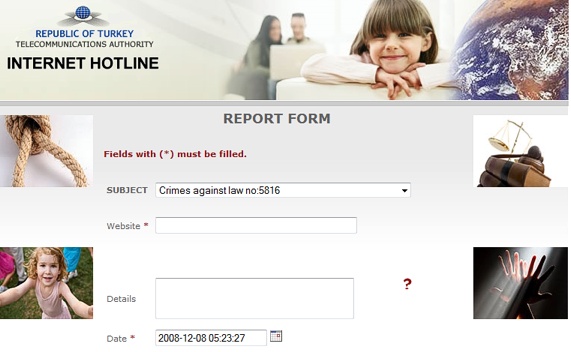
- Citizen Censorship - "Turkey encourages a 'democratization of censorship.' Private Internet users have the option to file complaints about specific websites. In fact, Internet users are encouraged to do so by using the “hotline” to alert the Telecommunications Authority, the government agency that is supposed to implement the Internet law 5651. Violations of the law can be reported to the agency through a telephone number, by e-mail, or by filling in a simple web form on its website [shown in the screenshot above].... Web users worldwide can report not only on 5651-violating websites, but also about an e-mail, newsgroup, instant messaging, chat, P2P, or other [including private conversations]....That brings back the dimension of societies desiring to protect their distinct norms. Yet some of these restrictions can be seen as infringing on the individual right of every human being (to express oneself, to access information, to exchange ideas)."
- The Blunt Instrument of Censorship - The article notes that frequently entire sites are blocked by the government censors for infringements found on a limited number of pages, as in the case of YouTube. The author points to several cases of accusations leading to censorship by individuals or organisations with commercial or ideological motives, including promoting a personal belief in creationism by blocking sites mentioning evolution, and blocking blog sites posting sports clips which were being streamed for profit elsewhere.
- Web Surfer Response and Transparency - Two citizen responses of protest include: Five hundred Turkish websites shut themselves down for a day of protest. Many Turks have started using proxy servers to gain wider web access.
The article concludes that these action of censorship have led to contentious debate and have, in the minds of some, damaged Turkey's reputation on human rights and impeded its entrance into the European Union. However, it is noted here that "Turkey does not block views that are unfavourable to the government, nor does it imprison those who voice such criticism. For such reasons, Reporters without Borders will not define it an 'enemy of the Internet' (a state which extends its repression offline to the online realm). It does however, potentially, imprison those whose views can fit in the stretchable category of 'insulting Turkishness,' it blocks sites with relative ease and extensiveness, tries to exert Internet jurisdiction outside of its territory, and seems to have little regard for freedom of the Internet as a basis. The tendency to censor instead of protecting civil liberties may be reflective of seeing itself as being vulnerable. Perhaps no country should be forced to face up to difficult passages of its history, yet perhaps no country should disable its citizens’ ability to do so."
This material was created in the 2008 class "New Media and Development Communication" with Professor Anne Nelson, Columbia School of International and Public Affairs (SIPA).
Email from Anne Nelson to The Communication Initiative on April 22 2009.
- Log in to post comments