










































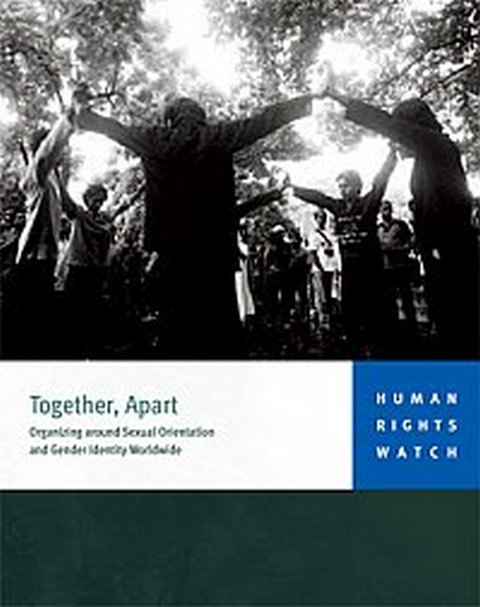
Together, Apart - Organizing around Sexual Orientation and Gender Identity Worldwide
Human Rights Watch
This 44-page Human Rights Watch report intends to give a picture of a global human rights movement around issues of sexuality and gender. The report is based on written surveys and in-depth interviews with more than 100 activists organising against discrimination and abuse for lesbian, gay, bisexual, and transgender (LGBT) rights in five regions: sub-Saharan Africa; the Middle East and North Africa; Eastern Europe and Central Asia; the Asia and Pacific region; and Latin America and the Caribbean. In each region, the report outlines: prevailing patterns of abuse and rights violations; the political and social challenges, and opportunities that activists see ahead; and key strategies these movements are using to achieve social change.
Findings include the following:
- "Organizations working on sexual orientation and gender identity are still under-resourced and severely isolated....The most important victories have been won by overcoming that isolation. Where signal successes have been won, as in Latin America, they have sprung from negotiations and coalitions among social movements. Integration with other human rights struggles needs to be the first priority in approaching sexual rights. We need stronger political alliances, and conceptual frameworks in which the commonalities between issues can become clear....
- Daily, defenders of LGBT people’s rights, and sexual rights in general, face extraordinary levels of violence....Considering carefully how human rights advocacy can be effective in a culturally charged atmosphere of moral panic is crucial....
- Sexuality has become a cultural and religious battleground....Finding ways to respond to fundamentalisms in human rights terms is complex, and crucial. Many groups we spoke to are practicing a cultural activism of their own, seeking to reach a public through art or images....One women’s rights activist told us that “we need voices inside” religious communities and other groups that claim monopolies of meaning....
- Changing laws is still a central issue - but in many different ways....Repealing sodomy laws across Latin America in the last 20 years opened up new political space for LGBT people’s movements. Getting rid of a sodomy law and enshrining non-discrimination in South Africa produced an example of global importance."
- Identities aren’t everything. In many cases, it is far more productive to talk about rights issues than about identities. Talking about 'gay rights' in Egypt or Iran makes no sense to most activists or to the public at large. However, talking about privacy or freedom from torture provides a frame many people can readily understand. By contrast, in some eastern European countries where minority rights have been a key political issue for two or more decades, discussing “sexual minorities” is still a valuable terminology.
- Differences cannot be papered over. Rights principles may create common ground for LGBT movements, but different approaches as well as multiple identities are still real. It is critical at all points to ask who is left out and who is included....The predominance of funding for HIV forces groups into a health framework, and shunts them into service provision, sometimes at the expense of political advocacy.
- Building better networks for support and communication is crucial. The different agendas and goals of groups in far-off places interact in unforeseen ways...But stronger networks for steady communication among movements - in the same regions, and around the world - are badly needed, so that groups can anticipate what is coming, and plan together."
Location-specific communication strategies include:
- In Africa, this observation comes from Nigeria, "An opportunity to dialogue with the police, if funded, would be one of the best options in dealing with homophobia." Other regional strategies include: build networks of sympathetic health professionals, religious leaders, and lawyers; and train reporters and editors on issues of human rights, homosexuality, confidentiality, and respect.
- In the Middle East, activists envision small outreach projects to reach individual journalists, family members, and each other, particularly with information.
- In Eastern Europe, entrance to the European Union offers some basis for human rights protections. Lobbying for cultural change through mass communications is suggested - using theatre and film, as well as lobbying for legal changes.
- In the Asia-Pacific region, provision of HIV services has opened a door. "Nepal’s leading LGBT group negotiated the thickets of HIV/AIDS funding, found its own path from service provision to political advocacy, and changed the country." In India, litigation is raising community and national awareness on a range of issues, including those involving LGBT sex workers. In Indonesia, LGBT activists, after cautious bridge-building with the Ministry of Religious Affairs, have quietly engaged in dialogues and trainings with young imams, raising issues of sexuality and gender.
- In Latin America, challenges include training and monitoring officials, reaching out to government and state ministries to enforce non-discrimination laws. Brazilian groups campaigned for a national law to criminalise homophobic hate speech. Paraguayan activists are building a broad coalition of civil society organisations supporting a law against "All Forms of Discrimination". Regional encuentras (gatherings), trainings, or networks are focused on lobbying and taking legal cases to Inter-American human rights system institutions.
Human Rights Watch website, February 10 2011.
- Log in to post comments