










































Street Children's Campaign Partnership
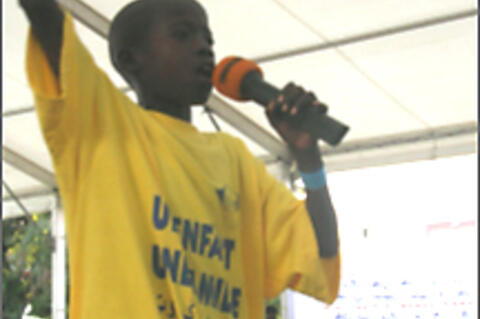
This campaign is founded on the principle of partnership. Working with two main daaras or Islamic schools (namely, Daara de Malika and Empire des Empire des enfants) as well as other structures dealing with street children in Senegal, organisers hope to reunite hundreds of street children with their estranged families and to establish a dozen or more centres offering protection and care for those who cannot go home. The Partnership began by piloting the project in Kolda, Tamba, and Matam, the three main cities from which the majority of street children originate. In those cities, the Partnership identified a number of youth coalitions including the Network of Agencies for Children and Youth in Difficulty (COSAED) and Coalition Nationale des Associations et ONG en Faveur de l'Enfance au Sénégal (CONAFE) that were already working nationwide on the matter. The organisations help with the implementation of activities related to bringing the children back to their homes or offering them temporary rehabilitation.
The strategy of involving religious leaders is understood as central, based on the observation that many street children are victims of child traffickers posing as marabous (religious leaders who teach the Koran). They kidnap the children from villages and take them to Dakar, where they are forced to beg for handouts in the streets; under threat of beatings, the children must give the money to their masters. Thus, Senegal's religious communities were engaged to denounce this practice, focusing on lamenting the fact that the country's tradition of teaching young boys the Koran has been distorted and exploited in this way.
Specifically, the Partnership launched a communication campaign in order to raise awareness and gain support. Organisers are working closely with domestic and foreign media, with a special focus on strengthening relations with media working in rural areas. The project is involving affected children in raising public awareness by working with them to produce songs, poems, and artwork for the PSAs. The hope is that these communications will reach government officials, businesses, and civil society (including faith communities and NGOs) - raising awareness and gaining political, social, and financial support for the cause of street children and their needs.
Other communication activities include: inviting artists (musicians) and football stars to promote the cause; organising round tables, conferences, and workshops; publishing survey results; and producing audio and visual communications.
Children.
Organisers maintain that, despite a large body of research on street children prepared with the supported of NGOs, UN agencies, and the World Bank, past efforts have been unable to put an end to the issue of street children in Senegal. Although the government has enacted laws to protect families and children, they are not enforced. Meanwhile, the general public has come to accept the sight of boys as young as 4 years old begging on city streets. Many unwittingly encourage the situation by giving the children money, food, or other small gifts. However, the practice of begging is in itself dangerous as many children disrupt traffic and become involved in accidents. Concerned by the situation, the World Bank's Country Director Madani M. Tall, in coordination with government officials, the donor community, civil society, and other advocates for children, set up a steering committee and tasked it with studying the issue of street children and proposing a response.
World Bank, Government of Senegal, UNICEF, UNESCO, French Cooperation, ILO.
Email from Helene Pieume Matam to Soul Beat Africa on January 31 2007.
