










































Self-Directed Research of Public and Environmental Health Problems by Indigenous People in Suriname
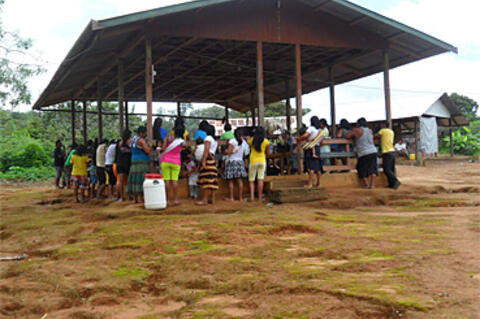
"The process was characterized by a cycle of dialogue, reflection, and action. This method relied less on the methodological framework than it did on the relationship between the researchers and the community....The community-directed approach increases the visibility of researcher and the transparency of their intentions, which are significantly greater than in conventional research."
This study was a collaboration between Western public health researchers and Suriname indigenous communities. The question asked was "how can Western researchers effectively engage traditional indigenous communities in Suriname, South America, in public health research?" This study began in 2007 with the overarching objective to empower the Wayana communities of Puleowime (Apetina) and Kawemhakan (Anapayke) in southeast Suriname to determine for themselves the risk of exposure to contaminants from gold mining, especially mercury (Hg), on their health. To this end, a community-led research design was created in partnership between community leaders in two Wayana villages and two non-governmental organisations (NGOs).
This study worked with Wayana community leadership to create a collaborative environmental health research project. To respond to what organisers describe as "[s]uppression of public health research on the impacts of mining and Hg contamination from gold mining by government and non-government organizations", the approach used a combination of Participatory Action Research (PAR) methods in which "Western" researchers became participating observers in an indigenous-led research initiative. This form of research is a pragmatic integration of both scientific and traditional knowledge systems. Western science focuses on hypothesis testing by data collection and statistical analysis. Indigenous traditional knowledge is based on cumulative experience, close observation, and oral knowledge communicated by elders and handed down over generations. "Methodologically, outside experts became learners, facilitators, and catalysts in a process that gathered momentum as the community came together to analyze and discuss the research process and the results it yielded."
Specifically, local NGO Stichting Wadeken Wasjibon Maria (SWWM), in partnership with the United States (US)-based Suriname Indigenous Health Fund (SIHF), held group discussions in Puleowime (Apetina) and Kawemhakan (Anapayke) to define roles and responsibilities and identify issues critical to establishing an effective, cooperative partnership between the scientists, health professionals, and the community. All meetings were held in the Wayana language. The elements of the community-led research process were as follows: (1) outside science experts were issued an invitation by community members to participate in a co-directed study; (2) community members co-developed a research plan according to appropriate scientific procedures and traditional cultural norms; (3) data were collected by trained community members; (4) data were owned and interpreted by community members; and (5) community members made the final determination for the disposition of research results according to traditional decision-making processes.
Leaders from Puleowime (Apetina) and Kawemhakan (Anapayke) chose to collect hair samples for analysis (as opposed to blood or urine) because it is the least invasive sample to collect and the best indicator of dietary exposure to Hg from fish. Community members received training from SWWM educators and collected hair samples for analysis using methods designed to maximise sample quality and consistency and minimise cross-contamination. Community members, with the assistance of representatives from the SWWM, collected and submitted hair samples for Hg analysis from 158 people in Puleowime (Apetina) and 106 people in Kawemhakan (Anapayke).
SWWM and SIHF consulted with the communities throughout the process. Individual, community, and hazard quotient indices were used to quantify risk. After the risk assessment analyses were complete, meetings were held to discuss the results and answer any questions the community had regarding the data. Next, a community meeting was held to reflect on the process, outcome, and future needs. A physician was in attendance to answer questions from the community. The attending physician performed limited examinations on persons who requested a consultation because they thought they had been exposed to potentially hazardous levels of mercury. The purpose of this examination was to address their concerns, alleviate anxiety, determine whether their concerns had merit, and provide a baseline for future health monitoring.
The communities then asked SIHF and SWWM to help write a report communicating results of the community-directed risk assessment. The report was drafted in English, translated into their native language (Wayana), and reviewed. Regardless of the other languages understood by the people in Puleowime and Kawemhakan, they were only able to fully understand the details of this complex problem when the report was translated into their native language for their review, comment, and approval. As a consequence of this process, the communities reportedly now want to repeat the education programmes presented previously by government and NGOs - this time in their Wayana language.
Health, Environment
According to SIHF, since the early 1990s, there has been an explosive increase in gold mining activities in Suriname. It is estimated that between 10 and 60 metric tons of mercury are used in mining and released into the environment in Suriname each year. Hair analysis results indicate that the general population living in areas where gold mining occurs may be exposed to mercury. Mercury levels found in human hair in the volunteers from the southeast region of Suriname ranged from 2 to 15 ppm. Clinical signs of mercury toxicity were observed including ptosis, and impaired hearing, sight, and speech.
As part of the process of the research process described above, residents challenged suggestions made by Westerners that communities impacted by Hg contamination must eat small, young fish from the lowest possible trophic level; residents noted they do not often have a choice. "We eat what the river gives us. We tried eating only the fish we were told to eat but could not catch enough and after 3 or 4 months we had to quit trying." Instead, communities want to focus on integration, education, land rights, human rights, and the root causes leading to a wider range of problems that includes risk from exposure to mercury.
SIHF says that "[k]nowledge and information empowers people to become vocal participants in the political decision-making process. We provide the indigenous people in Suriname with the materials and technical support they need to negotiate and apply pressure for socially and environmentally responsible activities in their own territories. Informed communities are able to demand and shape transparency and accountability in the activities of governmental and nongovernmental organizations. This is the first step in gaining control of the research and intervention process and improving the quality of life of their communities."
SWWM and SIHF. Financial support for this project was provided through an International Engagement Award from Wellcome Trust.
"International Engagement Awards: Projects funded in 2010" [PDF]; "Community-Led Assessment of Risk from Exposure to Mercury by Native Amerindian Wayana in Southeast Suriname", by Daniel Peplow and Sarah Augustine, Journal of Environmental and Public Health, 2012; and SIHF website, November 19 2012.