










































Scope, Opportunity and Challenges of TIE (Theatre In Education) in Primary Education of Bangladesh
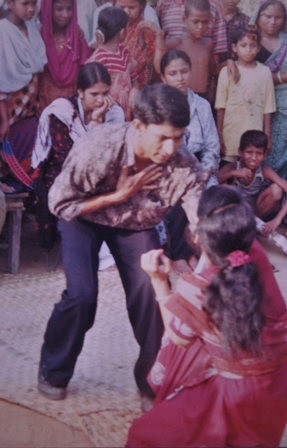
Following an overview of the challenges associated with access to primary education in Bangladesh, this paper describes the way in which theatre in education (TIE) is being used an alternative education process to make learning more effective and appealing in that country.
As detailed here, TIE is grounded in Augusto Boal's Theatre of the Oppressed (click here for background), which involves using theatre as a medium for providing lessons in the educational setting. As part of a continuous process, a trained theatre team or group of performers prepares a play, drawing on the school curriculum or events from learners' personal lives. They stage it at the school wherever the theatre company can accommodate it. Key to this process is the active participation by performers and learners; in the author's words: "One of the most effective terms of TIE is to confirm constructive participation where they have been fallen into such experiences so that every theatrical moment would realizable for themselves. They could act-react with the characters and be able to take decision in complicated situations."
More specifically, TIE is a programme built around a play, integrating theatre with education. The objective is not to directly instruct the pupils but, rather, to - through a participatory process - raise an issue or theme which they then can discuss and relate to with their own lives. TIE is presented in 3 steps: a pre-performance interactive workshop based on the theme of the play, the performance of the play, and a teacher's resource pack containing detailed information on the targeted themes of the programme.
The author explains that: "The objective is not to stun and paralyse them with the power of theatre but to induct them into the process of thinking, analysing acting. In the forum following the play, the students are shown a scene from the play. The problems contained in this scene are similar to the problems the students had encountered earlier when they were actors. Students are questioned about options and choices, courses of action available to them and are given the opportunity to take on the role of the central characters to test out their ideas. This method of working means that the TIE team has to be very clear about the motivations and anxieties of the characters involved and portray these truthfully and in a way that is identifiable to the students...In TIE, the audiences are encouraged to articulate their own ideas and are either challenged by each other or by the Joker [a neutral party at the centre of the proceedings]..."
The author concludes that: "In Bangladesh the theatre is still at the fringe of mainstream education. The few who are interested in educational theater find the challenge of developing a viable praxis daunting because of the reductive and prejudicial view that theatre is about presenting non-threatening, pretty plays which challenge no assumptions, open no access to knowledge, liberate no understanding and are content to simply entertaining. But, the TIE has the scope to open such kind of situation that encourages thinking, as well as seeks to provide children with both a 'filing cabinet' of cognitive and experiential ideas that they can tap into throughout their classroom lessons, surroundings, lives, and the opportunities for them to constantly sharpen their skill and expose themselves to all kinds of experience..."
Emails from Alim Al Razi to The Communication Initiative on November 15 2010 and February 4 2011.
- Log in to post comments