










































Scaling-up Sustainable Aquaculture Development in Sri Lanka
A two-year International Development Research Centre (IDRC)-funded project identified challenges to the sustainable management of aquaculture in Sri Lanka, including poor knowledge mobilisation and low connectivity, particularly for smallholder farmers. Pilot interventions tested the effectiveness of mobile short text messaging (SMS) to disseminate information to farmers and others in the aquaculture industry. Building on this project, researchers from Wayamba University of Sri Lanka (WUSL) and the British Columbia Aquatic Food Resources Society tested three ways of scaling up smallholder aquaculture development in the northwestern, northern, and eastern provinces. The information and communication technology (ICT)-based project sought to reach about 2,000 smallholder aquaculture farmers involved in shrimp and oyster cultivation, as well as fish farmers, particularly women, who play a large role in the industry. The goal was to increase production and income for these farmers by 75%.
The central hypothesis reflected in the primary objective of this project is that sustainable aquaculture systems - defined by farmers implementing better practices, achieving higher productivity, and enjoying increased incomes - can be built through interventions that directly focus on improving knowledge connectivity and knowledge sharing. Knowledge mobilisation as defined by the project encompasses the products, processes, and relationships among knowledge creators, users, and mediators - both individuals and organisations - and attempts to address the spectrum and multi-directionality of knowledge, from the generation of data, to information and evidence, to knowledge sharing and exchange, to its implementation and application serving the common good. Knowledge mobilisation involves analysis and interventions conducted to increase connectivity of all of the participants in the network of particular food production systems.
Three main knowledge mobilisation strategies were devised and targeted to address critical production constraints identified in each of the three sectors: (a) enhancing the social knowledge-sharing networks including using ICTs such as mobile phones and a web-based platform to boost adoption of better practices, risk reduction, and value chain strengthening tested with shrimp farmers, (b) adopting foundational structures and processes for "co-management", facilitated by knowledge sharing, by both farmer organisations and relevant state agencies in the seasonal reservoirs of the inland aquaculture sector and in the better management practices (BMPs) of the shrimp farming sector, and (c) building capacity for knowledge and technology adoption in resource-poor coastal communities (specifically reaching out to women as key participants) and integrating them with private sector actors, developing markets, and state agencies that are building natural resource management as well as public health and food safety capabilities. These were complemented with capacity enhancements including equipping and operationalising a lab for shrimp pathogen detection, enhancing and operationalising six nurseries for improving fingerling supply, as well as establishing a research and training nursery at WUSL and strengthening production of oysters, processing them through depuration (purification) systems, and monitoring for environment and food safety.
The assessment of the baseline status with regard to identified attributes in the inland and coastal aquaculture sectors was conducted in December 2013 and January 2014 using a participatory process. Ten communities representative of the three sectors and of different regions were selected for participation. A facilitated process was implemented in each, with a total of approximately 400 community members participating. The participatory rapid appraisal (PRA) processes and detailed investigations using key informants and focus groups helped identify various constraints and limitations on gender equity. They also provided insight into areas for development and policy interventions that are likely to promote gender equity and increase the role of women in contributing to overall productivity enhancement in the three aquaculture sectors. This reflected the project’s strategy of striving towards a "performance-based accountability", with more transparent and inclusive participation that improves the likelihood that project interventions will achieve a demonstrated impact that is tangible to the stakeholders.
Young people were one of the groups engaged in the ICT project. For example, a standardised procedure was developed, and 10 groups of youth from among the farming community clusters were trained to undertake water quality testing and assist farmers with information gathering and implementation. Data on water quality and farm issues were gathered by these trained persons, with each cluster equipped with laptop computer, internet access, and a set of water quality instruments. Data were entered onto forms, and the forms uploaded to the database built on the web platform. These data would then be accessible for review by an expert group comprised of technical experts in the industry and project researchers. Once the group validated information uploaded by clusters, the incoming information was assessed for potential risks and conditions that warranted an advisory or alert to farmers. The web application was also programmed to detect any abnormal readings in water quality parameters and to automatically generate an email alert to the experts. These experts would then communicate over the web platform to evaluate the alert levels of water quality parameters and decide on the content development for short messaging. Once messages to farmers were formulated and target farms identified, the message was sent by a team member to designated farmers. Messages sent were also archived for monitoring and reference. A hotline number, monitored by Sri Lanka Aquaculture Development Alliance (SLADA), was made available with a response person on standby to answer farmer questions or respond to alerts.
Furthermore, knowledge resources and training material was published, distributed, and posted on the Aquaculture Lanka website (available in local languages) and also shared with farmers in print format. These included manuals on Best Management Practices, Shrimp Diseases and Health Management, and Water Quality Management. Leaflets focused on Using Water Quality Testing Equipment, Pond Preparation, Pond Bottom Management, Biosecurity in Shrimp Farming, and Utilisation of Acid Soils for Coastal Aquaculture. Knowledge resources for culture-based fish production were developed as training posters to help farmers understand fish species, their distribution in different depths in reservoirs, and steps for developing viable farmer organisations and participating in co-management.
Rural Development, Poverty, Food Security, Gender
A case study on gender in aquaculture and the expectations, constraints, and opportunities in becoming engaged in oyster culture activities was conducted in March 2014 using the communities at Gangewadiya and at Kandakuliya. A survey of women stakeholders from the three project districts was also conducted in September 2014 using a structured questionnaire to assess the project outcomes on gender roles and status.
Among the findings: Despite the fact that 78% of the women in the two communities of Kandakuliya and Gangewadiya had completed education through grade 10, they had been unable to transform this attainment into more equitable positions in the capture fishery value chain They were also unable to find opportunities in the villages to undertake employment or engage in entrepreneurial activities that would provide a means to increase their contribution to household income or build a larger asset base. Food security is a high concern among these women, since income is episodic and inconsistent. Although they reported spending an average of 39% of income on food, 87% of them indicated that they needed to borrow to meet household food expenses at some time during the year. There was also a high level of housing insecurity related to ownership of land or fear of loss of housing. Access to clean water and inadequate sanitation facilities were also cited by women as challenges in maintaining households.
A few factors emerged as common themes in the gender analysis of aquaculture in Sri Lanka as well as from a literature survey of women in fisheries and aquaculture. Firstly, women are attracted to aquaculture by the need to earn supplementary income, but this is done in addition to or integrated with existing household and community responsibilities, and this constraint largely prescribes their involvement, demanding flexibility. Secondly, the domestic or reproductive burden limits the ability of women to participate in aquaculture and specifically in traditionally delivered training activities such as workshops, field schools, or demonstrations, where being away from home is required. Thirdly, access to productive resources such as land (in cases where land is required for aquaculture activities such as pond or tank construction), and machinery and equipment can constrain the participation of women as enterprise owners or managers. Fourthly, women are typically less mobile than men, and distance from home is an important consideration for women engaging in aquaculture. Finally, women are often marginalised from traditional forms of extension for knowledge acquisition and training, and these must be adapted to women's situations and context.
The analysis demonstrated that it is also important to understand how the opportunity of aquaculture for women in poverty is embedded in household and social norms, relationships, and practices with respect to access and control of resources and income. This identifies what specific constraints they face, what decisions they make, and whether their decision-making is in fact choice or necessitated by a constraint. The strategy in the project was to consider where there could be more "space" for women and where opportunities could be developed in areas where they already have some degree of decision-making or control. For example, gathering clams or small fish from a lagoon often plays an important role in household food security. This activity may be more easily transitioned to women than, for example, taking over fishing activities normally carried out by men. While this may be initiated in a way that does not directly challenge social norms and practices, as women take on new types of responsibilities, decision-making, negotiating, and leadership roles, it can also be transformative.
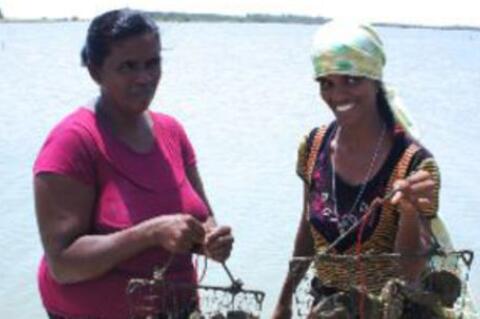
Researchers say that, as a result of the project, positive outcomes for small-scale shrimp farmers were significant, particularly in the Northwestern Province (NWP). For example, overall, farmers with fewer than 5 ponds in NWP increased production yields per acre from an average of 740 kilograms in 2010 and 832 kilograms in 2013 to an average of 932 kilograms in 2014, a 26% increase over 5 years and a 12% increase from the previous year. Communities participating in the oyster culture pilot projects at Gangewadiya and Kandakuliya earned approximately 22,500 LKR per month in the first 4-month cycle of production from the pilot sites, a significant addition of 1,500 LKR per month per household where at least 85% of households earn less than 100,000 LKR annually. Moreover, it was women taking the leading role in this emerging area of aquaculture.
Wayamba University of Sri Lanka (WUSL) and the British Columbia Aquatic Food Resources Society (Canada). Funded by the International Development Research Centre (IDRC).
Emails from Liane Cerminara to The Communication Initiative on October 4 2017 and December 7 2017; and IDRC website and Final Technical Report [PDF], November 8 2014 - both accessed on October 5 2017.
- Log in to post comments