










































Sawa Le Baad - Together for Each Other: An Integrated Social and Behavior Change Strategy for Family Planning and Maternal, Newborn and Child Health
"At 1,150 deaths per 100,000 live births, South Sudan has one of the highest maternal mortality ratios in the world."
This report documents the social and behaviour change (SBC) strategy used for the Breakthrough-ACTION-designed Sawa Le Baad (Together for Each Other) programme, which sought to reduce maternal, newborn, and child mortality and morbidity in South Sudan. Based on the experience of Sawa Le Baad, the report provides insight into the process of developing and implementing an integrated and multi-level SBC strategy to address health challenges in a conflict-ridden country. It explores the context in Sudan; the objectives, strategy, approaches and messaging that guide the project; and the programme's approach to evaluation and monitoring.
As explained in the report, Breakthrough ACTION South Sudan (the Project) was a two-year SBC project designed "to nurture an enabling environment that leverages and grows the existing system of community support for increased and equitable access across the service delivery continuum. The Project is tasked to co-design, develop, pilot, and refine SBC packages that will be utilized and implemented by multiple USAID-supported projects and host country government programs as well as donor and multilateral supported activities that focus on family planning and reproductive health (FP/RH), gender-based violence (GBV), maternal, neonatal and child health (MNCH), water, sanitation, and hygiene (WASH), and resilience."
Following a discussion on the context of South Sudan, the report outlines the principles of engagement that guide how the project conducted and framed its activities. These are: a strength-based approach (leveraging strengths, existing assets, and aspirations - not problems and deficits); a conflict transformation approach that considers the fragile context of South Sudan and prioritises justice and fairness in all engagements; the use of trauma-informed tools and practices that take into consideration the impact of trauma on health seeking behaviour and provider trust; and a gender-transformative approach that ensures that the project systematically integrates gender across its work, including in each health area being addressed, in addition to research and monitoring and evaluation (M&E) activities.
The report then outlines in detail how the Sawa Le Baad project was developed and implemented, highlighting some of the key takeaways in separate "Guidance" sections. In brief, the following is covered:
Strategy objective
As explained in the report, the overall objective of the Sawa Le Baad strategy was to reduce maternal, newborn, and child mortality and morbidity. This would be achieved by:
- Improving health-seeking experiences and reducing provider bias;
- Encouraging timely health-seeking behaviours and practices through increased awareness and knowledge;
- Increasing acceptance and demand for family planning (birth spacing) services; and
- Contributing to a more enabling environment through education, promotion, community dialogue, and more equitable gender norms.
"Sawa Le Baad" branding
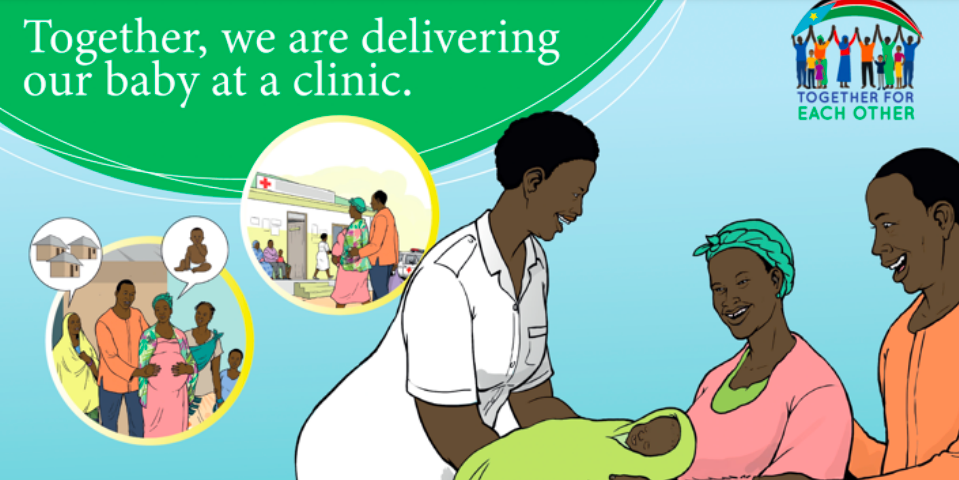
The concept of "Sawa Le Baad" (Together for Each Other) is the overarching and original SBC brand developed by the project that provides a culturally appropriate framework to design SBC interventions that seek to build trust, achieve gender equity, balance inequitable power dynamics, and sustain healthy behaviours. The concept reflects the importance and meaning of providing a level playing field - the idea of "justice and fairness", especially regarding gender equity and power relations between men and women, health providers and clients, and community leaders and members. The brand is designed to be unifying and flexible to encourage trust and inspire equitable access to and engagement with health services. As a key takeaway here, the report highlights the importance of an overarching concept or brand that can be used to develop integrated SBC programmes designed to cohesively address more than one health or development issue within the same programme.
Framework
The report describes the framework that guided Breakthrough ACTION South Sudan. Called Pathways™ to Improved Health, it was developed by the project to identify causal pathways to health behaviour outcomes via the socio-ecological model. This framework encourages projects to design and test SBC interventions across social-ecological levels, as appropriate: at the individual, family and household, community and opinion leaders, provider and facility, and subnational and national levels. The framework links specific indicators to multiple outcomes and arranges intermediate outcomes in a gender analysis framework, providing a structure for organising information about gender roles and relations. As a key takeaway here, the report notes that SBC programmes are more effective when they are based on social and behavioural science theories or frameworks. A programme theory or framework provides a map for looking at the problem, designing interventions, and evaluating programme success.
Audience
The report explains how the audience for Sawa Le Baad was grouped across the levels of the socio-ecological model (individual, household, community, service delivery, and enabling environment), as well as how audiences at the individual level were broken up by life stage (e.g., adolescents, parents with first child, parents of young children, etc.) As a key takeaway, the report notes that communication should not be designed to address everyone and that audience segmentation, based on research, allows one to be more specific in the design of messages and interventions.
Communication objectives
The report discusses the specific communication objectives of the different focus areas of the programme: FP, maternal health, community support, health-seeking experience, and gender. For example, under FP, one objective is "To increase the self-efficacy of the audience to discuss, agree upon as a couple, and plan to access family planning (birth spacing) services." For maternal health, one objective is to "increase the number of the audience who know the importance of attending antenatal care." As a key takeaway, the report notes that communication objectives are important, as they clearly and concisely state the intended impact of communication efforts. They should also focus on addressing key constraints, or the biggest communication challenges.
Inside the strategy - approaches
As stated in the report, SBC is the coordinated use of a range of different channels or approaches applied across the social-ecological model to achieve individual and collective behaviour change. It discusses a number of available approaches: SBC communication, community mobilisation, social marketing, and knowledge management, as well as best practices from disciplines like human-centred design and behavioural economics. The report also outlines the different forms of communication that can be used, such as advocacy, digital media, entertainment education, interpersonal communication, and print media. The takeaway here is that the communication objectives will guide the selection of strategic approaches. Typically, several approaches will be used, either in a phased manner or at the same time and are determined by a number of factors such as literacy levels, cost, desired reach, etc.
Inside the strategy - messaging
In this section, the report outlines the overarching key messages for different audiences for the two priority areas: MNCH and FP (birth spacing). For example, one general message for MNCH is "Having a healthy baby begins with ANC [antenatal care]." A message for men is "Accompany your partner for antenatal visits from the first trimester." The takeaway guidance here makes the point that "when SBC materials and interventions carry well-designed messages that are closely linked to audience needs and the communication objectives developed, they will more effectively persuade the priority audience to change or adopt new behaviours." The report also highlights the importance of concept testing and pretesting when designing materials - in addition to designing communication products through a co-design process.
Finally, the report stresses the importance of seeking stakeholder consensus for the M&E of an integrated SBC programme, as this is important to set research priorities, allocate appropriate resources, select and harmonise indicators, facilitate sharing and utilisation of data, agree on reporting mechanisms (including how to prevent double counting), and disseminate findings. As a takeaway, it recommends an M&E plan, which is a document that helps to track and assess the results of the interventions throughout the life of a programme.
The appendices include examples of posters and radio scripts from Sawa Le Baad, as well as the indicator table developed by the project for M&E.
Breakthrough ACTION website on August 30 2024. Image credit: Breakthrough ACTION
- Log in to post comments