










































Sawa
The children's magazine Sawa was an entertainment-educational tool published (until 1994) that included not only school exercises, but also stories, arts and crafts activities, arithmetic lessons, and so on. Recognising that distribution would be complicated, UNICEF made use of the network of dispensaries it had managed to maintain in spite of the fighting. To publicise the magazine, UNICEF produced public service announcements (PSAs) for airing on local radio stations. The message was: "Kids, tell your parents to go to the dispensary when it's safe. UNICEF has something fun for you and your friends there." In the following weeks, 3 newsletters were produced and distributed free of charge; subsequently, funding was initially made available for 50,000 copies (later increased to 70,000) of the 30-page magazine every 6 weeks. Sawa was distributed via children's groups, day-care centres, playgrounds, churches, mosques, shelters, and other public areas. In addition, 10,000 copies of every issue were distributed to Palestinian refugee camps.
Each issue of Sawa focused on a central theme designed to take children beyond the confines of the shelters, stimulate their imaginations, encourage them to think, provide entertainment, and impart lessons in an interactive and approachable way. For example:
- Young readers were introduced to an inclusive view of the world through "Know Your Country", which took readers on imaginary tours to different areas of Lebanon. The goal here was to emphasise a common Lebanese identity to those children who tended to view people in terms of their religion, ethnicity, or clan affiliation.
- Similarly, "From Our Culture" featured Lebanese proverbs and folktales, or prominent figures from Lebanese history, often combining educational material on culture with a moral message. The features were designed to cut across ethnic and cultural lines.
- "Living Sawa" was the primary vehicle for promoting an explicit message of peace. This included stories and parables illustrating children's rights, solidarity, unity, and nonviolence.
- "Right or Wrong?" provided a chance for the children to decide appropriate forms of behaviour in different situations.
Sawa's approach was described as interactive, not paedantic; it sought to involve children on their own terms by seeing the world through their eyes. Each colourfully bound issue invited kids to play with word games, puzzles, jokes and riddles, colouring and drawing exercises, and magic tricks. Sawa's content was designed to send an unthreatening message while helping to fill the gap left by the closure of schools. Stories presented a problem or an exercise involving looking at the world from various perspectives. Sometimes the readers were challenged to finish a story.
Integrating the perspectives and experiences of children constituted a central component of the Sawa strategy. For instance, following the distribution of the first issue, UNICEF received 1,500 letters from children; in response, from the second issue onwards, Sawa devoted 2 pages to a section called "Have Your Say" in which children were encouraged to bring their contributions to the points where Sawa was distributed. (UNICEF soon received an average of 2,500 replies from each issue.) Selected responses were published in a "Return Mail" section that often included suggestions from readers on what content they would like to see next. A commentator exploring this programme has said that "it was from this source of feedback that the magazine began to take on a more overtly peace-oriented and activist role. Through Sawa, children spontaneously began to give expression to their yearning for a better life. Poems, pictures, stories, and prayers from the children talked about peace and possibilities, not about war and violence."
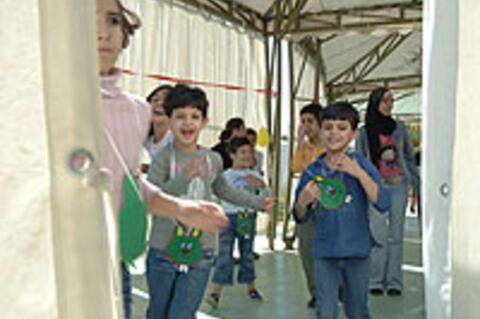
UNICEF also drew upon interpersonal communication - in the form of summer camp programmes - as a way to bridge gaps between children from across regional, ethnic, social and religious barriers. Fifty or so non-governmental organisations (NGOs) were asked to help recruit children and youth from their communities for camps designed to encourage "living together" positively, and to share human, social, and relational values, through creative and recreational activities. Reportedly, "[b]esides the benefits for the young campers who met each other and played together for the first time, the older monitors, some of whom had served as militia members during the war, also underwent a transformation." These trained "youth animators" participated with campers in a daylong "Peace Festival" alongside campers each September. By September 1991, UNICEF peace camps had reached 100,000 children and had mobilised 240 NGOs to work on the programme.
Children, Youth, Conflict, Education.
Organisers explain that, following a 14-year period of war, in March 1989 "the most densely populated areas of Beirut were subjected to an onslaught of rocket and artillery fire that was to continue intermittently, for more than a year....During the war years, UNICEF offered emergency relief assistance, health care and medicine, and educational programs in Lebanon....With the renewed outbreak of violence in 1989, traditional educational assistance was rendered impossible..."
Reportedly, "the Sawa and peace camp projects demonstrated that when peace activities are focused on youth, even ostensible adversaries may exhibit more tolerant attitudes. This may be because the adult community has a genuine wish for their children to live in peace, or because large segments of the adult community view children as a sort of 'zone of peace.' Whatever the reasons, the successful implementation of peacebuilding activities focused on children led to opportunities to expand the peacebuilding initiatives into the society at large."
"Uniting Children During War: Sawa–UNICEF in Lebanon", by Amal Dibo.