










































Save the Children: Community Health Worker Training
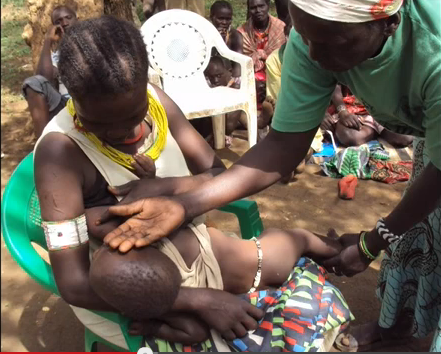
This 22-minute-long video-based training resource was created for Save the Children's Community Based Distributors (CBDs) and Community Health Workers (CHWs) in South Sudan in an effort to build capacity to properly fill out treatment registers when they are administering medication to children in their communities.
The training includes staff from the Ministry of Health, and though they are not necessarily the trainers of the CHWs, they sometimes participate in the sessions. These tools are also shared with other non-governmental (NGO) partners to use when training other CHWs. The Ministry of Health and NGO partners have been involved in the production of this training package.
Needs assessment is usually based on what is typically used in other similar programmes for training, and how this can be adapted to the country context. In the case of South Sudan, training resources were simplified and job aids with pictorials were adapted from a similar programme in Uganda. While the specific needs of each community Save the Children works with related to training materials may not be assessed, the programme team usually draws on ideas from existing materials, looking also at what other partners are using and discussing with Ministry of Health and field staff what would be useful in designing materials.
This particular video is part of a larger package of tools. The main training tool reviews all the steps that CHWs need to learn when assessing, classifying, treating, and/or referring a sick child for malaria, pneumonia, or diarrhoea. This is a paper-based training manual. The videos are designed to show real-life cases of sick children to CHWs who are normally not accustomed to seeing very sick children with danger signs or fast breathing for pneumonia. Usually, trainings are done at health facilities so that CHWs can see real-life cases, but in the context of South Sudan, this is often not feasible for logistical reasons. Following the training, CHWs receive a post test; this will involve testing the CHWs' skills in managing sick children in the community by providing case scenarios and asking the CHW to carry out all the relevant steps needed to treat the child. This is a competency-based post test
CHW Supervisors are trained in community case management and in supervising CHWs. They participate in the training of the CHWs and are assigned a set of CHWs to supervise. They are expected to visit each CHW once a month to check their records, collect their monthly reports, and provide additional medical supplies as needed. Weaker CHWs are meant to receive more frequent supervision visits. The NGO partner will also conduct supervision visits with the supervisor to monitor performance of both the CHW and supervisor. However, it is not always the case that the supervision visit occurs, and, as many CHWs in South Sudan are not literate, supervisors often spend their time during the supervision visit in completing the treatment register book.
Publishers
Emails from Jenn Warren and Janani Vijayaraghavan to The Communication Initiative on March 23 2015 and April 10 2015, respectively.
- Log in to post comments