










































Research Uptake: A Guide for DFID-Funded Research Programmes
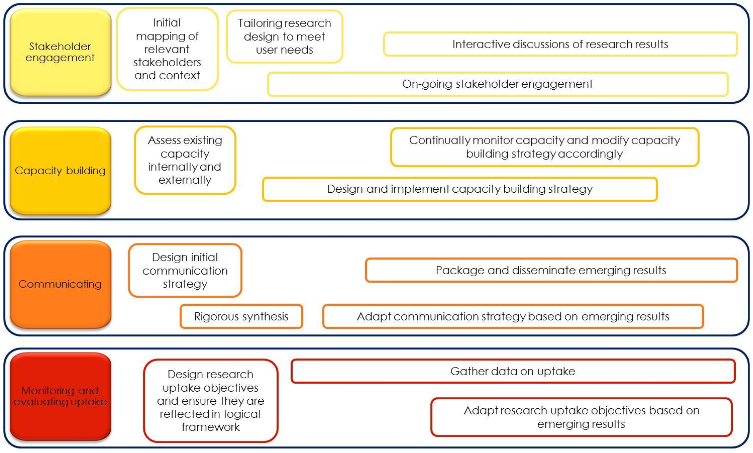
"Research uptake strategies should encompass stakeholder engagement, capacity building, communication and monitoring and evaluation."
This toolkit is a "beginner's guide" aiming to support research programmes funded by the United Kingdom (UK) Department for International Development (DFID) as they develop and implement their research uptake strategy. (DFID funds research in order to contribute to its overarching goal of poverty reduction.) Research uptake activities aim to:
- support the supply of research by ensuring research questions are relevant through engagement with potential users; communicating research effectively (not just disseminating findings through a peer-reviewed journal article); and synthesising and repackaging research for different audiences; and
- support the usage of research by building capacity and commitment of research users to access, evaluate, synthesise, and use research evidence.
The toolkit outlines 4 strands of research uptake:
- Stakeholder engagement - This begins with mapping out stakeholders (e.g., policymakers), considering for each what their (potential) interest is and the extent and type of engagement (e.g., presenting at non-governmental organisation (NGO) network meetings) that would be needed to support uptake. One then consults with stakeholders in order to determine their needs - aligning the research design to meet those needs. (A case study outlining how a research programme ensured its objectives meet user needs can be found in box 5.) The toolkit stresses the importance of ongoing stakeholder engagement; for example, tools such as Facebook or Twitter can be useful ways of communicating with some (although not all) audiences, though it takes time to build up a community of friends/followers (so it is helpful to start engaging in discussions and building up your community from the outset). and interactive, evidence-informed discussions of research results. Once results start to emerge, it is important to find ways to facilitate discussion. Though this can be done through email lists or online discussion fora, DFID finds that face-to-face discussion is typically more effective. This section of the toolkit outlines some of the ongoing debates about the role research programmes should play in influencing policy and practice.
- Capacity building - This involves, for example: assessing existing capacity, internally and externally; continually monitoring capacity and modifying the capacity building strategy accordingly; and designing and implementing the strategy. The case study in box 7 shows how Peru's Young Lives Research Programme has taken a gradual approach to get researchers on board. Box 8 features "top tips for running training". Considerations for building capacity at both individual and organisational levels are explored.
- Communicating - Tips for carrying out a research synthesis are offered; box 10 contains a case study on communicating synthesised research. Other sections here explore planning communications, publishing research results, and packaging and communicating results. Tips for writing effective research summaries focus on, for instance, the need to clearly outline the relevance of the research to policy without using jargon. Suggestions for the sharing of research findings via oral presentations are put forth.
- Monitoring and evaluation - DFID asks all research programmes to have a framework for results (e.g. logframe), which is the primary tool used for monitoring progress. Research uptake indicators should be embedded in this framework; a description of offers various strategies for articulating them, and box 12 contains a case study about developing indicators. The guidebook talks through the design of research uptake objectives to ensure they are reflected in the logical framework, the gathering of data on uptake, and the adaptation of update objectives based on emerging results. DFID programmes are encouraged to develop a theory of change from the outset which describes how change is assumed to come about as a result of the programme. "In line with an ongoing DfID-wide commitment to learning and accountability through evaluation, we are investing in impact evaluations of research programmes. We are open-minded about appropriate methodologies to tackle this evaluation challenge, though we are committed to quality and rigour in line with international good practice in evaluation. However, we shall commission a formal, independent evaluation for only a minority of programmes." DFID notes that learning can be shared by documenting and discussing ccase studies and contributing to the different online communities of practice (see Appendix 2 for examples).
The research checklist included in Appendix 1 is designed to facilitate review of research uptake strategies produced at the outset of the programme and assessment of progress with research uptake throughout the programme.
25
"Research Uptake - what goes in is what comes out", by Sudeep Uprety, Research to Action, December 8 2016 - accessed on January 13 2017.