










































A Realist Evaluation of a Community-Centered Radio Initiative for Health and Development in Mindanao, Philippines
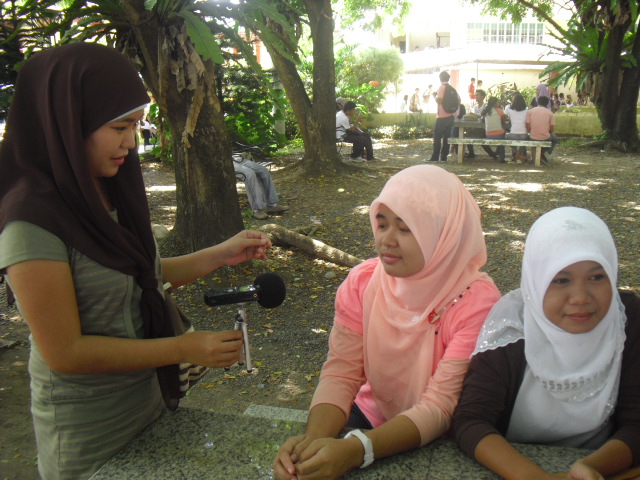
The Bamboocamel Collaborative (James); Health Communication Resources, or HCR (Romo-Murphy); Consultant, Health Promotion (Oczon-Quirante)
"In a context characterised by conflict, disadvantage and disempowerment, two key mechanisms, community-centred radio and community radio volunteers, became voices for the voiceless."
Since 2000, Radio Gandingan (RG), a radio programme initiative in Mindanao, Philippines, has aimed to bring about social change and development among minority communities affected by decades of armed struggle for political autonomy. The present investigation was prompted by the response of RG to the 5-month armed conflict that followed the May 2017 storming of Marawi in north Mindanao by ISIS-aligned fighters. To understand that response, these researchers conducted a secondary analysis of existing data sets to explore the roots of the RG community-centred initiative.
Home to the Muslim minority Magindanaon people (ethnic groupings commonly referred to as the Bangsamoro), the six communities associated with RG have experienced: isolation from health and development service providers, ill health due to poor hygiene, high unemployment, a poor environment, and tension between neighbours and within families. Ordinary people have tended to be excluded from decision-making, with little access to information, resulting in low self-confidence and disempowerment.
In that context, RG - which takes its name from the gandingan, gongs traditional to Maguindanaon music and culture that are used to summon people to action - began broadcasting in 2000 within these communities as a weekly one-hour radio programme with airtime purchased from a local commercial radio station. It expanded in 2004 to two-and-a-half hours of purchased airtime, spread over five evenings each week. Following the storming of Marawi City in north Mindanao, RG volunteers provided evacuees with field reports, updates and information provided by governmental and non-governmental organisation (NGO) service providers. Local communities claimed RG was more trustworthy than other sources of information because of RG's demonstrated compassion and credibility through community-centred activities.
To understand how this came to be the case, the researchers undertook a realist evaluation (RE), which is based on the idea that it is not interventions that work but, rather, the way people respond to mechanisms (components or resources) that brings about change. An RE develops middle-range theories (MRTs) that test Context-Mechanism-Outcome (C-M-O) configurations: how context influences intervention resources or processes (mechanisms) to produce outcomes. This particular RE involved a secondary analysis of existing data sets progressively gathered in the years 2005 to 2009. Most respondents from nearly all six communities were females, possibly because women had been mobilised by RG's promotion of women's empowerment.
The researchers constructed C-M-O configurations from the existing data sets in order to represent what took place to improve dialogue, livelihood, and participatory communication through 2 key mechanisms: community-centred radio and community radio volunteers (CRVs). The community-centred radio programme supported 18 trained CRVs to mobilise communities to participate in radio segments that modelled dialogue and offered opportunities for diverse voices, including those of women, people living with disability, and those with little education, to be heard on local issues. Dramas prompted family communication about values such as honesty and tolerance. People said RG made them aware of harmful practices to environmental resources, such as cutting down trees. A project to install community toilets was organised in one community after an RG programme led them to identify cleanliness as a problem.
In short, the RE found that, through RG, dialogue had resolved community conflict and strengthened family bonds and relationships and improved communication and understanding between community leaders and community members; livelihood had improved with behaviours and practices that led to better protection of the environment, health, community cohesion, and unity; and community participation was better through involvement in the RG radio programme and increased participation and communication in community meetings.
The 13 outcomes for improving dialogue, livelihood, and participatory communication that were generated from qualitative data are validated by quantitative data that shows high listener engagement (97% listenership), and strong perceptions of how the project:
- benefitted families (92%);
- influenced better community behaviours (91%);
- improved community peace and order (87%);
- resolved conflict between families and communities and promoted cultural identity (82%);
- defined community issues (79%);
- increased community access to communication (47%); and
- resulted in community leaders showing greater attention to community opinions and needs (24%).
The researchers note that "Impact measures of wide-scale, well-funded systematic interventions in public health and community development traditionally explore message related factors (audience reach, message comprehension and recall) or pre- and post-intervention approaches that focus on either increases or reductions in participation rates or observed behaviours, depending on the desired goal of the communication intervention. Participatory communication...does not easily fit the mindset of institutional aid, wary of confronting politics or power-dynamics in communities." This RE, however, found that the mechanisms identified indeed supported the MRT: A community-centred radio programme (and associated mechanisms) can facilitate social development (outcomes) for vulnerable communities in conflict-ravaged Maguindanao (context).
Asia Pacific Journal of Public Health, Vol. 31, Issue 6, Pages 559-71 DOI: 10.1177/1010539519870661 - sourced from emails from Ross James to The Communication Initiative on September 25 2019 and October 3 2019; email from Jon Hargreaves to The Communication Initiative on October 4 2019; and "How a radio project dramatically improved the lives of communities in conflict...", by Dr Ross James, September 11 2019 - accessed on October 21 2019. Image caption/credit: Community Radio Volunteers visit communities in Magindnaon Province, Mindanao, Philippines. HCR
- Log in to post comments