










































Pul-e-Jawan (Bridges of Youth)
Growing out of a Kabul, Afghanistan-based master class on peace and citizen journalism, Pul-e-Jawan (Bridges of Youth) is a platform and ongoing exchange of ideas for young people involved in media in Afghanistan, Pakistan, and India. By facilitating an exchange between citizen journalists of these 3 countries and providing a platform to discuss issues usually ignored in the debate about security, Internews Networks hopes to create a paradigm shift in the discussions about peace and reconciliation in the region.
In addition to on-the-ground work, campaigns, and meetings, this forum intends to use the power of social media to exchange ideas and reach out to people across national boundaries. It also looks to finding ways of fostering conversations without being limited by the difficulty in attaining visas.
Pul-e-Jawan started off by engaging youth in person-to-person exchange. Fifteen young bloggers, citizen journalists, filmmakers, and technologists were invited to Kabul, September 25-29 2011, to be a part of a regional forum on security. They met policymakers, non-governmental organisation (NGO) representatives, academics, journalists, and experts in the field. They also attended a master class in peace and citizen journalism and designed the project's in-country programme. The workshop focused on how to use online and social media tools to address social causes, common challenges, and shared aspirations in the 3 countries.
After the regional meeting, the participants returned to their countries to lead a local group of young citizen journalists in collaborative media production and online discussions. Their contributions are posted on the Pul-e-Jawan website to start debate on peace and stabilisation in the region. Topics include: gender, identity, environment, economy, culture, politics, and society.
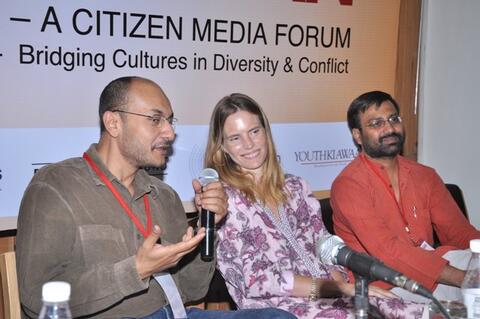
In April 2012, two additional in-person forums were held in Pakistan and India to engage a wider audience in the discussion and present the work of Pul-e-Jawan to a local audience. In-person forums were also held in Pakistan and India in April 2012, using Skype to link in participants from the other countries. The event on April 14 in New Delhi reportedly went viral on the internet because of live streaming and live reporting of the event. According to a blogger who was in attendance, speakers "gave the audience a vibrant range of examples and ways in which citizens can become media practitioners and contribute enthusiastically to public dialogue and social change....Dilip Simeon gave a spirited talk, emphasising the importance of speaking out and standing up against injustice and human rights violations. He introduced the audience to the concept of 'collective guilt', whereby the onus of acts committed by individuals is seen as synonymous with what the whole community should take responsibility for."
Pul-e-Jawan has become a social media network. The participants returned to their home countries and recruited other citizen journalists and activists to join. Facebook is the primary platform to discuss topics relevant to their communities, and, as of July 2012, the group had 80 active members from the 3 countries.
Conflict, Youth, Rights.
Pul-e-Jawan was supported by The Ploughshares Fund, and organised by Internews in partnership with Bytes for All and the Digital Empowerment Foundation. Internews' work in Afghanistan is supported by the United States Agency for International Development (USAID) through the Afghanistan Media Development and Empowerment Project.
Posting on the Internews website, July 18 2012 - accessed on August 15 2012; "Pul-e-Jawan in India: How Talks Can Bring Peace" by Chintan Modi, April 28 2012, The Express Tribune: Blogs; "Connecting India, Pakistan, Afghanistan through Social Media" by Osama Manzar, May 28 2012, LiveMint, The Wall Street Journal; and Pul-e-Jawan website, August 15 2012.
- Log in to post comments