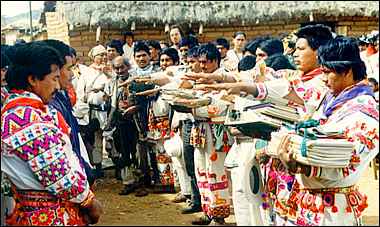
Project for the Integral Reconstitution of the Wixarika Territory and Habitat
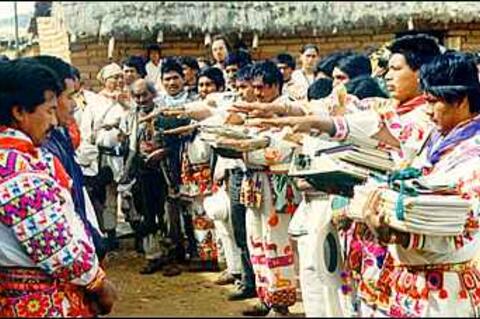
Reflection and Planning Workshops, which address a single issue, are carried out as many times as necessary for participants to arrive at consensus on environmental protection measures. These workshops strive to:
- implement the lessons and gains from current litigation;
- train indigenous people in environmental management skills, such as topographic mapping and geographic information systems (GIS);
- encourage the Huichol participation in the national and global indigenous rights movement;
- build partnerships at home and abroad with academics and other non-governmental organisations (NGOs);
- create opportunities for organic agriculture and ecotourism; and
- establish a formal education regime that responds to indigenous needs, such as the need for computer skills essential to the creation of a data bank for land-use planning.
Environment, Indigenous Cultures, Rights.
A succession of settlers, farmers, miners, refugees, ranchers, loggers, and narcotics growers has gradually eroded the Huichols' land base. When AJAGI arrived on the scene in 1990, 309 square miles (80,000 hectares) of Huichol territory had been invaded by groups whose power effectively dissuaded officials from taking action against them. This usurpation has eroded the Huichol culture, which is intimately tied to, and dependent on, natural resources. For example, the efforts of recent generations of indigenous people to maintain traditions have been impeded, as many have been forced to migrate to work in tobacco fields that sicken them.
Because of the geographical isolation of their territory, the people have minimal understanding of the language, laws, and institutional workings of dominant society. Some non-indigenous groups who have tried to bridge the abyss between the Huichols and the political establishment have had good will but little understanding of how to respond appropriately to their needs. AJAGI has tried to avoid such pitfalls by responding only to needs expressed by Huichol communities. As part of the project, AGAJI negotiated with international, national, state and local power brokers to build the political muscle needed to gain respect for the Huichols' legal case. Huichols also redoubled their participation in land-use decisions, strove to reconcile with non-Huichol neighbours, and worked to build alliances with other sectors of society.
As a result, AJAGI has helped establish legal claims to Huichol land. The Huichols have won recognition for their ancestral land claims in 172 legal battles before Mexican tribunals, plus a precedent-setting United Nations (UN) resolution for the return of tribal territories. Thus far, AJAGI's court victories have recovered more than 115 square miles (30,000 hectares) of land.
The Project for Integral Resolution has spread knowledge of the legal system to the Huichols, focused government and civil society attention on Huichol problems, and rekindled hopes within Huichol communities. Specific workshop outcomes include: three training and demonstration centres for sustainable agriculture; training and placement of organic agriculture trainers; reduced use of agrichemicals; and crop detection for their territorial claims. In addition, the camp experience is expected to spread understanding of the Huichols' environmental rationale for creating a protected area.
Finally, AJAGI is proposing the creation of an environmental, agricultural demonstration centre that will sell its products as a way to establish economic self-sufficiency that will help carry the project forward. It has also extracted a promise from the federal administration's top liaison for indigenous policy that the government will ensure that police are present to protect the Huichols from their neighbours' opposition - not only on the dates when lands are turned over, but for as many months as necessary for the indigenous people to settle their recovered tracts.
Jalisco Indigenous Groups Support Association, or Asociación Jaliscience de Apoyo a Grupos Indigenas (AJAGI); The University of Guadalajara and the Ancient Forests Civil Association; Guadalajara's Occidental Technological Institute of Higher Studies (ITESO)
"Reclaiming a Territory and the Culture that Goes with It". by Talli Nauman, Changemakers, February 2002. Image credit: Miguel Angel Torres