










































Programa Comunitario Materno Infantil de Diversificación Alimentaria - PROCOMIDA
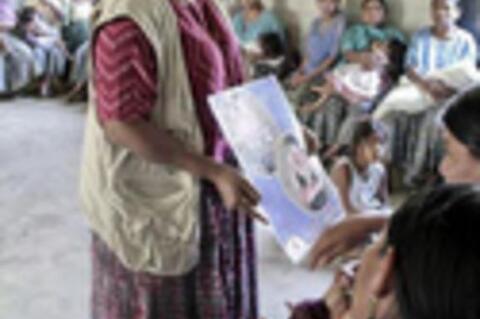
"Because of the high number of monolingual illiterate population, especially women, we identified the need to prioritize oral language more than written language and the use of the local language (Q'eqchi) instead of Spanish. Besides, the material is graphic and contextualized so beneficiaries identify themselves with the posters."
PROCOMIDA is a preventive programme designed to improve the general health and nutritional status of pregnant women, nursing mothers, and children under the age of 2 who are vulnerable to food and nutrition security issues in different villages of the counties of Cobán, Carchá, Cahabón, Senahú and Lanquín, in Alta Verapaz, Guatemala. Behaviour change communication (BCC) strategies play a key role in the initiative, which was launched by Mercy Corps with the support of the United States Agency for International Development (USAID).
The design and development of informational, promotional, and educational materials is part of a BCC process that entails: investigation of topics or areas of paramount interest; identification of key messages that can positively influence the change in knowledge, attitudes, and practices in the programme beneficiaries, their families, and their community; formulation of specific messages and approaches; and establishment of adequate communication channels to promote and encourage individual, community, and social behaviour change in an adult population who, in many cases, does not speak, read, or write Spanish (nor can they read or write in their own language).
Therefore, within each community and for educational purposes, several groups have been formed: pregnant mothers, lactating women with children 0 to 6 months old, mothers with children 6 to 24 months old, mothers with sick children, grandmothers, caregivers, groups of men, and others. They work as discussion groups where the beneficiary mothers, based on their life experience, knowledge, and common practices, provide alternatives and local solutions that are positively reinforced by the programme educator based on key messages previously researched and defined. The programme educator assumes a role of a moderator and facilitator to motivate and generate dialogue and participation through discussion or analytic questions. All educators are local and speak the local language (Q'eqchi') and Spanish. Half of educators are female and half are male. Preferably, female educators work with women and male educators work with men, health commissions, community leaders, and others, whenever possible.
Recognising the fact that each group of the intended population has different informational needs, PROCOMIDA developed areas or topics for each specific group. In the case of breastfeeding, for example, the message will not be to promote the advantages of nursing or the qualities of breastfeeding, but, rather, to address the mother's concern that "breastfeeding quenches the baby's thirst", "breastfeeding alleviates the baby's colic", or "breastfeeding suppresses the baby's hunger". The type of key messages that were elaborated are short and direct, addressing a specific concern. As part of the BCC strategy, these messages were used as a basis for the design of different posters or educational figures presented in a flipchart and on food bags. The figures portrayed in these materials were developed in a local setting, with scenes that organisers say represent the community's daily life and that are self-explanatory without the need for text.
Children, Women, Health, Nutrition
PROCOMIDA operates in a setting where 79% of the intended population lives in rural areas and 93% is indigenous. It is also estimated that 84% of this population is economically poor, while 41% is extremely economically poor; the illiteracy rate is 65%. Almost 60% of all children under the age of 5 suffer chronic malnutrition and stunting, conditions that are more severe in rural areas and among the indigenous population. From 2000 to 2009, maternal mortality was steady between 271 and 191 per 100,000 live births, which was the highest mortality rate in the Republic of Guatemala during the last decade.
According to organisers, there have been multiple efforts by various institutions to modify behaviour and practices related to health, food, and nutrition in the population of Alta Verapaz. However, effects have not met expectations, possibly due to the lack of mutual understanding between the agents of change and the intended population. After collecting and revising the existing training, informational, and promotional material from different sources, organisers found that a considerable amount of the messages could not be read or understood by the local population, since they were presented with text in Spanish to illiterate and Q'eqchi' monolingual audiences. Most also included generic technical information that did not respond to the local setting, nor the needs of specific audiences, such as pregnant and nursing mothers, mothers of infants from 6-24 months, mothers with sick children, or other adult women and men.
"Behavior Change Communication Strategy: Programa Comunitario Materno Infantil de Diversificación Alimentaria - PROCOMIDA" [PDF], sent from Rafael Carranza to Soul Beat Africa on June 13 2012. (Click here to access it in Spanish [PDF]). Please note: "This publication is made possible by the support of the American people through the United States Agency for International Development - USAID under the terms of Cooperative Agreement No. AID-FFP-A-09-00005-03. The contents of this publication are the sole responsibility of the authors and do not necessarily reflect the views of USAID or the United States Government."