










































Potential Barriers to and Facilitators of Civil Society Organization Engagement in Increasing Immunization Coverage in Odukpani Local Government Area of Cross River State, Nigeria: An Implementation Research
University of Calabar Teaching Hospital (Etokidem, Mpama, Isika); University of Calabar (Nkpoyen); Cross River State Ministry of Health (Ekanem)
"Grassroots CSOs in the study area have the capacity, capability and willingness to mobilize their communities towards increased demand for and uptake of immunization services."
In Cross River State, Nigeria, only 42% of children aged 12-23 months are fully immunised. Factors such as geographical inaccessibility, inadequate numbers of health staff in rural areas, and sociocultural factors that fuel anti-vaccine sentiments contribute to this problem. In Nigeria and elsewhere, civil society organisations (CSOs) often work in partnership with governments to extend healthcare services to marginalised communities, particularly in remote, hard-to-reach rural areas. Grassroots CSOs, being indigenous associations, have the capacity to penetrate hard-to-reach communities to carry out activities such as sensitisation and mobilisation on the importance of immunisation. This study explored the potential barriers to and facilitators of CSO engagement in increasing immunisation coverage in Odukpani local government area (LGA) of Cross River State, Nigeria.
The researchers conducted 22 focus group discussion (FGD) sessions, 3 in-depth interviews (IDIs), and 26 key informant interviews (KIIs). The selection of the CSO members and non-CSO community members for the FGDs and IDIs was on the basis of previous involvement or willingness to be engaged in health or immunisation-related services. For the IDIs, leaders of 26 CSOs that were not involved in the FDGs were purposively selected; 2 from each of the 13 political wards in the LGA took part.
The data revealed that CSOs encounter barriers in the course of their immunisation advocacy, communication, and social mobilisation due to male child preference (leading to shielding of male children and not allowing them to be given vaccines) and patriarchy, whereby "Most husbands do not give their wives the authority to get their children immunized, even though the wives are willing" (Male, 35, FGD). Other reasons cited included distrust in vaccinators who are not from the community, safety concerns, religious concerns, anti-vaccine misinformation and rumours, low perception of effectiveness and efficacy of vaccines, inaccessibility of localities, low health literacy, and superstitious beliefs.
Facilitators of demand for and uptake of immunisation services highlighted in the FDGs, IDIs, and KIIs included various community structures, such as the institution of the village head and elders' council, and local change agents/advocates. The existence of several immunisation information dissemination channels, including town criers (announcers) and schools, was deemed helpful.
Factors such as religion and community social control mechanisms, such as Ekpe and Obon culture masquerades, act as either barriers or facilitators, depending on the community and the mode of deployment.
CSO members expressed willingess to overcome barriers and leverage facilitators. The interviews revealed that CSOs have good rapport with community members, which builds trust and facilitates immunisation service provision. Some CSO members already have experience in community mobilisation for immunisation. However, CSOs expect some assistance from the government, such as stipends that show appreciation and/or help with transportation, as many use their own personal vehicles (e.g., motorcycles, boats) to navigate hard-to-reach areas.
Among the suggestions going forward: The CSOs can leverage existing community social mechanisms and institutions. For instance, the village heads and council of elders are highly revered in Nigerian communities. Their pro-immunisation messages and instructions to community members might facilitate demand creation and uptake. CSOs could also work to overcome resistance by religious leaders by emulating the Civil Society Human and Institutional Development Programme (CHIP) in Pakistan, which held a series of sensitisation meetings with religious leaders until they eventually became immunisation advocates.
In conclusion: "The work of the CSOs can be further enhanced by collaboration with non-CSO community volunteers and the government, all working in partnership to bring immunization services to people in this rural community."
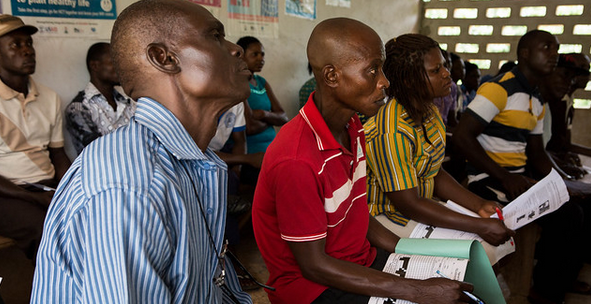
Health Research and Policy Systems 2021, 19(Suppl 2):46. https://doi.org/10.1186/s12961-021-00697-y. Image credit: RTI International/Ruth McDowall via Flickr - Attribution-NonCommercial-NoDerivs 2.0 Generic (CC BY-NC-ND 2.0)
- Log in to post comments