










































Philippines Network of Environmental Journalists (PNEJ)
"The local media plays a critical role in influencing how the government and society balance growth with sustainable environment."
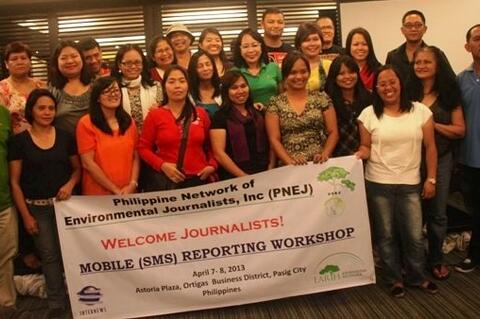
The Philippine Network of Environmental Journalists (PNEJ) is a non-governmental, non-profit, and non-partisan media group. With the support from the United States (US)-based Internews' Earth Journalism Network, PNEJ was launched in Manila on June 5 2010 (World Environment Day) to empower and enable journalists to improve the quality, accuracy, and intensity of environmental reporting in the Philippines.
As detailed on the PNEJ website, the organisation highlights the importance and advancement of public understanding of environmental issues by providing support to journalists of all media in their efforts to cover complex issues of the environment responsibly. PNEJ offers services for working journalists through seminars/conferences, study tours, links to other media organisations working locally and internationally, awards for the best environmental reporting, and other activities. PNEJ works to strengthen the connection between media and society, including businesses, academia, government, and local people, to participate in environmental protection activities in the Philippines - in part by highlighting not just environmental problems but also creating stories that suggest solutions. Another effort focuses on strengthening communication and collaboration between PNEJ and journalists from other countries through a network of environmental journalists.
PNEJ uses a number of tools in its effort to improve the reach, quality, and sustainability of local media, as well as to connect to various sectors in the society about environment and development issues. For example, in the aftermath of Typhoon Haiyan, PNEJ sent a delegation of journalists from other regions to Tacloban City to learn from first responders, supported ongoing story production, and began improvements to PNEJ's SMS platform that allows journalists to spread news and information via text messages.
PNEJ developed and launched Philippine EnviroNews in an effort to deliver a steady stream of information about environmental issues in the Philippines from its network of over 200 journalists. The website integrates elements of SMS reporting - using text messages on mobile phones - to maintain communications with journalists spread throughout the country, as well as in the event of the natural disaster, when internet connectivity is threatened. It is built on the platform of FrontlineSMS, a free, open source software that turns a laptop and a mobile phone or modem into a central communications hub to facilitate structured communication between members of the network and the public. The team behind Philippine EnviroNews doesn't only report on disaster and climate change. Rather, the text messaging system is used to manage a national newsroom that covers topics that include agriculture, eco-cities, biodiversity, water, health, energy, waste, and international policies (including their impact on local communities).
Environment, Risk Management
The Philippines is an island nation of more than 100 million people living at the doorstep of climate change. Each year, Filipinos face recurring natural disasters: enduring typhoons, severe drought, floods, and coastal erosion. When super typhoon Haiyan hit the shore of the Philippines in November 2013, it was the country's 25th typhoon of the year. Among the toll were 4 PNEJ journalists who worked for a local radio station in Tacloban City, where the eye of the storm was concentrated. In response, Internews re-launched a crowdfunding campaign to begin rebuilding critical communications infrastructure and assist PNEJ in covering the recovery and rebuilding effort in the long term.
Internews Earth Journalism Network (EJN) Newsletter, December 18 2013; PNEJ website and "FrontlineSMS: How to Create a Mobile Newsroom for Disaster Reporting" - both accessed on March 17 2014; and email from Imelda Abano to The Communication Initiative on March 17 2014.
- Log in to post comments