Peace Action, Training and Research Institute of Romania (PATRIR)
PATRIR defines itself as fulfilling several different, but interconnected, roles in the peacebuilding process. These roles are delineated below.
PATRIR - the organisation:
The core method of all PATRIR work is praxis, combining research with active peace work and peaceful conflict resolution. PATRIR cooperates with researchers, students, individuals, governments, and civil society groups to address the structural transformations and challenges facing the countries of Eastern Europe. PATRIR promotes policies designed to meet the needs of local communities, including continuing democratisation, strengthening regional cooperation, and supporting human security and well-being. PATRIR is dedicated to strengthening human rights and the rights of the people of Romania and eastern Europe and to promoting global solidarity, democracy, and the meeting of human needs. Organisers are committed to promoting democratic structures and citizens' participation both within Romania and internationally. To this end, PATRIR works to strengthen cooperation between Romanian organisations, and to strengthen cooperation with similar peace and development organisations throughout Eastern Europe, Latin America, Africa, Asia, and Western Europe, and North America.
PATRIR - the research institute and network of scholars:
The PATRIR Network is made up of critical thinkers throughout Romania dealing with issues related to peace and conflict, development, globalisation, poverty, structural violence, gender, human rights, and ecology. Their research is based on a method called "Diagnosis-Prognosis-Therapy", which combines analysis with creative therapy to find suggestions for what can be done. In cooperation with Babes-Bolyai University (Cluj), PATRIR offers courses in peace and development studies, a Masters Programme in Peace and Conflict Studies, a programme for the training of Junior Peace Researchers, and research positions for MA and PhD students. The 7 core subjects of PATRIR research are:
- Peacebuiding and Conflict Transformation
- Nonviolence and Peace Strategies
- Politics and Governance
- Globalisation, Human Rights, and Social and Economic Development
- Alternative Defence and Security
- Ecological Sustainability
- Gender, Equality, Empowerment
Social, economic, and political transformations resulting from the events following the collapse of the Berlin Wall and continuing transformations in Romania and throughout Eastern Europe are among PATRIR's core research foci. People's movements, nonviolent action, democratic participation, and peaceful conflict resolution are at the heart of the search for alternatives. To support this emphasis, PATRIR established the Gandhi Peace Library and Resource Centre. It is open to the public, and all materials are freely available.
PATRIR - the training centre:
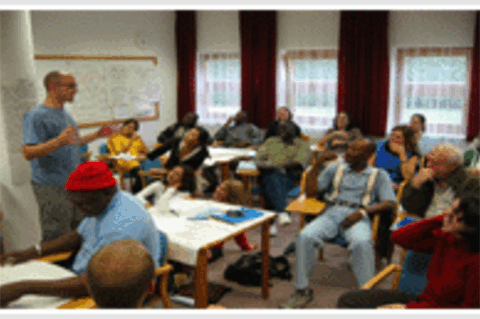
PATRIR organises training programmes in peacebuilding and peaceful conflict transformation; peace journalism; democracy and human rights; multi-culturalism; empowering civil society; gender and peace; people-centred, sustainable development; post-war reconstruction, rehabilitation, reconciliation and healing; and, environment and ecology. Though the Centre itself is based in Cluj-Napoca, PATRIR training can be carried out in any location throughout Romania or internationally (in cooperation with partners such as the TRANSCEND Centre for South-Eastern Europe). PATRIR training includes 1- and 2-day modules, 1- and 2-week courses, and the 3-week TRANSCEND Summer Peace Institute for advanced scholars and practitioners. Participants in PATRIR training programmes frequently include politicians and diplomats, aid and development workers, United Nations (UN) and non-governmental organisation (NGO) staff, civil society activists, professors, teachers, students, journalists, artists, and psychologists from Romania and more than 30 countries.
Participatory methodologies define these training programmes. For example, the 3-day "Preparing for Nonviolent Actions in Practice" will take place in May 2004 in cooperation with TRANSCEND. Held in Cluj-Napoca, the workshop will begin with a session in which participants talk about some of their own stories and experiences with non-violent action (as observers or participants). Each participant will explore the central obstacles to the pursuit of non-violent action in his or her work or life. Additional sessions will focus on strategic planning of a political campaign, with a focus on adapting campaigns to particular cultural, social, religious, and political contexts.
PATRIR - the centre for peace action:
PATRIR works closely with Romanian, Hungarian, and Romani organisations to address conflicts within Romania, and to promote human rights and peaceful conflict resolution. PATRIR also collaborates with organisations and institutions in neighbouring countries working to address these issues. This action strategy involves workshops; direct action; dialogues with citizens' groups, politicians, and community and business leaders; and cooperation with schools and civil society organisations to raise awareness and mobilise people to find solutions to the challenges facing them. For example, in April 2002, PATRIR helped organise and carry out Peace Week: Building a Culture and Vision for Peace in Europe. The Romania event brought together youth activists and community leaders from across Europe for 5 days of training programmes, workshops, skills exercises, and bridge-building. And from August through September 2002, approximately 30 PATRIR volunteers carried out a Solidarity March for Peace and Democracy from Cluj-Napoca to Bucharest, organising citizens' forums with local communities and civil society organisations along the 460 km route.
Details about all the above programmes, and updated information, may be found on the PATRIR website.
Peace, Rights, Gender, Political Participation, Education.
Babes-Bolyai University, TRANSCEND.
Email from Alex Moldovan to The Communication Initiative on February 6 2004; PATRIR description on the TRANSCEND website; and PATRIR website.