










































Parental Support for HPV Vaccination Mandates Among African Americans: The Impact of Message Framing and Consideration of Future Consequences
University of Maryland-College Park (Nan, Holt); La Salle University (Daily); Texas Christian University (Richards)
"Is parents' support for mandating human papillomavirus (HPV) vaccination for their adolescent children influenced by how the policy advocacy message is framed?"
Improving government communication about health policies in order to promote public support can be a challenging task. Since 2007, policymakers in over 2 dozen states in the United States (US) have introduced legislation to make the human papillomavirus (HPV) vaccine mandatory in attempts to increase vaccination rates. The early attempts, in particular, met with controversy related to government and pharmaceutical collusion, as well as sexual promiscuity. Using prospect theory, the present study investigated whether emphasising the benefits of passing a policy (i.e., gain-frames) or the consequences of failing to implement a policy (i.e., loss-frames) is more persuasive. It specifically assesses African-American parents' support of HPV vaccination mandates as shaped by message framing, examining how the relative impact of gain vs. loss-frames on policy support might be moderated by parents' consideration of future consequences (CFC).
Before describing their own study, the researchers present an overview of message-framing research. Much of it has been grounded in prospect theory, which postulates that individuals prefer taking risks when considering losses and favour certainty when considering gains. Scholars have put forth a message-framing postulate that argues loss-framed messages will be more persuasive when people perceive an advocated action as risky and that gain-framed messages will be more persuasive when people perceive a promoted action to be of low risk or safe.
They also discuss CFC, a personality trait that has been linked to health behaviours in general and vaccination decisions in particular. Overall, research suggests that people low in CFC may overemphasise the short-term costs of vaccination (e.g., pain, inconvenience), may not fully appreciate the long-term benefits of vaccination, and may actually perceive vaccinating themselves or their children against a disease as risky (e.g., unsafe and ineffective).
Participants in the study included 211 African-American custodial parents of at least one child between the ages of 9 and 17 who had not yet initiated the HPV vaccine series. They were given a pamphlet about HPV vaccination that was either gain- or loss-framed. The pamphlets included a photographic montage of African-American adult-child dyads along with 4 numbered content sections informing the reader about, in order, HPV, the HPV vaccine, reasons for vaccinating one's child, and contact information for the Centers for Disease Control and Prevention (CDC). All information was identical between the gain and loss versions except for in the third section, featuring 4 bulleted reasons to vaccinate one's child against HPV, in which message frame was experimentally manipulated (e.g., by having/not having your child receive the HPV vaccine, you make it much less/more likely for him/her to get genital HPV).
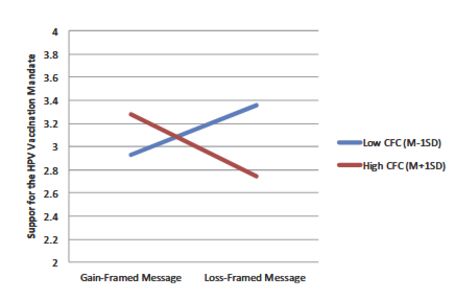
In short, the researchers found that parents responded more positively to gain-frames if they focused on the distant future and to loss-frames if they focused on the immediate future. Neither message framing nor CFC independently predicted policy support. However, the results suggested that when CFC was at or lower than -1.016 (centred score), the loss-framed message resulted in significantly greater policy support than the gain-framed message, whereas when CFC was at or higher than .614 (centred score), the gain-framed message led to significantly greater policy support than the loss-framed message.
Overall, the researchers suggest, CFC functions as a marker of perceived HPV vaccination risk to moderate message-framing effects according to tenets of prospect theory. Because parents high in CFC privilege future benefits associated with vaccination, they are better persuaded by messages that emphasise the advantages of HPV vaccination. Because parents low in CFC privilege immediate hazards associated with vaccination, they are better persuaded by messages that emphasise the costs of HPV vaccination.
According to the researchers, the findings may help health communicators strategically decide whether to emphasise the far or near outcomes associated with a health behaviour. For instance, some forms of HPV cause cancers that do not develop tumors until 10-30 years after initial infection; other forms of the virus can cause genital warts that appear as soon as 2 weeks after infection.
This study also has practical implications for the use of message framing when determining how to focus on particular groups in health campaigns. Put another way, communication interventionists should consider how populations of interest consider future consequences. For instance, as CFC is thought to decline with age, gain-frames may be more appropriate for advocacy aimed toward youth, whereas loss-frames may be increasingly appropriate as message recipients advance in age.
In conclusion: "it is important to recognize that public support of HPV vaccination policy is not only contingent on the message-based educational strategy employed to parent, but on the degree to which parents consider how present behaviors influence future well-being."
Health Communication 2019, Vol. 34, No. 12, 1404-12. https://doi.org/10.1080/10410236.2018.1493419
- Log in to post comments